

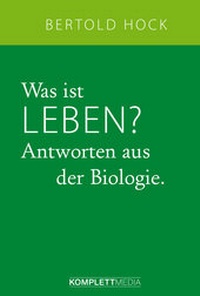
Was ist Leben?
Antworten aus der Biologie.
1st Edition
Published on 1. February 2018
96 pages
978-3-8312-6959-4 (ISBN)
Description

Die Frage »Was ist Leben?« ist eine der grundlegendsten und schwierigsten Fragen überhaupt. Sie hat die Menschheit seit ihren Anfängen beschäftigt. Bertold Hock gibt Antworten aus der Biologie und erklärt, warum die Frage trotz all unseres Wissens nichts von ihrer Aktualität verloren hat.
Prof. Dr. Bertold Hock war bis zu seiner Emeritierung im Herbst 2006 Inhaber des Lehrstuhls für Zellbiologie an der Technischen Universität München.
Prof. Dr. Bertold Hock war bis zu seiner Emeritierung im Herbst 2006 Inhaber des Lehrstuhls für Zellbiologie an der Technischen Universität München.
More details
Other editions
Additional editions
Book
02/2018
1st Edition
scholo Verlag
€8.00
Article exhausted; check different version
Person
Prof. Dr. Bertold Hock und sein Lehrstuhl wurden international bekannt durch bahnbrechende Arbeiten zum Nachweis von Pestiziden und Umweltschadstoffen mit Hilfe der Immunanalytik. Er war maßgeblich am Konzept der wirkungsbezogenen Analytik beteiligt, einer Kombination von Biotests und chemischer Analytik. Er machte sich einen Namen als Autor und Herausgeber vieler Forschungsartikel und Bücher. Hock war bis zu seiner Emeritierung Inhaber des Lehrstuhls für Zellbiologie an der Technischen Universität München.
Content
- Intro
- Einleitung
- Was ist Leben?
- Der zelluläre Aufbau aller Lebewesen
- Wachstum und Entwicklung
- Stoffwechsel
- Gemeinsamkeiten aller lebendigen Systeme
- Speicherung und Weitergabe genetischer Information
- Die DNA als molekulare Schrift
- Das Genom
- Transkription und Translation
- DNA-Replikation
- Codierende und nichtcodierende Bereiche der DNA
- Lebewesen als offene, selbsterhaltende Systeme
- Komplexität
- Netzwerke
- Evolution
- Von der Ähnlichkeitsanalyse zum phylogenetischen Baum
- Fossile Belege für die Evolution
- Die Evolutionstheorie von Darwin
- Evolutionsstrategien in der Technik nutzen die Mechanismen der Evolution
- Evolution der Lebewesen
- Genaustausch
- Genetische Algorithmen
- Entstehung und Entfaltung des Lebens
- Panspermie-Hypothese
- Entstehung des Lebens auf der Erde
- Die ersten Lebewesen
- Chemische Evolution
- Protobionten
- Veränderungen der Atmosphäre
- Ökologie
- Artenvielfalt
- Ökologie
- Gefährdung der biologischen Vielfalt
- Ökologie als ganzheitliche Wissenschaft
- Ökosystemare vs. molekularbiologische Analyse
- Biologie als Motor innovativer Entwicklungen
- Bionik
- Biotechnologie
- Ausblick
- Literatur
