

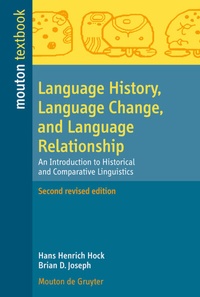
Language History, Language Change, and Language Relationship
Description

Why does language change? Why can we speak to and understand our parents but have trouble reading Shakespeare? Why is Chaucer's English of the fourteenth century so different from Modern English of the late twentieth century that the two are essentially different languages? Why are Americans and English 'one people divided by a common language'? And how can the language of Chaucer and Modern English - or Modern British and American English - still be called the same language? The present book provides answers to questions like these in a straightforward way, aimed at the non-specialist, with ample illustrations from both familiar and more exotic languages.
Most chapters in this new edition have been reworked, with some difficult passages removed, other passages thoroughly rewritten, and several new sections added, e.g. on language and race and on Indian writing systems. Further, the chapter notes and bibliography have all been updated.
The content is engaging, focusing on topics and issues that spark student interest. Its goals are broadly pedagogical and the level and presentation are appropriate for interested beginners with little or no background in linguistics. The language coverage for examples goes well beyond what is usual for books of this kind, with a considerable amount of data from various languages of India.
Reviews / Votes
"Hock and Joseph's book is very well planned and, in my opinion, it carries out its didactic purpose to an above-average level." Matteo Tarsi in: https://linguistlist.org/issues/30/30-3136.html (10.03.2020)More details
Other editions
New editions
Additional editions

Previous edition
Persons
Content
- Frontmatter
- Contents
- Chapter 1. Introduction
- Chapter 2. The discovery of Indo-European
- Chapter 3. Writing: Its history and its decipherment
- Chapter 4. Sound change
- Chapter 5. Analogy and change in word structure
- Chapter 6. Syntactic change
- Chapter 7. Semantic change
- Chapter 8. Lexical borrowing
- Chapter 9. Lexical change and etymology: The study of words
- Chapter 10. Language, dialect, and standard
- Chapter 11. Dialect geography and dialectology
- Chapter 12. Language spread, link languages, and bilingualism
- Chapter 13. Convergence: Dialectology beyond languageboundaries
- Chapter 14. Pidgins, creoles, and related forms of language
- Chapter 15. Language death
- Chapter 16. Comparative method: Establishing language relationship
- Chapter 17. Proto-World?: The question of long-distance genetic relationships
- Chapter 18. Historical linguistics, history, and prehistory: Linguistic paleontology and other applications of our methods
- Chapter notes and suggested readings
- Backmatter
