

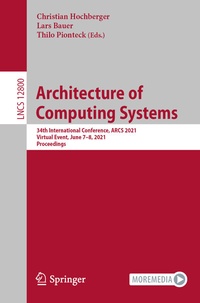
Architecture of Computing Systems
Description

This book constitutes the proceedings of the 34th International Conference on Architecture of Computing Systems, ARCS 2021, held virtually in July 2021.
The 12 full papers in this volume were carefully reviewed and selected from 24 submissions. 2 workshop papers (VEFRE) are also included. ARCS has always been a conference attracting leading-edge research outcomes in Computer Architecture and Operating Systems, including a wide spectrum of topics ranging from fully integrated, self-powered embedded systems up to high-performance computing systems. It also provides a platform covering newly emerging and cross-cutting topics, such as autonomous and ubiquitous systems, reconfigurable computing and acceleration, neural networks and artificial intelligence. The selected papers cover a variety of topics from the ARCS core domains, including heterogeneous computing, memory optimizations, and organic computing.
More details
Other editions
Additional editions
Content
Memory Organization.- Locality: The 3rd Wall and The Need for Innovation in Parallel Architectures.- Static extraction of memory access profiles for multi-core interference analysis of real-time tasks.- Transparent Resilience for Approximate DRAM.- Heterogeneous Computing.- Automatic Mapping of Parallel Pattern-based Algorithms on Heterogeneous Architectures .- Assessing and Improving the Suitability of Model-Based Design for GPU-Accelerated Railway Control Systems .- DRT: A Lightweight Runtime for Developing Benchmarks for a Dataflow Execution Model.- Instruction Set Transformations.- Performance Gain of a Data Flow Oriented ISA as Replacement for Java Bytecode.- Towards Transparent Dynamic Binary Translation from RISC-V to a CGRA .- Organic Computing.- An Organic Computing System for Automated Testing.- Evaluating a Priority-Based Task Distribution Strategy for an Artificial Hormone System .- Low Power Design.- Streamlining the OpenMP Programming Model on Ultra-Low-Power Multi-Core MCUs .- Energy Efficient Power-Management for Out-of-Order Processors using Cyclic Power-Gating.- VEFRE Workshop.- BCH 2-Bit and 3-Bit Error Correction with Fast Multi-Bit Error Detection.- Evaluating Soft Error Mitigation Trade-offs During Early Design Stages.
