

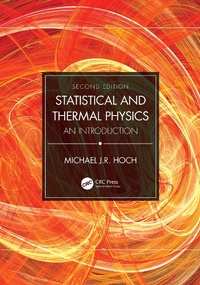
Statistical and Thermal Physics
An Introduction
2nd Edition
Published on 20. May 2021
348 pages
978-1-000-38911-1 (ISBN)
Description

Thermal and statistical physics has established the principles and procedures needed to understand and explain the properties of systems consisting of macroscopically large numbers of particles. By developing microscopic statistical physics and macroscopic classical thermodynamic descriptions in tandem, Statistical and Thermal Physics: An Introduction provides insight into basic concepts and relationships at an advanced undergraduate level. This second edition is updated throughout, providing a highly detailed, profoundly thorough, and comprehensive introduction to the subject and features exercises within the text as well as end-of-chapter problems.
Part I of this book consists of nine chapters, the first three of which deal with the basics of equilibrium thermodynamics, including the fundamental relation. The following three chapters introduce microstates and lead to the Boltzmann definition of the entropy using the microcanonical ensemble approach. In developing the subject, the ideal gas and the ideal spin system are introduced as models for discussion. The laws of thermodynamics are compactly stated. The final three chapters in Part I introduce the thermodynamic potentials and the Maxwell relations. Applications of thermodynamics to gases, condensed matter, and phase transitions and critical phenomena are dealt with in detail.
Initial chapters in Part II present the elements of probability theory and establish the thermodynamic equivalence of the three statistical ensembles that are used in determining probabilities. The canonical and the grand canonical distributions are obtained and discussed. Chapters 12-15 are concerned with quantum distributions. By making use of the grand canonical distribution, the Fermi-Dirac and Bose-Einstein quantum distribution functions are derived and then used to explain the properties of ideal Fermi and Bose gases. The Planck distribution is introduced and applied to photons in radiation and to phonons on solids. The last five chapters cover a variety of topics: the ideal gas revisited, nonideal systems, the density matrix, reactions, and irreversible thermodynamics. A flowchart is provided to assist instructors on planning a course.
Key Features:
Fully updated throughout, with new content on exciting topics, including black hole thermodynamics, Heisenberg antiferromagnetic chains, entropy and information theory, renewable and nonrenewable energy sources, and the mean field theory of antiferromagnetic systems
Additional problem exercises with solutions provide further learning opportunities
Suitable for advanced undergraduate students in physics or applied physics.
Michael J.R. Hoch spent many years as a visiting scientist at the National High Magnetic Field Laboratory at Florida State University, USA. Prior to this, he was a professor of physics and the director of the Condensed Matter Physics Research Unit at the University of the Witwatersrand, Johannesburg, where he is currently professor emeritus in the School of Physics.
Part I of this book consists of nine chapters, the first three of which deal with the basics of equilibrium thermodynamics, including the fundamental relation. The following three chapters introduce microstates and lead to the Boltzmann definition of the entropy using the microcanonical ensemble approach. In developing the subject, the ideal gas and the ideal spin system are introduced as models for discussion. The laws of thermodynamics are compactly stated. The final three chapters in Part I introduce the thermodynamic potentials and the Maxwell relations. Applications of thermodynamics to gases, condensed matter, and phase transitions and critical phenomena are dealt with in detail.
Initial chapters in Part II present the elements of probability theory and establish the thermodynamic equivalence of the three statistical ensembles that are used in determining probabilities. The canonical and the grand canonical distributions are obtained and discussed. Chapters 12-15 are concerned with quantum distributions. By making use of the grand canonical distribution, the Fermi-Dirac and Bose-Einstein quantum distribution functions are derived and then used to explain the properties of ideal Fermi and Bose gases. The Planck distribution is introduced and applied to photons in radiation and to phonons on solids. The last five chapters cover a variety of topics: the ideal gas revisited, nonideal systems, the density matrix, reactions, and irreversible thermodynamics. A flowchart is provided to assist instructors on planning a course.
Key Features:
Fully updated throughout, with new content on exciting topics, including black hole thermodynamics, Heisenberg antiferromagnetic chains, entropy and information theory, renewable and nonrenewable energy sources, and the mean field theory of antiferromagnetic systems
Additional problem exercises with solutions provide further learning opportunities
Suitable for advanced undergraduate students in physics or applied physics.
Michael J.R. Hoch spent many years as a visiting scientist at the National High Magnetic Field Laboratory at Florida State University, USA. Prior to this, he was a professor of physics and the director of the Condensed Matter Physics Research Unit at the University of the Witwatersrand, Johannesburg, where he is currently professor emeritus in the School of Physics.
More details
Edition
2nd edition
Language
English
Place of publication
London
United Kingdom
Publishing group
Taylor & Francis Ltd
Target group
College/higher education
Illustrations
4 Tables, black and white; 143 Line drawings, black and white
ISBN-13
978-1-000-38911-1 (9781000389111)
Copyright in bibliographic data and cover images is held by Nielsen Book Services Limited or by the publishers or by their respective licensors: all rights reserved.
Schweitzer Classification
Other editions
Additional editions
Book
05/2021
2nd Edition
CRC Press
€132.20
Shipment within 15-20 days
Book
05/2021
2nd Edition
CRC Press
€272.61
Shipment within 15-20 days
Person
Michael J.R. Hoch spent many years as a visiting scientist at the National High Magnetic Field Laboratory at Florida State University, USA. Prior to this he was professor of physics and director of the Condensed Matter Physics Research Unit at the University of the Witwatersrand, Johannesburg where he is currently professor emeritus in the School of Physics.
Content
PART I Classical Thermal Physics: The Microcanonical Ensemble Section IA Introduction to Classical Thermal Physics Concepts: The First and Second Laws of Thermodynamics Chapter 1 Introduction: Basic Concepts Chapter 2 Energy: The First Law Chapter 3 Entropy: The Second Law Section IB Microstates and the Statistical Interpretation of Entropy Chapter 4 Microstates for Large Systems Chapter 5 Entropy and Temperature: Microscopic Statistical Interpretation Chapter 6 Zero Kelvin and the Third Law Section IC Applications of Thermodynamics to Gases and Condensed Matter, Phase Transitions, and Critical Phenomena Chapter 7 Application of Thermodynamics to Gases: The Maxwell Relations Chapter 8 Applications of Thermodynamics to Condensed Matter Chapter 9 Phase Transitions and Critical Phenomena PART II Quantum Statistical Physics and Thermal Physics Applications Section IIA The Canonical and Grand Canonical Ensembles and Distributions Chapter 10 Ensembles and the Canonical Distribution Chapter 11 The Grand Canonical Distribution Section IIB Quantum Distribution Functions, Fermi-Dirac and Bose-Einstein Statistics, Photons, and Phonons Chapter 12 The Quantum Distribution Functions Chapter 13 Ideal Fermi Gas Chapter 14 Ideal Bose Gas Chapter 15 Photons and Phonons: The "Planck Gas" Section IIC The Classical Ideal Gas, Maxwell- Boltzmann Statistics, Nonideal Systems Chapter 16 The Classical Ideal Gas Chapter 17 Nonideal Systems Section IID The Density Matrix, Reactions and Related Processes, and Introduction to Irreversible Thermodynamics Chapter 18 The Density Matrix Chapter 19 Reactions and Related Processes Chapter 20 Introduction to Irreversible Thermodynamics
