

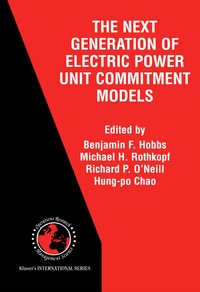
The Next Generation of Electric Power Unit Commitment Models
Published on 11. April 2006
VIII, 320 pages
978-0-306-47663-1 (ISBN)
Description

Over the years, the electric power industry has been using optimization methods to help them solve the unit commitment problem. The result has been savings of tens and perhaps hundreds of millions of dollars in fuel costs. Things are changing, however. Optimization technology is improving, and the industry is undergoing radical restructuring. Consequently, the role of commitment models is changing, and the value of the improved solutions that better algorithms might yield is increasing. The dual purpose of this book is to explore the technology and needs of the next generation of computer models for aiding unit commitment decisions.
Because of the unit commitment problem's size and complexity and because of the large economic benefits that could result from its improved solution, considerable attention has been devoted to algorithm development in the book. More systematic procedures based on a variety of widely researched algorithms have been proposed and tested. These techniques have included dynamic programming, branch-and-bound mixed integer programming (MIP), linear and network programming approaches, and Benders decomposition methods, among others. Recently, metaheuristic methods have been tested, such as genetic programming and simulated annealing, along with expert systems and neural networks. Because electric markets are changing rapidly, how UC models are solved and what purposes they serve need reconsideration. Hence, the book brings together people who understand the problem and people who know what improvements in algorithms are really possible. The two-fold result in The Next Generation of Electric Power Unit Commitment Models is an assessment of industry needs and new formulations and computational approaches that promise to make unit commitment models more responsive to those needs.
Because of the unit commitment problem's size and complexity and because of the large economic benefits that could result from its improved solution, considerable attention has been devoted to algorithm development in the book. More systematic procedures based on a variety of widely researched algorithms have been proposed and tested. These techniques have included dynamic programming, branch-and-bound mixed integer programming (MIP), linear and network programming approaches, and Benders decomposition methods, among others. Recently, metaheuristic methods have been tested, such as genetic programming and simulated annealing, along with expert systems and neural networks. Because electric markets are changing rapidly, how UC models are solved and what purposes they serve need reconsideration. Hence, the book brings together people who understand the problem and people who know what improvements in algorithms are really possible. The two-fold result in The Next Generation of Electric Power Unit Commitment Models is an assessment of industry needs and new formulations and computational approaches that promise to make unit commitment models more responsive to those needs.
More details
Other editions
Additional editions
Benjamin F. Hobbs | Michael H. Rothkopf | Richard P. O'Neill
The Next Generation of Electric Power Unit Commitment Models
Book
03/2013
Springer
€235.39
Shipment within 15-20 days
Benjamin F. Hobbs | Michael H. Rothkopf | Richard P. O'Neill
The Next Generation of Electric Power Unit Commitment Models
Book
04/2001
Kluwer Academic Publishers
€235.39
Shipment within 15-20 days
Content
The Evolving Context for Unit Commitment Decisions.- Why this Book? New Capabilities and New Needs for Unit Commitment Modeling.- Regulatory Evolution, Market Design and Unit Commitment.- Development of an Electric Energy Market Simulator.- New Features in Unit Commitment Models.- Auctions with Explicit Demand-Side Bidding in Competitive Electricity Markets.- Thermal Unit Commitment with a Nonlinear AC Power Flow Network Model.- Optimal Self-Commitment under Uncertain Energy and Reserve Prices.- A Stochastic Model for a Price-Based Unit Commitment Problem and Its Application to Short-Term Generation Asset Valuation.- Probabilistic Unit Commitment under a Deregulated Market.- AlgorithmicAdvances.- Solving Hard Mixed-Integer Programs for Electricity Generation.- An Interior-Point/Cutting-Plane Algorithm to Solve the Dual Unit Commitment Problem - on Dual Variables, Duality Gap, and Cost Recovery.- Building and Evaluating GENCO Bidding Strategies and Unit Commitment Schedules with Genetic Algorithms.- An Equivalencing Technique for Solving the Large-Scale Thermal Unit Commitment Problem.- Decentralized Decision Making.- Strategic Unit Commitment for Generation in Deregulated Electricity Markets.- Optimization-Based Bidding Strategies for Deregulated Electric Power Markets.- Decentralized Nodal-Price Self-Dispatch and Unit Commitment.- Decentralized Unit Commitment in Competitive Energy Markets.
