

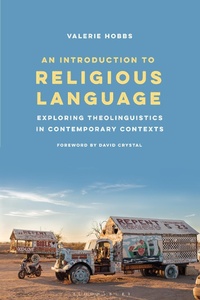
An Introduction to Religious Language
Exploring Theolinguistics in Contemporary Contexts
1st Edition
Published on 10. December 2020
240 pages
978-1-350-09576-2 (ISBN)
Description

Religious language is all around us, embedded in advertising, politics and news media. This book introduces readers to the field of theolinguistics, the study of religious language. Investigating the ways in which people talk to and about God, about the sacred and about religion itself, it considers why people make certain linguistic choices and what they accomplish.
Introducing the key methods required for examining religious language, Valerie Hobbs acquaints readers with the most common and important theolinguistic features and their functions. Using critical corpus-assisted discourse analysis with a focus on archaic and other lexical features, metaphor, agency and intertextuality, she examines religious language in context. Highlighting its use in both expected locations, such as modern-day prayer and politics, and unexpected locations including advertising, sport, healthcare and news media, Hobbs analyses the shifting and porous linguistic boundaries between the religious and the secular. With discussion questions and further readings for each chapter, as well as a companion website featuring suggested answers to the reflection tasks, this is the ideal introduction to the study of religious language.
Introducing the key methods required for examining religious language, Valerie Hobbs acquaints readers with the most common and important theolinguistic features and their functions. Using critical corpus-assisted discourse analysis with a focus on archaic and other lexical features, metaphor, agency and intertextuality, she examines religious language in context. Highlighting its use in both expected locations, such as modern-day prayer and politics, and unexpected locations including advertising, sport, healthcare and news media, Hobbs analyses the shifting and porous linguistic boundaries between the religious and the secular. With discussion questions and further readings for each chapter, as well as a companion website featuring suggested answers to the reflection tasks, this is the ideal introduction to the study of religious language.
More details
Edition
1. Auflage
Language
English
Place of publication
London
United Kingdom
Publishing group
Bloomsbury Publishing PLC
Target group
College/higher education
ISBN-13
978-1-350-09576-2 (9781350095762)
Copyright in bibliographic data and cover images is held by Nielsen Book Services Limited or by the publishers or by their respective licensors: all rights reserved.
Schweitzer Classification
Other editions
Additional editions
Valerie Hobbs
An Introduction to Religious Language
Exploring Theolinguistics in Contemporary Contexts
Book
01/2021
Bloomsbury Academic
€37.50
Shipment within 15-20 days
Person
Valerie Hobbs is Senior Lecturer in Applied Linguistics at the University of Sheffield, UK.
Content
Preface
Foreword by David Crystal
Acknowledgements
Permissions
1. Why Religious Language?
2. What is Religion? What is Religious Language?
3. Functions of Religious Language
4. Investigating Religious Language: Contexts, Text Types and Strategies
5. Investigating Religious Language: Vocabulary, Archaism and Parallelism
6. Investigating Religious Language: Metaphor and Intertextuality
7. Religious Language and Prayer
8. Religious Language at the Time of Human Death
9. Religious Language Here, There, Everywhere
10. Religious Language: An Open Horizon
Appendices
Notes
References
Index
Foreword by David Crystal
Acknowledgements
Permissions
1. Why Religious Language?
2. What is Religion? What is Religious Language?
3. Functions of Religious Language
4. Investigating Religious Language: Contexts, Text Types and Strategies
5. Investigating Religious Language: Vocabulary, Archaism and Parallelism
6. Investigating Religious Language: Metaphor and Intertextuality
7. Religious Language and Prayer
8. Religious Language at the Time of Human Death
9. Religious Language Here, There, Everywhere
10. Religious Language: An Open Horizon
Appendices
Notes
References
Index
