

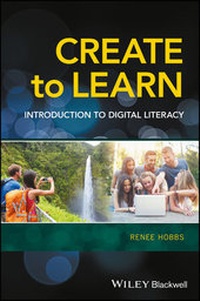
Create to Learn
Description

More details
Other editions
Additional editions
Person
Renee Hobbs is a Professor at Temple University's School of Communications and Theater in Philadelphia, where she founded the Media Education Lab. She holds a BA in English Literature and Film/Video Studies and an MA in Communication from the University of Michigan and an EdD from the Harvard Graduate School of Education. She teaches graduate and undergraduate courses in media literacy, digital authorship, children and media, media education and contemporary propaganda to students in Education, English, Communication Studies and Library and Information Studies.
Content
1
Create to Learn
KEY IDEAS
People learn best when they create. Creating media is a powerful way to demonstrate your learning. But it's also a way to generate ideas and transform static information into dynamic understanding. Today, the availability of free and low-cost digital production tools are contributing to a participatory culture where people are not just consuming media but also sharing, remixing, and creating. Although a college course can still rely on the exclusive expertise of one faculty member and one textbook, it's better when a course becomes a type of learning community where everybody learns from everybody. A learning community more closely models the kind of learning that happens in the workplace and contemporary society. To participate in a learning community, you can't just be a passive receiver of information. By creating and sharing media as a way to represent what you are learning, you can activate your intellectual curiosity in ways that naturally make learning more engaging and relevant.
You've grown up using the Internet. You may be comfortable with a variety of social media platforms that you access through your mobile phone, tablet, or laptop. You probably have a favorite way of using YouTube to support your interests in music and entertainment and you may participate in interest groups using Snapchat, Instagram, Reddit, Tumblr, or other platforms. Perhaps you're a gamer and engage in online social play with people from around the world.
But how skilled are you at using digital tools, texts, and technologies in the workplace or to advance your career? Most Americans admit that they're not as skilled as they need to be. More than 200 million US workers use digital skills on the job, but researchers have found that fewer than 1 in 10 feel proficient in the use of the digital tools and technologies they're required to use.1 That's because, on average, the digital tools that we use change every two to three years. As digital products and platforms are rapidly proliferating, many people are challenged by the need to be lifelong learners when it comes to digital media and technology.
Today there is a digital skills gap as more and more people graduate from college without having had sufficient opportunity to develop competencies and habits of mind that are at the core of every job in a knowledge economy. According to management consultants, these core competencies include:
- Attention management. The ability to identify, prioritize, and manage in an increasingly dense information landscape involves strategic decision making about how and when to focus one's attention.
- Communication. The ability to use effective strategies for interacting and sharing information and ideas with others requires continual awareness of how, when, why, and what to communicate. This includes creating digital and multimedia documents, using language, image, sound, and interactive media effectively to express and share ideas.
- Digital etiquette. Awareness of privacy, legal, and security issues is essential to be effective in the workplace. The ability to use appropriate codes and conventions for communicating via e-mail, video conference, text message, and telephone also requires sensitivity to the ethical dimensions of social relationships in a networked age.
- Search and research. The ability to gather information and sift through it to identify what's relevant, trustworthy, and reliable demands a strong understanding of how information and authority is constructed in particular contexts. Tenacity and intellectual curiosity are a must in the search and research process.
- Collaboration and leadership. When people work together, they do many different things all working at the same time towards a shared and common goal. Skills of coordinating projects and organizing group activity are vital competencies for both workplace and citizenship in a democratic society.2
Knowledge Matters
Today, knowledge is not fixed and static. Knowledge is widely networked and distributed. As David Weinberger notes in his book, Too Big to Know, the smartest person in the room is the room. That is, in an era where anyone can access information, entertainment, and propaganda all at the touch of a fingertip, knowledge is less and less tied to expertise, authority, credentials, or public reputation. Indeed, anyone can start a cooking blog, not only someone trained at Le Cordon Bleu. Weinberger reminds us that before the Enlightenment, knowledge was understood as coming from God. Later, we placed our trust in the scientific method.3 Today, we've grown up experts who disagree with each other about every topic imaginable. The explosion of new knowledge made possible by the Internet, with the disappearance of gatekeepers and filters, has contributed to the rise of niche communities or echo chambers, where a small group of people find comfort in their shared beliefs and attitudes. Indeed, it seems that the growing ease of access to information and entertainment is leading to both increased levels of apathy and political polarization.
Literacy Matters
When you hear the word literacy, you may think of the practice of reading and writing. But for a growing number of scholars and researchers, the concept of literacy is expanding as a result of changes in media, technology and the nature of knowledge. Today we define literacy as the sharing of meaning through symbols.4 Everyone - from all walks of life - needs to be able to create and share meaning through language, images, sounds, and other media forms.
The concept of literacy has been expanding for over 2,000 years. In Ancient Greece, a literate man was skilled in the art of rhetoric, possessing the ability to use public speaking to move the hearts and minds of other men in the Forum. All over the world, in medieval times, to be literate meant to be able to read from the holy books, and only a very few scholars and scribes were specially trained to be writers. Then the printing press changed the definition of writing as more and more people were able to read - and then write - as publishers found there to be a marketplace for romantic and adventure novels, personal essays, and scientific books. During the twentieth century, literacy expanded again with the rise of popular photography and people began using photographs for self-expression and communication. The terms visual literacy, information literacy, and media literacy developed as educators, scholars, artists, and librarians all recognized the need for new skills that mapped onto the changes in society that are reshaping the business, communication, and information landscape.
It's obvious how much images, sound, and interactivity combine with language as essential dimensions of the way people share and communicate ideas. It's simply not fair to put written language at the top of the pyramid and consider multimedia forms to be lesser than or inferior. As the National Council of Teachers of English stated in 2005, "All modes of communication are codependent. Each affects the nature of the content of the other and the overall rhetorical impact of the communication event itself."5 As a result, today the practice of acquiring, organizing, evaluating, and creatively using multimodal information is a fundamental competence for people in all fields of study and professions. Television programming, movies, and online videos are major sources of information and entertainment for people of all ages. Today, we see the integration of multiple modes of communication and expression in every part of life. Our social relationships with family and friends, leisure time, the workplace, and civic and cultural spaces all depend on the use of messages that skillfully combine image, language, sound, and interactivity.
What is Digital Literacy?
Digital literacy is the constellation of knowledge, skills, and competencies necessary for thriving in a technology-saturated culture. As information, entertainment, and persuasion are now shared digitally and personal, social and professional relationships are developed through interaction with social media as well as mass media and popular culture, people of all ages need the ability to access, analyze, create, reflect, and take action using a wide variety of digital tools, forms of expression and communication strategies.
Learning Matters
Learning is generally defined as the acquisition of skills and knowledge through experience, study, or teaching. When you think of learning, you may conjure up the routine practices of sitting in class, taking tests, and doing homework. If you were lucky, there was a teacher or two who recognized and appreciated your unique interests and talents. Perhaps you got to make a speech in class or compose essays on topics of your choice. If you were even more lucky, you got to create things - in art class, as a member of a robotics team, in the drama club, or even as a regular part of your coursework.
Learning happens through formal and informal means. During childhood and throughout life, play is a form of learning. Children learn by exploring their world, by using their imaginations, and by creating and building - using words, clay, paper and crayons, old blankets, and much more. During adolescence, we continue to play, learning by experimenting and taking risks as we discover...
