

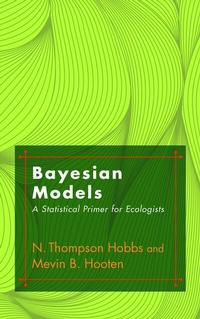
Bayesian Models
Description

Bayesian modeling has become an indispensable tool for ecological research because it is uniquely suited to deal with complexity in a statistically coherent way. This textbook provides a comprehensive and accessible introduction to the latest Bayesian methods-in language ecologists can understand. Unlike other books on the subject, this one emphasizes the principles behind the computations, giving ecologists a big-picture understanding of how to implement this powerful statistical approach. Bayesian Models is an essential primer for non-statisticians. It begins with a definition of probability and develops a step-by-step sequence of connected ideas, including basic distribution theory, network diagrams, hierarchical models, Markov chain Monte Carlo, and inference from single and multiple models. This unique book places less emphasis on computer coding, favoring instead a concise presentation of the mathematical statistics needed to understand how and why Bayesian analysis works. It also explains how to write out properly formulated hierarchical Bayesian models and use them in computing, research papers, and proposals. This primer enables ecologists to understand the statistical principles behind Bayesian modeling and apply them to research, teaching, policy, and management.
- Presents the mathematical and statistical foundations of Bayesian modeling in language accessible to non-statisticians
- Covers basic distribution theory, network diagrams, hierarchical models, Markov chain Monte Carlo, and more
- Deemphasizes computer coding in favor of basic principles
- Explains how to write out properly factored statistical expressions representing Bayesian models
More details
Other editions
Additional editions
Persons
Content
I Fundamentals 1
1 PREVIEW 3
1.1 A Line of Inference for Ecology 4
1.2 An Example Hierarchical Model 11
1.3 What Lies Ahead? 15
2 DETERMINISTIC MODELS 17
2.1 Modeling Styles in Ecology 17
2.2 A Few Good Functions 21
3 PRINCIPLES OF PROBABILITY 29
3.1 Why Bother with First Principles? 29
3.2 Rules of Probability 31
3.3 Factoring Joint Probabilities 36
3.4 Probability Distributions 39
4 LIKELIHOOD 71
4.1 Likelihood Functions 71
4.2 Likelihood Profiles 74
4.3 Maximum Likelihood 76
4.4 The Use of Prior Information in Maximum Likelihood 77
5 SIMPLE BAYESIAN MODELS 79
5.1 Bayes' Theorem 81
5.2 The Relationship between Likelihood and Bayes' 85
5.3 Finding the Posterior Distribution in Closed Form 86
5.4 More about Prior Distributions 90
6 HIERARCHICAL BAYESIAN MODELS 107
6.1 What Is a Hierarchical Model? 108
6.2 Example Hierarchical Models 109
6.3 When Are Observation and Process Variance Identifiable? 141
II Implementation 143
7 MARKOV CHAIN MONTE CARLO 145
7.1 Overview 145
7.2 How Does MCMC Work? 146
7.3 Specifics of the MCMC Algorithm 150
7.4 MCMC in Practice 177
8 INFERENCE FROM A SINGLE MODEL 181
8.1 Model Checking 181
8.2 Marginal Posterior Distributions 190
8.3 Derived Quantities 194
8.4 Predictions of Unobserved Quantities 196
8.5 Return to the Wildebeest 201
9 INFERENCE FROM MULTIPLE MODELS 209
9.1 Model Selection 210
9.2 Model Probabilities and Model Averaging 222
9.3 Which Method to Use? 227
III Practice in Model Building 231
10 WRITING BAYESIAN MODELS 233
10.1 A General Approach 233
10.2 An Example of Model Building: Aboveground Net Primary Production in Sagebrush Steppe 237
11 PROBLEMS 243
11.1 Fisher's Ticks 244
11.2 Light Limitation of Trees 245
11.3 Landscape Occupancy of Swiss Breeding Birds 246
11.4 Allometry of Savanna Trees 247
11.5 Movement of Seals in the North Atlantic 248
12 SOLUTIONS 251
12.1 Fisher's Ticks 251
12.2 Light Limitation of Trees 256
12.3 Landscape Occupancy of Swiss Breeding Birds 259
12.4 Allometry of Savanna Trees 264
12.5 Movement of Seals in the North Atlantic 268
Afterword 273
Acknowledgments 277
A Probability Distributions and Conjugate Priors 279
Bibliography 283
Index 293
