

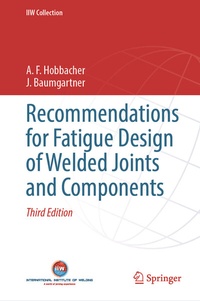
Recommendations for Fatigue Design of Welded Joints and Components
Description

This book presents an enriched exploration of structural fatigue assessment. Now in its updated form, this comprehensive edition delves into foundational principles while introducing extensive revisions and fresh content. Notable enhancements include a refined discussion on stress determination, an expanded section on fatigue resistance, also for welded thin sheets, and a thorough update of crucial chapters such as fatigue assessment using S-N curves at constant and variable amplitudes as well as practical application of fracture mechanics on fatigue of welded joints. The addition of new chapters on high-frequency mechanical impact (HFMI) treatment, insightful statistical
considerations based on IIW recommendations, and practical application examples further distinguish this edition. With updated references and meticulous attention to detail, this new edition emerges as an indispensable resource, offering professionals and enthusiasts a deeper understanding of fatigue assessment in structural engineering. Prepared as the result of an initiative by Commissions XIII and XV of the International Institute of Welding (IIW), this book represents a significant contribution to the field.
More details
Other editions
Additional editions
Persons
Prof. Hobbacher studied mechanical engineering at the Technical University in Stuttgart, Germany. He started his career in the industry, specializing in chemical plant equipment, heavy machinery, and pressure vessels, culminating in his role as Head of the design office. Later, he completed his doctoral thesis at the Aachen Institute of Technology in aerospace engineering. In 1980, he assumed the position of Full Professor at the University of Applied Sciences in Wilhelmshaven, Germany, where he lectured on welding technology, structural steelwork, pressure vessels, and pipes. During his tenure, he founded the Institute for Materials and Production Technology, serving as its inaugural Director. He held the position of Chairman of the German Welding Society (DVS) working group on design and analysis for over 30 years, and previously chaired the International Institute of Welding (IIW) Commission XV on Design and Analysis of Welded Structures for a decade. Additionally, he led an IIW Working Group responsible for developing the IIW Fatigue Design Recommendations. Prof. Hobbacher's extensive scientific contributions are evident in his numerous publications, documents, and books. In recognition of his outstanding efforts and achievements, he was honored with the "Evgeny Paton Prize" in 2013.
Dr. Baumgartner studied mechanical engineering at the Technical University in Darmstadt, Germany. He completed his PhD thesis dealing with the influence of residual stresses on the fatigue life of welded structures at the Technical University in Darmstadt, Germany. Starting in 2011, he worked in different positions at the Fraunhofer Institute of Structural Durability and System Reliability, LBF, in Darmstadt. Currently, he is scientific expert for the section structural durability. He currently holds the position of Chairman of the German Welding Society (DVS) working group on design and analysis and chairs the International Institute of Welding (IIW) Working Group 3 "Stress Analysis" within Commission XIII. In addition, he gives lectures at the Karlsruhe Institute of Technology on the subject fatigue assessment of welded joints.
Content
1 GENERAL.- 2 FATIGUE ACTIONS (LOADING).- 3 FATIGUE RESISTANCE.- 4 FATIGUE ASSESSMENT.- 5 SAFETY CONSIDERATIONS.- 6 APPENDICES.- 7 References.
