

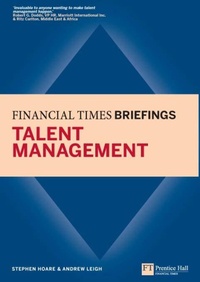
Talent Management: Financial Times Briefing
Description

FT Briefing on Talent Management is your short, results-focusedguide to the principles, behaviours and actions that underpin any successful talent management strategy and provides the practical and accessible guidance to attract, develop and retain talent in your business.
It shows you how to genuinely engage your people, how to establish a meaningful succession plan at all levels and how to integrate talent management fully into your leadership approach. The book's unique structure will ensure that you get the targeted advice you need.
Financial Times Briefings are designed to give busy decision-makers the answers to pressing issues that require hard measurable results
More details
Other editions
Additional editions
Person
Stephen Hoare is a regular contributor to The Guardian , Human Resources magazine, Talent Management Review and writes special reports on careers and MBAs for the Times. As a consultant on communication he has worked with a number of business schools including Cass, Cranfield, and RSM Erasmus University. Andrew Leigh is a former business feature writer from The Observer, Director of Maynard Leigh Associates and author of books, including, The Charisma Effect (Pearson Education 2008) and Secrets of Success in Management (Pearson Education 2008).
Content
Table of Contents
PART 1 - In Brief
1. The executive précis: the challenge, risk and opportunity of talent management
To be effective, talent management has to be led and championed at board level. But talent management or HR is only one strand of corporate governance. Long term thinking and consistency is needed in the face of short term expediency and hopping from one crisis to the next.
A new attitude to talent - Employers have to understand that even with the shortage of jobs, generation Y are still the generation that believes in working to live rather than living to work. To retain talent employers need to understand this dynamic and offer genuine commitment to improving work/life balance.
2. What is it? What do I need to know? Key terms/ concepts-
War for Talent
Pyschometric testing
Employee engagement
Employee Retention
Work/Life Balance
CSR
Leadership
Succession planning
Performance Appraisal
Matrix
Competency framework
Coaching
Mentoring
Career Development Plans
3. Why do it?. Risks/ Rewards
Should a company invest in helping all of its people achieve their potential or concentrate spending where it believes it will be most effective - ie on succession planning and developing the next generation of leaders?
Risks - Talent management is vulnerable in a downturn. Traditional command and control management has failed to empower workers at all levels in the organisation.
Rewards- Modern talent management practice recognizes that a more egalitarian and consensual approach is needed to bring out the best in people.
4. Who's doing it? Who has done it?
Real life examples
What do success and failure look like?
Many organizations view talent as their key differentiator. It is the quality of service, their ideas and intellectual property that generates wealth for the company. But a company needs to have a long term vision of where it is heading.
Case studies
Bourne Leisure
BSkyB
Thomson Reuters
M&S
PART 2 In Practice
5. Step by step guide-
A.) How to identify talent -
Forward thinking companies have a set of core values or behaviours they seek to promote. They will recruit to those values. (See brand). Internally, graduate development and management development centres play a big role in ensuring that talent is developed in the most appropriate ways.
B.) How to attract talent -
Merely paying the highest salary is not going to get you very far, especially when budgets are being squeezed. Employer brand is vital to attract and recruit staff who will be a good fit with corporate values. For the best companies this is an extension of their marketing both internal and external. The message has to be consistent.
C. How to nurture talent-
Many organizations are discovering that giving people a challenge works best. It is the variety and the challenge of the job as well as communicating with individuals and letting them know when they have done a good job. Corporate culture plays a big role.Good leadership is a positive self-reinforcing cycle. Board champions understand the value of having a relevant policy to develop talent within the organization.
6. How to justify talent management - the business case
The changing role of HR - In times of recession few companies can afford a top heavy HR department. Current best practice means devolving appraisal and career planning to line managers. HR's job is to oversee the process and focus on the strategic issues where it can add most value.
