

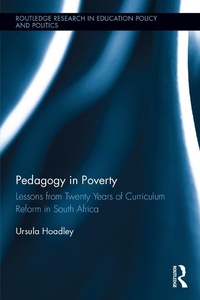
Pedagogy in Poverty
Lessons from Twenty Years of Curriculum Reform in South Africa
Published on 9. August 2017
254 pages
978-1-317-39862-2 (ISBN)
Description

As South Africa transitioned from apartheid to democracy, changes in the political landscape, as well as educational agendas and discourse on both a national and international level, shaped successive waves of curriculum reform over a relatively short period of time. Using South Africa as a germane example of how curriculum and pedagogy can interact and affect educational outcomes, Pedagogy in Poverty explores the potential of curricula to improve education in developing and emerging economies worldwide, and, ultimately, to reduce inequality.
Incorporating detailed, empirical accounts of life inside South African classrooms, this book is a much-needed contribution to international debate surrounding optimal curriculum and pedagogic forms for children in poor schools. Classroom-level responses to curriculum policy reforms reveal some implications of the shifts between a radical, progressive approach and traditional curriculum forms. Hoadley focuses on the crucial role of teachers as mediators between curriculum and pedagogy, and explores key issues related to teacher knowledge by examining the teaching of reading and numeracy at the foundational levels of schooling.
Offering a data-rich historical sociology of curriculum and pedagogic change, this book will appeal to academics, researchers and postgraduate students in the fields of education, sociology of education, curriculum studies, educational equality and school reform, and the policy and politics of education.
Incorporating detailed, empirical accounts of life inside South African classrooms, this book is a much-needed contribution to international debate surrounding optimal curriculum and pedagogic forms for children in poor schools. Classroom-level responses to curriculum policy reforms reveal some implications of the shifts between a radical, progressive approach and traditional curriculum forms. Hoadley focuses on the crucial role of teachers as mediators between curriculum and pedagogy, and explores key issues related to teacher knowledge by examining the teaching of reading and numeracy at the foundational levels of schooling.
Offering a data-rich historical sociology of curriculum and pedagogic change, this book will appeal to academics, researchers and postgraduate students in the fields of education, sociology of education, curriculum studies, educational equality and school reform, and the policy and politics of education.
Reviews / Votes
'Ursula Hoadley is one of the very best of the new generation of writers on curriculum and pedagogy. She is a creative and rigorous researcher with an interest in making a difference - and her research on South African schools and their challenges in the post-Apartheid era is confronting. This book brings together vivid depictions of classrooms, teachers, students and failed education reforms - and it develops fresh thinking about curriculum, pedagogy and place in moving forward. It deserves to be widely read.' - Lyn Yates, Foundation Chair of Curriculum, Melbourne Graduate School of Education, University of Melbourne, Australia.'Ursula Hoadley examines the complex and revealing relationship between societal structuring, the three South African curriculum reforms, and pedagogic practices in classrooms, detailing its implications for theory, policy and research. Key among these is the reciprocal relation between reform and teacher development. Without "a significant shift in the cognitive horizons of those teaching in our schools," Hoadley concludes, reform must fail. Hoadley makes a compelling argument for a relational conception of curriculum and pedagogy (or knowledge in pedagogy) in thinking about curriculum change. It is argument curriculum studies scholars not only in South Africa but worldwide will want to address.' - William F. Pinar, Canada Research Chair in Curriculum Studies, University of British Columbia, Vancouver, Canada.
More details
Series
Language
English
Place of publication
London
United Kingdom
Publishing group
Taylor & Francis Ltd
Target group
College/higher education
Professional and scholarly
Illustrations
27 Tables, black and white; 17 Line drawings, black and white; 3 Halftones, black and white; 44 Illustrations, black and white
File size
1,74 MB
ISBN-13
978-1-317-39862-2 (9781317398622)
Copyright in bibliographic data and cover images is held by Nielsen Book Services Limited or by the publishers or by their respective licensors: all rights reserved.
Schweitzer Classification
Other editions
Additional editions
Book
04/2020
1st Edition
Routledge
€65.40
Shipment within 15-20 days
Book
08/2017
1st Edition
Routledge
€215.41
Shipment within 10-20 days
Person
Ursula Hoadley is Associate Professor in the School of Education at the University of Cape Town in South Africa. She has a particular interest in curriculum, teachers' work and the sociological study of pedagogy.
Content
Credits Acknowledgements 1. Introduction 2. Curriculum and Pedagogy in Developing Country Contexts 3. From Tribalism to Technicism: Curriculum Policy under Apartheid 4. The Formal Frame: Pedagogy under Apartheid 5. Knowledge, Curriculum, Pedagogy: Theoretical Framings 6. Curriculum 2005 and the Dissolution of Boundaries 7. Waiting to Learn: Pedagogy under Curriculum 2005 8. One Step Forward: the Compromise National Curriculum Statement 9. The Communalised Classroom: Pedagogy under the National Curriculum Statement 10. Reclaiming Knowledge: The Curriculum and Assessment Policy Statement 11. Form and Substance: Pedagogy under the CAPS Reform 12. Conclusion: Knowledge in Pedagogy Appendix A: The 66 Specific Outcomes of Curriculum 2005 Appendix B: Theory into Data
