

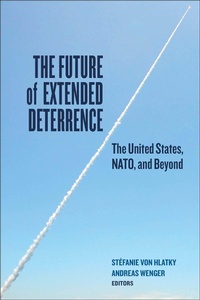
The Future of Extended Deterrence
Description

Are NATO's mutual security commitments strong enough today to deter all adversaries? Is the nuclear umbrella as credible as it was during the Cold War? Backed by the full range of US and allied military capabilities, NATO's mutual defense treaty has been enormously successful, but today's commitments are strained by military budget cuts and antinuclear sentiment. The United States has also shifted its focus away from European security during the wars in Afghanistan and Iraq and more recently with the Asia rebalance. Will a resurgent Russia change this?
The Future of Extended Deterrence brings together experts and scholars from the policy and academic worlds to provide a theoretically rich and detailed analysis of post-Cold War nuclear weapons policy, nuclear deterrence, alliance commitments, nonproliferation, and missile defense in NATO but with implications far beyond. The contributors analyze not only American policy and ideas but also the ways NATO members interpret their own continued political and strategic role in the alliance.
In-depth and multifaceted, The Future of Extended Deterrence is an essential resource for policy practitioners and scholars of nuclear deterrence, arms control, missile defense, and the NATO alliance.
More details
Other editions
Additional editions
Persons
Stéfanie von Hlatky is an assistant professor in the Department of Political Studies and director of the Centre for International and Defence Policy at Queen's University. She is the author of American Allies in Times of War: The Great Asymmetry.
Andreas Wenger is professor of International and Swiss Security Policy and director of the Center for Security Studies at ETH Zurich. He is the coeditor of Bioterrorism: Confronting a Complex Threat.
Content
Introduction: American Alliances and Extended Deterrence
Stéfanie von Hlatky, Queen's University
PART I: New Thinking on Deterrence
1. Threat Scenarios, Risk Assessments, and the Future of Nuclear Deterrence
Joachim Krause, University of Kiel
2. US Extended Deterrence and Europe: Time to Consider Alternative Structures?
Jeffrey A. Larsen, Director, NATO Defense College (Research Division)
PART II: NATO's Nuclear Weapons Policy
3. The Nuclear Straightjacket: American Extended Deterrence and Nonproliferation
Benoit Pelopidas, University of Bristol
4. NATO's Protracted Debate over Nuclear Weapons
Paul Schulte, Carnegie Endowment for International Peace
5. Nuclear Weapons in NATO's Deterrence Posture: Status Quo or Change?
Hans Kristensen, Federation of American Scientists
PART III: The Politics of Missile Defense
6. From Offense to Defense? Extended Deterrence and Missile Defense
Oliver Thränert, Center for Security Studies, ETH Zurich
Kerry M. Kartchner, US Defense Threat Reduction Agency
7. Ballistic Missile Defense in Europe: Getting to Yes with Moscow?
Paul Bernstein, National Defense University
Conclusion: Reconciling Alliance Cohesion with Policy Coherence
Andreas Wenger, Center for Security Studies, ETH Zurich
Bibliography
Contributors
Index
