

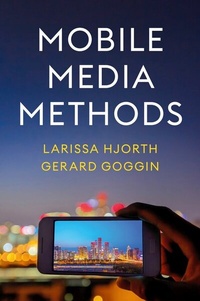
Mobile Media Methods
Description

This is the first textbook devoted to explaining these innovative and groundbreaking mobile media methods. Exploring the opportunities and limitations mobile media offer for methods, the book covers a range of topics from mobilities and placemaking to virtual reality and AI, as well as new kinds of mobility such as e-scooters and connected cars. Student-friendly features such as practical guidance on how to gather and analyse data alongside exercises are also included. Underscoring the book throughout is the definition of methods as not just a series of tools and techniques, but as an invitation to rethink how to conceptualize, practice, study and theorize the relationship between research, data and the field.
Drawing from the best of mobile and digital communication research, Mobile Media Methods offers a clear, accessible, and practical guide to mobile media methods. It is essential reading and a useful resource for students and scholars of digital technology and research methods.
More details
Other editions
Additional editions
Persons
Larissa Hjorth is Distinguished Professor in the School of Media and Communication at RMIT University.
Gerard Goggin is Professor in the Institute for Culture and Society at Western Sydney University.
Content
Figures
Abbreviations and Acronyms
1. Introduction
2. Methods
3. Placemaking
4. Mobilities
5. Practices
6. Play
7. Data
8. Futures
References
Index
1
Introduction
In Montreal, a 60-year old woman takes pictures of her beloved, a Golden Labrador, and shares them on Facebook for her family and friends - all via the mobile phone.
In Naarm/Melbourne, a Boon Wurrung woman in her thirties takes a selfie of herself with her mob and posts to Instagram with the hashtag Day of Mourning on the contested (colonial) Australia Day.
In Sydney, a climate emergency activist uses a combination of social mobile media - WhatsApp, Facebook and Instagram - to get the story of her local town out to different audiences and to connect with others.
In Tokyo, a passionate quantified selfer (QS), who uses data tracking to reflect and change behaviours, puts a sensing tracker on their greyhound to track their dog's movements, heart rate and moods while away at work.
These are just a few ways in which mobile media inhabit our lives. They shape, and are shaped by, our everyday rhythms, rituals and routines. They are also intimately entangled in our social, material and environmental worlds. With the rise of sensing data, automation, robotics and the Internet of Things (IoT), we witness the potential for mobile media to provide expanding possibilities for researching our society. Indeed, mobile media can be understood in a variety of ways - as a set of sociocultural technologies, media practices, platforms, algorithms, context and a lens for being in the world.
So what are mobile media? Mobile media encompass various dimensions:
- Media - such as photos, videos, text and music
- Device or technology, such as smartphone, smartwatch, laptop, mobile phone, sensing device
- Network, such as 3G, 4G, 5G or 6G, Internet, Wi-Fi, Bluetooth, or sensor network
- Software, computational and cloud-based technology system, infrastructure or platform, such as a messaging or social media service or app (e.g. WhatsApp, WeChat, Instagram, TikTok, Facebook).
Mobile media were firmly associated with the emergence of mobile phones, based on cellular mobile telecommunications networks (Goggin, 2006). As devices have proliferated, networks have evolved, interconnected, and to some extent become interoperable; convergence has occurred across media, communication and information; and digital technologies have grown to underpin many domains of economy, society, culture and nature. Mobile media entail a variety of media, contexts, devices and platforms. Once, the term 'mobile media' was defined as distinct from mobile communication as mobile technology devices started to diverge and become more multimedia.
However, now mobile media encapsulate both communication and technology (Goggin & Hjorth, 2009). As mundane tools that are an integral part of our lives, they provide intimate, expressive, creative and practical ways to research on the move in and through place. Far from being 'placeless', they illustrate how they are embedded in place (Ito, Matsuda & Okabe, 2006). They are about emplacement - that is, interwoven into our stories of place and placemaking. For example, think about how taking and sharing pictures on Instagram operates to visualize a moment in a place while on the move (Hjorth & Pink, 2014). In sum, to locate place.
For users, mobile media include mobile phones, tablet computers, apps, wearable devices such as smartwatches, trackers and connected clothes, RFID chips and sensors. While these are distributed, owned and used unevenly, they have become an integral part of everyday life globally. For researchers, mobile media have also created a wide range of new capabilities for investigation, fieldwork, experimentation, documentation, data-gathering, alternative academic and extramural communication, and new links with publics and audiences.
The field of mobile media is contested and dynamic, having multiple histories across disciplines and ways of being - in place, by the body, in movement. In ways visible and invisible, mobile media have become a ubiquitous part of how we move through place, space and time, and mediate most aspects of our lives. Mobile media are extensions of our body and senses, devices for capturing a complexity of data (Harari et al., 2020; Nelson et al., 2019; Lee, 2019; Gabrys, 2019a). They are vehicles for making artificial intelligence (AI) mundane and taken-for-granted (Ling, 2012). Mobile media are a big part of the environmental e-waste problem (Maxwell & Miller, 2019), not just in the inherent materiality of the devices but in their support for and normalization of collecting and sharing enormous amounts of data. Mobile media are a significant part of the wider energy consumption, environmental impact (Allard et al., 2022) and sustainability challenge posed by the internet and information and communication technologies (ICT) (Brevini, 2022; Jones, 2018).
Yet, conversely, mobile media are tools for addressing a range of challenges. As we saw during the COVID-19 pandemic, smartphones can help to coordinate public health messaging and control through techniques such as quick response (QR) code tracing and tracking (Andrejevic et al., 2021; Davies et al., 2022). Mobile media can also be used as forms of creative practice through location-based games that enhance cooperation and place-based play (something that occurred at scale with the phenomenal rise of Pokémon GO in 2015-16). Tapping into such a variety of trivial, significant and essential things, mobile media play an integrative and integral role in how many of us visualize, experience and represent the world.
Thus, across most societies, people's lives are deeply mediated by digital technologies - especially mobile devices, apps and data (Figure 1.1). We experience place, movement and sociality in and through mobile media. The rise of mobile media has significant implications for research and practice. Across disciplines and settings, researchers are seeking to make sense of the place of mobile media in social life. Increasingly, they also rely upon mobile media for their research. Mobile media are a researcher's device for collecting, documenting and dynamically capturing their fields of investigation. They also shape digital methodologies across technologies, their social formations, affordances and environments of uses as these move across digital, social and material worlds. Consider, for instance, how apps and platforms play a powerful role in how we not only see, but feel the world (Goggin, 2020; Lupton, 2017a). As devices that are often attached to the body all the time, such mobile media provide ways of 'reading' or interpreting our lives. From qualitative methods such as the 'walkthrough approach' to study apps (Light et al., 2018) - whereby researchers ask participants to talk through the app as they scroll - to quantitative and quantified approaches - such as the use of mobile media and app data collection and analysis (Harari et al., 2020) - mobile media provide an invitation and encounter for us to situate our research in different ways. Among other things, mobile media challenge us to take seriously, in our quotidian and mundane contexts:
- Intimacy and embodiment - the body as part of thinking and being in situ;
- proprioception - the knowledge of the body in and through movement;
- emplacement - stories of mobility, place and placemaking;
- datafication - the rendering of information into data in a digital form.
Figure 1.1. Mobile media play a key role in mediating and mediatizing our lives.
Photo credit: Larissa Hjorth.
In short, for researchers, mobile media offer a paradigm shift in methods - a rich and powerful, yet complex, set of developments. In this book, we explore the opportunities and limitations mobile media offer for methods. Core to our approach is expanding the definition of methods as not just a series of tools and techniques but as a conceptual lens for understanding the world. We do this by engaging with the key literature in the interdisciplinary field combined with interviews with key experts.
Mapping Mobile Media Methods
As anthropologist Daniel Miller (2021) highlights, mobile media offer ways to take seriously empirical - in the resonant sense of experience-based - methods as part of knowing, conceptualizing, theorizing and inhabiting the world. Miller argues that methods are not separate from theory or conceptualization; rather, they are an integral part of the research endeavour. This is especially the case given the different traditions of studying mobile media - from anthropology (where Miller is located), through cultural studies, sociology, media and communication, internet studies and science and technology studies to a wide range of other disciplines, such as human-computer interaction (HCI), economics, law and design, to mention just a few.
Jeffrey Boase and Lee Humphreys evocatively propose that mobile methods offer 'the means by which mobile communication technology is used to study the social world' (2018, p. 153). In the plethora of data collection that mobile media have evolved to undertake, we are yet to fully understand all the implications for mobile media methods. Boase and Humphreys identify three themes in mobile methods, each raising distinctive challenges: field-based on-hand/at-hand research (i.e. the...
