

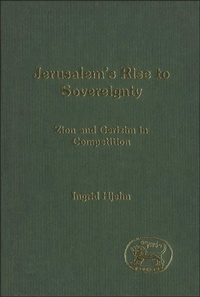
Jerusalem's Rise to Sovereignty
Zion and Gerizim in Competition
1st Edition
Published on 1. September 2004
386 pages
978-0-567-33197-7 (ISBN)
Description

Ingrid Hjelm examines the composition of the Books of Kings, using the Hezekiah narratives in 2 Kings 18-20 as a focus. She argues that this narrative is taken from that of the book of Isaiah, with which it shares linguistic and thematic elements. In Kings, it is used with the specific purpose of breaking the compositional pattern of curse, which threatens to place Jerusalem on a par with Samaria.
Jerusalem traditions are examined against theories of a late Yahwist author and the Pentateuch's origin within a Jerusalem cult. While the Pentateuch in its final form became a common work, acceptable to all groups because of its implied ambiguity, the Deuteronomistic History's favoring of David and Jerusalem holds a rejection of competitive groups as its implied argument.
Jerusalem traditions are examined against theories of a late Yahwist author and the Pentateuch's origin within a Jerusalem cult. While the Pentateuch in its final form became a common work, acceptable to all groups because of its implied ambiguity, the Deuteronomistic History's favoring of David and Jerusalem holds a rejection of competitive groups as its implied argument.
More details
Series
Edition
1. Auflage
Language
English
Place of publication
London
United Kingdom
Publishing group
Bloomsbury Publishing PLC
ISBN-13
978-0-567-33197-7 (9780567331977)
Copyright in bibliographic data and cover images is held by Nielsen Book Services Limited or by the publishers or by their respective licensors: all rights reserved.
Schweitzer Classification
Other editions
Additional editions
Book
09/2004
T.& T.Clark Ltd
€263.30
Shipment within 3-4 weeks
Person
DR. INGRID HJELM is Research Associate at the Carsten Niebuhr Institute of Near Eastern Studies and the Department of Biblical Studies, University of Copenhagen.
Content
- Intro
- Contents
- Preface
- Abbreviations
- Chapter 1 INTRODUCTION: CREATING THE CASE
- 1. Preliminary Remarks on Contextual Problems Regarding the Zion Metaphor
- 2. Biblical Chronology and Historical Reconstruction
- 3. The Value of Form and Redaction Criticism
- 4. Concluding Remarks Regarding Form and Redaction Criticism
- 5. Outline of the Investigation
- Chapter 2 THE HEZEKIAH NARRATIVE AND THE COMPOSITION OF THE DEUTERONOMISTIC HISTORY
- 1. 2 Kings 17-20: A Survey
- 2. What Happened to Jerusalem and Hezekiah?
- 3. Biblical Narrative and Historical Reality: Some Remarks
- 4. Motifs and Themes in the Hezekiah Narrative's Zion Ideology
- 5. Hezekiah and the Function of the Judgment Formulae in the Books of Kings
- 6. Jeroboam's Sin: The High Places and the Temples
- 7. The High Places, [Omitted], and the Habits of the Foreigners
- 8. Hezekiah as Moses' Successor? The Nehustan Motif
- 9. Josiah's Acts as a Variant Tradition? How Do We Fit this Narrative into the Ideology of the Books of Kings?
- 10. Patronage and Idolatry, or How to Characterize 'the Way of David'?
- Chapter 3 THE BOOK OF ISAIAH'S AHAZ AND HEZEKIAH NARRATIVES AS FOUNDATION MYTHS
- 1. Preliminary Remarks on the Composition of the Book of Isaiah
- 2. The Provenance of the Hezekiah Narrative: The Form- and Redaction-Critical Discussion
- 3. The Linguistic Evidence for an Isaianic Provenance
- a. Isaiah's Pronouncement of Exile and its Fulfilment in 2 Kings 24-25
- b. The Hezekiah Sickness Narrative
- c. Hezekiah's Reform
- d. Conclusions about the Linguistic Evidence
- 4. The Function of the Hezekiah Narrative within the Book of Isaiah: Ahaz and Hezekiah: Competing Characters?
- 5. Isaiah 7.9b
- 6. The Sign Motif, or Will they Stand the Water Test?
- 7. Isaiah's Preaching in the Light of Assyrian Royal Ideology
- 8. Isaiah 37.3-4: Yahweh's Day of Wrath-The Birth Motif
- 9. Excursus: Yahweh Zebaoth
- 10. Isaiah 37.3-4: The Day of Distress, [Omitted]
- 11. Isaiah 37.3-4: Children Have Come to the Cervical Opening and there is No Strength to Deliver Them
- Chapter 4 DEUTERONOMIST VS. YAHWIST: AGREEMENT AND CONFLICT IN JEWISH AND SAMARITAN TEXT TRADITIONS
- 1. Tradition History According to Van Seters: Some Considerations
- 2. Deuteronomist and Yahwist: Jewish and Samaritan Traditions of Text Composition-The Pre-Exilic Period
- a. Introduction to Samaritan Chronicles
- b. Samaritan 'Variants' to the Deuteronomistic History
- 3. Shiloh between Shechem and Jerusalem?
- 4. Samaritan-Jewish Discussions over Cult Place and Tradition-The Post-Exilic Period
- a. Samaritan Temple: Fiction or Fact?
- b. Which Law?
- Chapter 5 PROPHETIC UNDERSTANDING OF THE STATUS AND THE FUNCTION OF THE LAW: DAVID AND MOSES IN COMPETITION
- 1. From Priesthood to Kingship
- 2. David and Moses: Prophet vs. Prophet?
- 3. Law and Prophecy: Davidic Institutions vs. Mosaic Law
- a. Kingship vs. Priestly Leadership
- b. Jerusalem as the Chosen Place
- c. 'No Prophet Arose Again Like Moses'
- 4. 'Look, I Have Created Something New'
- Chapter 6 MOUNTAIN VS. MOUNTAIN: THE PLACE YAHWEH HAS CHOSEN
- 1. Mt Zion as the Mountain of the House of Yahweh
- 2. Zion and David Traditions in Extra-Biblical Literature
- a. Baruch, Sirach, Judith and Jubilees
- b. Eupolemus, Pseudo-Eupolemus, 1 Enoch and Tobit
- c. 1 Maccabees as Apologia?
- 3. 1 Maccabees: The Introduction
- 4. 1 Maccabees: Jerusalem-Zion vs. Antioch: Fighting the Seven-Headed Monster
- 5. 1 Maccabees: Utopia's Realization?
- 6. 2 Maccabees: Divine Election of Jerusalem as Yahweh's Abode and Judas as a Worthy Theocratic Leader
- Chapter 7 CONCLUSION: THE PLACE YAHWEH HAS CHOSEN
- Bibliography
- Index of References
- Index of Authors
- A
- B
- C
- D
- E
- F
- G
- H
- I
- J
- K
- L
- M
- N
- O
- P
- Q
- R
- S
- T
- U
- V
- W
- Y
- Z
