

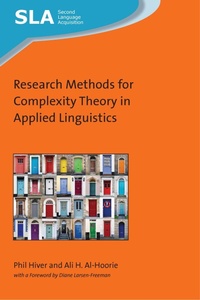
Research Methods for Complexity Theory in Applied Linguistics
Published on 6. December 2019
296 pages
978-1-78892-576-1 (ISBN)
Description

This book provides practical guidance on research methods and designs that can be applied to Complex Dynamic Systems Theory (CDST) research. It discusses the contribution of CDST to the field of applied linguistics, examines what this perspective entails for research and introduces practical methods and templates, both qualitative and quantitative, for how applied linguistics researchers can design and conduct research using the CDST framework. Introduced in the book are methods ranging from those in widespread use in social complexity, to more familiar methods in use throughout applied linguistics. All are inherently suited to studying both dynamic change in context and interconnectedness. This accessible introduction to CDST research will equip readers with the knowledge to ensure compatibility between empirical research designs and the theoretical tenets of complexity. It will be of value to researchers working in the areas of applied linguistics, language pedagogy and educational linguistics and to scholars and professionals with an interest in second/foreign language acquisition and complexity theory.
Reviews / Votes
A harmonious blend of theory and method, Hiver and Al-Hoorie provide researchers in applied linguistics not only with a rationale but the tools to fully (and finally!) embrace CDST. I expect this book will become a landmark publication for the field. * Luke Plonsky, Northern Arizona University, USA * This book is an eye-opening and completely welcome introduction to a methodological world much wider than most applied linguists will have ever imagined existed. Rather than a how-to book, it is a guide to a plethora of methodological approaches that aim to send 'one-shot cross-sectional research' to its timely demise. In this book, readers will find an intriguing new approach for analyzing their data. * Jenifer Larson-Hall, University of Kitakyushu, Japan * This book offers both a timely and comprehensive guide to doing empirical research on Complex Dynamic Systems Theory in applied linguistics. A rarity for its breadth and depth, it presents a rich array of methodological options pooled from multiple disciplines of study, promoting and enabling integration of methods beyond mixing. * ZhaoHong Han, Teachers College, Columbia University, USA * I was certainly thrilled to finally see a publication that, instead of merely trying to convince us that SLA research should be grounded in CDST, in fact makes an earnest attempt to illustrate how this can be done in practice. -- Miroslaw Pawlak, Adam Mickiewicz University, Poland; State University of Applied Sciences, Poland * Studies in Second Language Learning and Teaching, Vol. 10, No. 2 * This book contains a wealth of information for any researcher interested in exploring new methods. -- Paul Pauwels, KU Leuven, Belgium * International Journal of Applied Linguistics 172:1 *More details
Series
Language
English
Place of publication
Bristol
United Kingdom
Target group
College/higher education
Product notice
Reflowable
ISBN-13
978-1-78892-576-1 (9781788925761)
Copyright in bibliographic data and cover images is held by Nielsen Book Services Limited or by the publishers or by their respective licensors: all rights reserved.
Schweitzer Classification
Other editions
Additional editions
Phil Hiver | Ali H. Al-Hoorie
Research Methods for Complexity Theory in Applied Linguistics
Book
12/2019
Multilingual Matters
€48.70
Shipment within 3-4 weeks
Persons
Phil Hiver is an Assistant Professor at Florida State University, USA. His research interests include instructed language learning and the role of psycho-social factors in second language teaching and learning. He is the co-editor (with Sarah Mercer and Ali H. Al-Hoorie) of Engagement in the Second Language Classroom (Multilingual Matters, forthcoming).
Ali H. Al-Hoorie is an Assistant Professor at the English Language Institute, Royal Commission for Jubail and Yanbu, Saudi Arabia. He holds an MA in Social Science Data Analysis from the University of Essex, and a PhD in Applied Linguistics supervised by Professors Zoltan Doernyei and Norbert Schmitt at the University of Nottingham. He is also the co-editor (with Peter D. MacIntyre) of Contemporary Language Motivation Theory (Multilingual Matters, 2020).
Ali H. Al-Hoorie is an Assistant Professor at the English Language Institute, Royal Commission for Jubail and Yanbu, Saudi Arabia. He holds an MA in Social Science Data Analysis from the University of Essex, and a PhD in Applied Linguistics supervised by Professors Zoltan Doernyei and Norbert Schmitt at the University of Nottingham. He is also the co-editor (with Peter D. MacIntyre) of Contemporary Language Motivation Theory (Multilingual Matters, 2020).
Content
Part I. Introduction to Complexity Theory
Chapter 1. Introduction
Chapter 2. What is Complexity Theory?
Chapter 3. Applying Complexity Theory to Research
Part II. Qualitative Methods
Chapter 4. Qualitative Comparative Analysis
Chapter 5. Process Tracing
Chapter 6. Concept Mapping
Chapter 7. Agent-Based Modeling
Chapter 8. Retrodictive Qualitative Modeling
Chapter 9. Social Network Analysis
Chapter 10. Design Based Research Methods
Part III. Quantitative Methods
Chapter 11. Panel Designs
Chapter 12. Latent Growth Curve Modeling
Chapter 13. Multilevel Modeling
Chapter 14. Time Series Analysis
Chapter 15. Experience Sampling Method
Chapter 16. Single-Case Designs
Chapter 17. Idiodynamic Method
Part IV. C The Future of CDST Methodology
Chapter 18. Method Integration
Chapter 19. Glossary and Further Resources for CDS Methodology
Chapter 1. Introduction
Chapter 2. What is Complexity Theory?
Chapter 3. Applying Complexity Theory to Research
Part II. Qualitative Methods
Chapter 4. Qualitative Comparative Analysis
Chapter 5. Process Tracing
Chapter 6. Concept Mapping
Chapter 7. Agent-Based Modeling
Chapter 8. Retrodictive Qualitative Modeling
Chapter 9. Social Network Analysis
Chapter 10. Design Based Research Methods
Part III. Quantitative Methods
Chapter 11. Panel Designs
Chapter 12. Latent Growth Curve Modeling
Chapter 13. Multilevel Modeling
Chapter 14. Time Series Analysis
Chapter 15. Experience Sampling Method
Chapter 16. Single-Case Designs
Chapter 17. Idiodynamic Method
Part IV. C The Future of CDST Methodology
Chapter 18. Method Integration
Chapter 19. Glossary and Further Resources for CDS Methodology
