

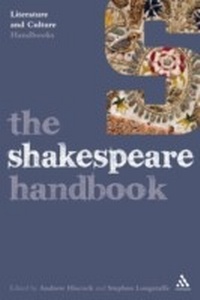
The Shakespeare Handbook
1st Edition
Published on 28. May 2009
280 pages
978-1-4411-8979-0 (ISBN)
Description

Literature and Culture Handbooks are an innovative series of guides to major periods, topics and authors in British and American literature and culture. Designed to provide a comprehensive, one-stop resource for literature students, each handbook provides the essential information and guidance needed from the beginning of a course through to developing more advanced knowledge and skills. Written in clear language by leading academics, they provide an indispensable introduction to key topics, including:
* Introduction to authors, texts, historical and cultural contexts
* Guides to key critics, concepts and topics
* An overview of major critical approaches, changes in the canon and directions of current and future research
* Case studies in reading literary and critical texts
* Annotated bibliography (including websites), timeline, glossary of critical terms.
The Shakespeare Handbook is an accessible and comprehensive introduction to Shakespeare and early modern literature.
* Introduction to authors, texts, historical and cultural contexts
* Guides to key critics, concepts and topics
* An overview of major critical approaches, changes in the canon and directions of current and future research
* Case studies in reading literary and critical texts
* Annotated bibliography (including websites), timeline, glossary of critical terms.
The Shakespeare Handbook is an accessible and comprehensive introduction to Shakespeare and early modern literature.
Reviews / Votes
"Clear, wide-ranging, and full of variety. This volume provides an accessible, and stimulating introduction to the study of Shakespeare, and is particularly fascinating for its extensive coverage of useful detail, its carefully staged treatment of particular topics, and for its overview of the productive tensions that characterise this vibrant field of study." - Professor John Drakakis, Department of English Studies, University of Stirling, UK. As with the book as a whole, [chapter 7] could be used to organize a series of seminars: prompts for further discussion on each topic are included, with specific scenes suggested as cues for closer reading. A technical, skills-oriented manual... the Shakespeare Handbook offers students an invaluable critical glossary that is simultaneously theoretical and practical... [offers] undergraduate classroom-friendly snapshots of the history and methods of Shakespearean criticism.More details
Series
Edition
1. Auflage
Language
English
Place of publication
New York
United States
ISBN-13
978-1-4411-8979-0 (9781441189790)
Copyright in bibliographic data and cover images is held by Nielsen Book Services Limited or by the publishers or by their respective licensors: all rights reserved.
Schweitzer Classification
Other editions
Additional editions
Andrew Hiscock | Stephen Longstaffe
The Shakespeare Handbook
Book
05/2009
Continuum International Publishing Group Ltd.
€192.80
Shipment within 15-20 days
Andrew Hiscock | Stephen Longstaffe
The Shakespeare Handbook
Book
05/2009
Continuum International Publishing Group Ltd.
€45.50
Shipment within 15-20 days
Persons
Andrew Hiscock is Professor of English at Bangor University, UK. Stephen Longstaffe is Senior Lecturer in English at the University of Cumbria, UK.
Content
General Editor's Introduction
PART 1: SHAKESPEARE'S TIME
1. Introduction - Andrew Hiscock and Stephen Longstaffe
2. A Shakespearean Timeline - Peter Sillitoe (University of Sheffield)
3. Shakespeare's Historical Context - William E. Engel(University of the South)
4. Shakespeare's Literary and Cultural Contexts - Stephen Longstaffe (St. Martin's College)
PART II: HOW TO READ SHAKESPEARE
5. Case Studies in Reading I: Reading the Texts - Kirk Melnikoff (UNC Charlotte)
6. Case Studies in Reading II: From texts to Theory - Mark Robson (University of Nottingham)
7. Shakespeare in the theatre and on film - Stuart Hampton-Reeves (University of Central Lancashire)
8. Key Critical Concepts and Topics - Adrian Streete (Queen's University Belfast)
PART III: SHAKESPEARE STUDIES NOW
9. Recent Critical Responses and Approaches, Lisa Hopkins (Sheffield Hallam University)
10. New Contexts for Shakespeare, Gabriel Egan (Loughborough University)
11. Recent Issues in Shakespearean Studies: From Margins to Centre, Willy Maley (Glasgow University)
12. Mapping the Current Critical Landscape, Ros King (University of Southampton)
Annotated Bibliography, Robert Evans (Auburn University Montgomery)
Glossary of Critical and Theoretical Terminology, Peter Sillitoe (University of Sheffield)
Appendix: Shakespeare: Teaching, Curriculum and Learning, David Webb (St. Martin's College, Lancaster)
Notes on Contributors
Index
PART 1: SHAKESPEARE'S TIME
1. Introduction - Andrew Hiscock and Stephen Longstaffe
2. A Shakespearean Timeline - Peter Sillitoe (University of Sheffield)
3. Shakespeare's Historical Context - William E. Engel(University of the South)
4. Shakespeare's Literary and Cultural Contexts - Stephen Longstaffe (St. Martin's College)
PART II: HOW TO READ SHAKESPEARE
5. Case Studies in Reading I: Reading the Texts - Kirk Melnikoff (UNC Charlotte)
6. Case Studies in Reading II: From texts to Theory - Mark Robson (University of Nottingham)
7. Shakespeare in the theatre and on film - Stuart Hampton-Reeves (University of Central Lancashire)
8. Key Critical Concepts and Topics - Adrian Streete (Queen's University Belfast)
PART III: SHAKESPEARE STUDIES NOW
9. Recent Critical Responses and Approaches, Lisa Hopkins (Sheffield Hallam University)
10. New Contexts for Shakespeare, Gabriel Egan (Loughborough University)
11. Recent Issues in Shakespearean Studies: From Margins to Centre, Willy Maley (Glasgow University)
12. Mapping the Current Critical Landscape, Ros King (University of Southampton)
Annotated Bibliography, Robert Evans (Auburn University Montgomery)
Glossary of Critical and Theoretical Terminology, Peter Sillitoe (University of Sheffield)
Appendix: Shakespeare: Teaching, Curriculum and Learning, David Webb (St. Martin's College, Lancaster)
Notes on Contributors
Index
