

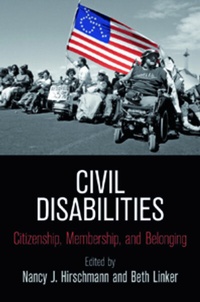
Civil Disabilities
Citizenship, Membership, and Belonging
1st Edition
Published on 24. December 2014
320 pages
978-0-8122-9053-0 (ISBN)
Description

An estimated one billion people around the globe live with a disability; this number grows exponentially when family members, friends, and care providers are included. Various countries and international organizations have attempted to guard against discrimination and secure basic human rights for those whose lives are affected by disability. Yet despite such attempts many disabled persons in the United States and throughout the world still face exclusion from full citizenship and membership in their respective societies. They are regularly denied employment, housing, health care, access to buildings, and the right to move freely in public spaces. At base, such discrimination reflects a tacit yet pervasive assumption that disabled persons do not belong in society.
Civil Disabilities challenges such norms and practices, urging a reconceptualization of disability and citizenship to secure a rightful place for disabled persons in society. Essays from leading scholars in a diversity of fields offer critical perspectives on current citizenship studies, which still largely assume an ableist world. Placing historians in conversation with anthropologists, sociologists with literary critics, and musicologists with political scientists, this interdisciplinary volume presents a compelling case for reimagining citizenship that is more consistent, inclusive, and just, in both theory and practice. By placing disability front and center in academic and civic discourse, Civil Disabilities tests the very notion of citizenship and transforms our understanding of disability and belonging.
Contributors: Emily Abel, Douglas C. Baynton, Susan Burch, Allison C. Carey, Faye Ginsburg, Nancy J. Hirschmann, Hannah Joyner, Catherine Kudlick, Beth Linker, Alex Lubet, Rayna Rapp, Susan Schweik, Tobin Siebers, Lorella Terzi.
Civil Disabilities challenges such norms and practices, urging a reconceptualization of disability and citizenship to secure a rightful place for disabled persons in society. Essays from leading scholars in a diversity of fields offer critical perspectives on current citizenship studies, which still largely assume an ableist world. Placing historians in conversation with anthropologists, sociologists with literary critics, and musicologists with political scientists, this interdisciplinary volume presents a compelling case for reimagining citizenship that is more consistent, inclusive, and just, in both theory and practice. By placing disability front and center in academic and civic discourse, Civil Disabilities tests the very notion of citizenship and transforms our understanding of disability and belonging.
Contributors: Emily Abel, Douglas C. Baynton, Susan Burch, Allison C. Carey, Faye Ginsburg, Nancy J. Hirschmann, Hannah Joyner, Catherine Kudlick, Beth Linker, Alex Lubet, Rayna Rapp, Susan Schweik, Tobin Siebers, Lorella Terzi.
Reviews / Votes
"Insightful, comprehensive, and personal. . . . These essays illuminate the social, political and environmental realities that have been variably experienced as helpful and harmful to the citizenship of those identified as disabled. The authors provide meaningful conceptualization and develop lexicon which enhance understanding of the obstacles to full citizenship, membership and belonging. The resulting narrative is steeped in the everyday experience of differentness that illuminates the impact of economic, legal, political and social forces."-Sex and Disability."Nancy Hirschmann and Beth Linker have compiled a set of arguments both impressive and accessible. . . . The editors and authors seize the opportunity to rethink issues of citizenship and collectivity in societies intrinsically based on concepts of normativity and admittance, which repeatedly disadvantage a sizable proportion of the population. Taking into account congenital disability, illness, age and institutions, these approaches cover a wide and evocative set of antinormative political positions."-Perspectives on Politics
"Civil Disabilities leaves no doubt that disability is central to the history, theory, and acts of citizenship. This marvelous collection of smart and varied essays argues that ideologies of disability draw the lines of membership and belonging that shape all of our lives-legally, economically, politically, and socially. Scholars of citizenship, from both the humanities and social sciences, will benefit from this book."-Kim E. Nielson, University of Toledo
"Civil Disabilities is a seriously interdisciplinary examination of the ways ideas of citizenship are deeply linked to disability, disabled people, and their families. Essays written by distinguished scholars educate us in this crucial area that is too often overlooked or given short shrift. An illuminating and truly educational book."-Lennard Davis, University of Illinois at Chicago
More details
Series
Language
English
Place of publication
Pennsylvania
United States
Target group
College/higher education
File size
3,05 MB
ISBN-13
978-0-8122-9053-0 (9780812290530)
Copyright in bibliographic data and cover images is held by Nielsen Book Services Limited or by the publishers or by their respective licensors: all rights reserved.
Schweitzer Classification
Other editions
Additional editions
Book
02/2019
University of Pennsylvania Press
€33.00
Shipment within 10-20 days
Book
02/2015
University of Pennsylvania Press
€66.85
Article exhausted; check different version
Persons
Nancy J. Hirschmann is Professor of Political Science at the University of Pennsylvania and author of Gender, Class, and Freedom in Modern Political Theory and The Subject of Liberty: Toward a Feminist Theory of Freedom. Beth Linker is Associate Professor in the Department of the History and Sociology of Science at the University of Pennsylvania and author of War's Waste: Rehabilitation in World War I America.
Content
- Cover
- Contents
- Disability, Citizenship, and Belonging: A Critical Introduction
- 1. Homer's Odyssey: Multiple Disability and The Best Years of Our Lives
- 2. Defect: A Selective Reinterpretation of American Immigration History
- 3. The Disremembered Past
- 4. Integrating Disability, Transforming Disease History: Tuberculosis and Its Past
- 5. Screening Disabilities: Visual Fields, Public Culture, and the Atypical Mind in the Twenty-First Century
- 6. Social Confluence and Citizenship: A View from the Intersection of Music and Disability
- 7. Our Ancestors the Sighted: Making Blind People French and French People Blind, 1750-1991
- 8. Citizenship and the Family: Parents of Children with Disabilities, the Pursuit of Rights, and Paternalism
- 9. Cognitive Disability, Capability Equality, and Citizenship
- 10. Invisible Disability: Seeing, Being, Power
- 11. Disability Trouble
- Notes
- List of Contributors
- Index
- A
- B
- C
- D
- E
- F
- G
- H
- I
- J
- K
- L
- M
- N
- O
- P
- Q
- R
- S
- T
- U
- V
- W
- X
- Y
- Z
- Acknowledgments
