

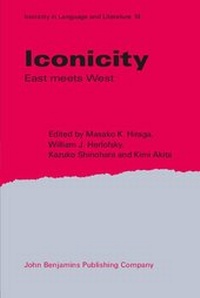
Iconicity
East meets West
1st Edition
Published on 15. April 2015
X, 274 pages
978-90-272-6883-9 (ISBN)
Description

Iconicity: East Meets West presents an intersection of East-West scholarship on Iconity. Several of its chapters thus deal with Asian languages and cultures, or a comparison of world languages. Divided into four categories: general issues; sound symbolism and mimetics; iconicity in literary texts; and iconic motivation in grammar, the chapters show the diversity and dynamics of iconicity research, ranging from iconicity as a driving force in language structure and change, to the various uses of images, diagrams and metaphors at all levels of the literary text, in both narrative and poetic forms, as well as on all varieties of discourse, including the visual and the oral.
More details
Other editions
Additional editions
Book
02/2015
John Benjamins Publishing Co
€111.30
Shipment within 10-15 days
Persons
Content
- Iconicity
- Editorial page
- Title page
- LCC data
- Table of contents
- Preface and acknowledgements
- List of contributors
- Introduction. Ubiquity of iconicity: East Meets West
- Part I. General
- Three paradigms of iconicity research in language and literature
- 1. The icon in the framework of Peirce's classification of signs
- 1.1 Iconicity, similarity, the icon, and the object of the sign
- 1.2 Icon, index, symbol
- 1.3 The icon as a Firstness in Thirdness, the pure icon, and the hypoicon
- 1.4 The triadic subdivision of icons into images, diagrams, and metaphors
- 1.5 Icons as rhemes, qualisigns, sinsigns, and legisigns
- 2. The first paradigm of study in iconicity in language: Form mimes meaning
- 3. The second paradigm: Form mimes form
- 4. The third paradigm: Ubiquity of iconicity in verbal communication
- 4.1 The ubiquity of icons in interpretant signs
- 4.2 Words as symbols, indices, and icons: Peircean principles of cross-classification
- 4.3 The iconicity of words and predicates
- References
- Iconicity of logic - and the roots of the "iconicity" concept
- 1. Peircean iconicity
- 2. Iconicity in logic formalizations
- 3. Algebra of logic
- 4. Existential graphs
- 5. Beta graphs
- 6. Lines of identity
- 7. Iconicity in EGs vs. linear notation
- 8. Conclusion
- References
- Part II. Sound meets meaning
- Iconic inferences about personality: From sounds and shapes
- 1. Introduction
- 1.1 General background and the current project
- 1.2 The current case study
- 2. Experiment I: Personality and sounds
- 2.1 Method
- 2.2 Result
- 2.3 Discussion
- 3. Experiment II: Personality and shapes
- 3.1 Method
- 3.2 Result and discussion
- 4. General discussion
- References
- Phonemes as images: An experimental inquiry into shape-sound symbolism
- 1. Introduction
- 2. The maluma-takete experiment
- 3. Analysing the distinctive features
- 3.1 Articulatory analysis
- 3.2 Acoustic analysis
- 3.3 Results of the analysis of the features
- 4. Isolating the distinctive features
- 4.1 First experiment
- 4.2 Second experiment
- 5. General discussion
- References
- Synaesthetic sound iconicity: Phonosemantic associations
- 1. Introduction
- 2. Research
- 2.1 Operationalization and hypotheses
- 2.2 Participants
- 2.3 Procedure
- 2.4 Materials
- 2.5 Apparatus
- 2.6 Processing of the data
- 2.7 Results
- 3. Discussion
- 4. Conclusion
- References
- What's in a mimetic? On the dynamicity of its iconic stem
- 1. Introduction
- 2. Iconic links in Japanese mimetics
- 3. Lexical representations of mimetics
- 4. Stem-based morphology of mimetics
- 5. Dynamicity of mimetic stems: Their limits and potentials
- 5.1 Accentuation of reduplicative mimetics
- 5.2 Absence of intrinsically static mimetics
- 6. Fictivity: Apparent counterexamples
- 7. Conclusion
- References
- Iconicity in the syntax and lexical semantics of sound-symbolic words in Japanese
- 1. Introduction
- 2. Preliminary
- 3. Frequency count
- 4. Phonomimes and the predicating nucleus
- 5. Conclusion
- References
- A corpus-based semantic analysis of Japanese mimetic verbs
- 1. Introduction
- 2. Data
- 3. Theme-subject verbs
- 4. Agent-subject verbs
- 5. Discussion
- 6. Concluding remarks
- References
- Data source
- Part III. Language meets literature
- Iconicity in translation: Two passages from a novel by Tobias Hill
- 1. Introduction
- 2. Tobias Hill, The Hidden: The excerpts and their iconic features
- 2.1 The first passage (p. 110)
- 2.2 The second passage (p. 290-291)
- 3. The attempts at iconic translations
- 3.1 The first passage
- 3.2 The second passage
- 4. Brief concluding remarks
- References
- The days pass Iconicity and the experience of time
- 1. A little theory
- 2. The diaries
- 3. Conclusion
- References
- Visual, auditory, and cognitive iconicity in written literature
- 1. Introduction
- 2. "Because I could not stop for Death"
- 3. Visual iconicity
- 4. Auditory iconicity
- 5. Cognitive iconicity
- 6. Conclusion
- Note
- References
- Don't read too much into the runes
- 1. Introduction
- 2. Characteristics of runic texts
- 2.1 General characteristics
- 2.2 Initiating the dedication
- 2.3 Deictic aspects
- 2.4 Identity and action
- 2.5 The rune master
- 2.6 Building bridges for the soul
- 2.7 Reader, be warned!
- 2.8 The iconicity of runic inscriptions
- 3. Runic text as oral narrative
- 4. In sum
- References
- Part IV. Grammar meets iconicity
- Iconicity in question: The case of 'optional' prepositions in Lithuanian
- 1. The problem
- 2. Hypotheses
- 2.1 Cases and prepositions are relators
- 2.2 The semantics of is and of the genitive in Lithuanian
- 3. Observations
- 3.1 Is or the saliency of X
- 3.2 Genitive case or unmarked extraction
- 4. Analysis
- 5. Outcome
- 6. Conclusion
- List of abbreviations
- Rethinking diagrammatic iconicity from an evolutionary perspective
- 1. Introduction
- 2. Iconicity in language: A reappraisal
- 3. Some illustrations of diagrammatic iconicity
- 3.1 Simultaneity and sequentiality
- 3.2 Asymmetry in logical connectives
- 4. Diagrammatic iconicity and language evolution
- 4.1 Preliminaries
- 4.2 Form-meaning separation
- 4.3 Higher-order analogy in humans
- 4.4 Analogy-based isomorphism between form and meaning
- 5. Concluding remarks
- Acknowledgements
- Note on glossing
- References
- Author index
- Subject index
