

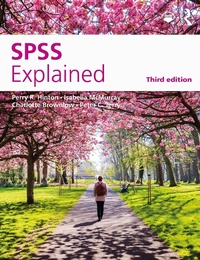
SPSS Explained
3rd Edition
Published on 12. September 2023
386 pages
978-1-000-92098-7 (ISBN)
Description

SPSS Explained provides the student with all that they need to undertake statistical analysis using SPSS. It combines a step-by-step approach to each procedure with easy-to-follow screenshots at each stage of the process. A number of other helpful features are provided, including:
regular advice boxes with tips specific to each test
explanations divided into 'essential' and 'advanced' sections to suit readers at different levels
frequently asked questions at the end of each chapter
The third edition of this popular book has been fully updated for IBM SPSS version 27 and also includes:
a new chapter on how to undertake mediation and moderation with SPSS
updates on changes to SPSS, including updated functionality within ANOVAs and calculations of a priori power analysis
Presented in full colour and with a fresh, reader-friendly layout, this fully updated new edition also comes with online support material featuring an array of supplementary resources for students and instructors.
Minimal prior knowledge is assumed, so the book is well designed for the novice user, but it will also be a useful reference source for those developing their own expertise in SPSS. It is suitable for all students who need to do statistical analysis using SPSS in various disciplines, including psychology, social science, business studies, nursing, education, health and sport science, communication and media, geography, and biology.
The authors have many years of experience in teaching SPSS to students from a wide range of disciplines. Their understanding of SPSS users' concerns, as well as a knowledge of the type of questions students ask, form the foundation of this book.
regular advice boxes with tips specific to each test
explanations divided into 'essential' and 'advanced' sections to suit readers at different levels
frequently asked questions at the end of each chapter
The third edition of this popular book has been fully updated for IBM SPSS version 27 and also includes:
a new chapter on how to undertake mediation and moderation with SPSS
updates on changes to SPSS, including updated functionality within ANOVAs and calculations of a priori power analysis
Presented in full colour and with a fresh, reader-friendly layout, this fully updated new edition also comes with online support material featuring an array of supplementary resources for students and instructors.
Minimal prior knowledge is assumed, so the book is well designed for the novice user, but it will also be a useful reference source for those developing their own expertise in SPSS. It is suitable for all students who need to do statistical analysis using SPSS in various disciplines, including psychology, social science, business studies, nursing, education, health and sport science, communication and media, geography, and biology.
The authors have many years of experience in teaching SPSS to students from a wide range of disciplines. Their understanding of SPSS users' concerns, as well as a knowledge of the type of questions students ask, form the foundation of this book.
Reviews / Votes
'Statistical methods are an integral part of teaching and research in almost all disciplines in the age of data revolution. The authors have presented introductory, descriptive, and numerical methods, as well as univariate and multivariate model fitting and inferential statistical procedures in a very clear, simplified, and step-by-step illustrative way. This book will be helpful to college and university students, teachers, and researchers who wish to analyse and interpret observational and experimental data from different disciplines across the world.'Professor Dr Shahjahan Khan, Vice Chancellor, Asian University of Bangladesh, Dhaka, Bangladesh
More details
Edition
3rd edition
Language
English
Place of publication
London
United Kingdom
Publishing group
Taylor & Francis Ltd
Target group
College/higher education
Illustrations
146 Tables, black and white; 50 Line drawings, color; 328 Halftones, color; 378 Illustrations, color
ISBN-13
978-1-000-92098-7 (9781000920987)
Copyright in bibliographic data and cover images is held by Nielsen Book Services Limited or by the publishers or by their respective licensors: all rights reserved.
Schweitzer Classification
Other editions
Additional editions
Perry R. Hinton | Isabella McMurray | Charlotte Brownlow
SPSS Explained
Book
09/2023
3rd Edition
Routledge
€167.13
Shipment within 15-20 days
Perry R. Hinton | Isabella McMurray | Charlotte Brownlow
SPSS Explained
Book
09/2023
3rd Edition
Routledge
€66.00
Shipment within 15-20 days
Persons
Perry R. Hinton is a cultural psychologist and a professor of applied linguistics at the University of Warwick, UK. He has taught in the areas of cognitive, social, and cultural psychology, to a wide range of students in psychology, linguistics, communication and media, education, philosophy, nursing, and social work. He is the author of Statistics Explained, also published by Routledge.
Isabella McMurray is a Principal lecturer in psychology at the University of Bedfordshire, UK. She has taught in a range of areas, primarily within psychology, including developmental psychology, and qualitative and quantitative research methods and analysis. She undertakes consultancy, training, and research with local authorities and charities, including working with social workers, probation services, education services, and road safety teams.
Charlotte Brownlow is a professor of psychology at the University of Southern Queensland, Australia. She has taught in a range of areas, primarily within psychology, including developmental and social psychology and qualitative and quantitative research methods.
Peter C. Terry is Dean of the Graduate Research School and a professor of psychology at the University of Southern Queensland, Australia. He has taught mainly in the areas of sport and exercise psychology, psychometrics, and statistics. He has provided psychological support at nine Olympic Games and more than 100 other international events.
Isabella McMurray is a Principal lecturer in psychology at the University of Bedfordshire, UK. She has taught in a range of areas, primarily within psychology, including developmental psychology, and qualitative and quantitative research methods and analysis. She undertakes consultancy, training, and research with local authorities and charities, including working with social workers, probation services, education services, and road safety teams.
Charlotte Brownlow is a professor of psychology at the University of Southern Queensland, Australia. She has taught in a range of areas, primarily within psychology, including developmental and social psychology and qualitative and quantitative research methods.
Peter C. Terry is Dean of the Graduate Research School and a professor of psychology at the University of Southern Queensland, Australia. He has taught mainly in the areas of sport and exercise psychology, psychometrics, and statistics. He has provided psychological support at nine Olympic Games and more than 100 other international events.
Content
1. Introduction
2. Data entry
3. Descriptive statistics
4. Illustrative statistics
5. Introduction to statistical testing
6. t tests
7. Introduction to analysis of variance (general linear model)
8. One-factor analysis of variance
9. Two-factor analysis of variance
10. Introduction to multivariate analysis of variance
11. Nonparametric two sample tests
12. Nonparametric k sample tests
13. Chi-square test of independence and goodness of fit test
14. Linear correlation and regression
15. Multiple regression and multiple correlation
16. Moderation and mediation
17. Introduction to factor analysis
18. Using SPSS to analyse questionnaires: reliability
18. Using SPSS to analyse questionnaires: reliability
2. Data entry
3. Descriptive statistics
4. Illustrative statistics
5. Introduction to statistical testing
6. t tests
7. Introduction to analysis of variance (general linear model)
8. One-factor analysis of variance
9. Two-factor analysis of variance
10. Introduction to multivariate analysis of variance
11. Nonparametric two sample tests
12. Nonparametric k sample tests
13. Chi-square test of independence and goodness of fit test
14. Linear correlation and regression
15. Multiple regression and multiple correlation
16. Moderation and mediation
17. Introduction to factor analysis
18. Using SPSS to analyse questionnaires: reliability
18. Using SPSS to analyse questionnaires: reliability
