

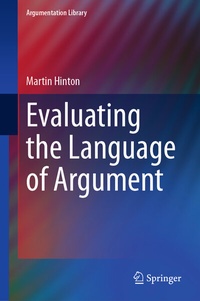
Evaluating the Language of Argument
Description

This book is concerned with the evaluation of natural argumentative discourse, and, in particular, with the language in which arguments are expressed. It introduces a systematic procedure for the analysis and assessment of arguments, which is designed to be a practical tool, and may be considered a pseudo-algorithm for argument evaluation.
The first half of the book lays the theoretical groundwork, with a thorough examination of both the nature of language and the nature of argument. This leads to a definition of argumentation as reasoning expressed within a procedure, which itself yields the three frames of analysis used in the evaluation procedure: Process, Reasoning, and Expression.
The second half begins with a detailed discussion of the concept of fallacy, with particular attention on fallacies of language, their origin and their effects. A new way of looking at fallacies emerges from these chapters, and it is that conception, together with the understanding of the nature of argumentation described in earlier sections, which ultimately provides the support for the Comprehensive Assessment Procedure for Natural Argumentation.
The first two levels of this innovative procedure are outlined, while the third, that dealing with language, and involving the development of an Informal Argument Semantics, is fully described. The use of the system, and its power of analysis, are illustrated through the evaluation of a variety of examples of argumentative texts.
More details
Other editions
Additional editions
Person
Martin Hinton is an assistant professor in the Faculty of Philology at the University of Lódz, in Poland. His research interests are in philosophy, linguistics and argumentation. He has published a number of papers on argumentation schemes and fallacies ( Argumentation , Informal Logic ; Logic & Logical Philosophy ), edited a special issue of the journal Research in Language , and co-edited a thematic issue of Studies in Logic, Grammar and Rhetoric . He has a strong interest in facilitating co-operation amongst the research community and organizes the WILL and PhilArg workshops, as well as being a founder member, and deputy chair, of the Polish argumentation society ArgDiaP.
