

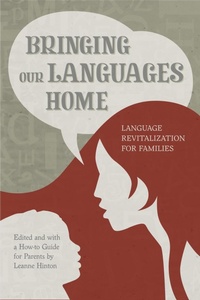
Bringing Our Languages Home
Language Revitalization for Families
Published on 23. November 2021
335 pages
978-1-59714-224-3 (ISBN)
Description

Thirteen personal accounts of endangered language preservation, plus a how-to guide for parents looking to do the same in their own home.
Throughout the world individuals in the intimacy of their homes innovate, improvise, and struggle daily to pass on endangered languages to their children. Elaina Albers of Northern California holds a tape recorder up to her womb so her baby can hear old songs in Karuk. The Baldwin family of Montana put labels all over their house marked with the Miami words for common objects and activities, to keep the vocabulary present and fresh. In Massachusetts, at the birth of their first daughter, Jesse Little Doe Baird and her husband convince the obstetrician and nurses to remain silent so that the first words their baby hears in this world are Wampanoag.
Thirteen autobiographical accounts of language revitalization, ranging from Irish Gaelic to Mohawk, Kawaiisu to Maori, are brought together by Leanne Hinton, professor emerita of linguistics at UC Berkeley, who for decades has been leading efforts to preserve the rich linguistic heritage of the world. Those seeking to save their language will find unique instruction in these pages; everyone who admires the human spirit will find abundant inspiration.
Languages featured: Anishinaabemowin, Hawaiian, Irish, Karuk, Kawaiisu, Kypriaka, Maori, Miami, Mohawk, Scottish Gaelic, Wampanoag, Warlpiri, Yuchi
"Practical and down to earth, philosophical and spiritual, Bringing Our Languages Home describes the challenges and joys of learning and passing on your language. It gives good detailed advice... Fantastic! I hope millions will read it!" -Tove Skutnabb-Kangas, Åbo Akademi University, Finland, emerita
"This rare collection by scholar-activist Leanne Hinton brings forward deeply affecting accounts of families determined to sustain their languages amidst a sea of dominant-language pressures. The stories could only be told by those who have experienced the joys and challenges such an undertaking demands. Drawing lessons from these accounts, Hinton leaves readers with a wealth of language planning strategies. This powerful volume will long serve as a seminal resource for families, scholars, and language planners around the world." -Teresa L. McCarty, George F. Kneller Chair in Education and Anthropology, University of California, Los Angeles
Throughout the world individuals in the intimacy of their homes innovate, improvise, and struggle daily to pass on endangered languages to their children. Elaina Albers of Northern California holds a tape recorder up to her womb so her baby can hear old songs in Karuk. The Baldwin family of Montana put labels all over their house marked with the Miami words for common objects and activities, to keep the vocabulary present and fresh. In Massachusetts, at the birth of their first daughter, Jesse Little Doe Baird and her husband convince the obstetrician and nurses to remain silent so that the first words their baby hears in this world are Wampanoag.
Thirteen autobiographical accounts of language revitalization, ranging from Irish Gaelic to Mohawk, Kawaiisu to Maori, are brought together by Leanne Hinton, professor emerita of linguistics at UC Berkeley, who for decades has been leading efforts to preserve the rich linguistic heritage of the world. Those seeking to save their language will find unique instruction in these pages; everyone who admires the human spirit will find abundant inspiration.
Languages featured: Anishinaabemowin, Hawaiian, Irish, Karuk, Kawaiisu, Kypriaka, Maori, Miami, Mohawk, Scottish Gaelic, Wampanoag, Warlpiri, Yuchi
"Practical and down to earth, philosophical and spiritual, Bringing Our Languages Home describes the challenges and joys of learning and passing on your language. It gives good detailed advice... Fantastic! I hope millions will read it!" -Tove Skutnabb-Kangas, Åbo Akademi University, Finland, emerita
"This rare collection by scholar-activist Leanne Hinton brings forward deeply affecting accounts of families determined to sustain their languages amidst a sea of dominant-language pressures. The stories could only be told by those who have experienced the joys and challenges such an undertaking demands. Drawing lessons from these accounts, Hinton leaves readers with a wealth of language planning strategies. This powerful volume will long serve as a seminal resource for families, scholars, and language planners around the world." -Teresa L. McCarty, George F. Kneller Chair in Education and Anthropology, University of California, Los Angeles
More details
Other editions
Additional editions
Book
04/2013
Heyday Books
€25.50
Article not available at the moment
Person
Leanne Hinton is professor emerita at the University of California, Berkeley, and a founding member of the board of the Advocates for Indigenous California Language Survival. She has authored many articles and several books on language revitalization, including
Flutes of Fire: Essays on California Indian Languages; The Green Book of Language Revitalization in Practice (edited with Ken Hale); and
How to Keep Your Language Alive: A Guide to One-on-One Language (with Matt Vera and Nancy Steele). She has worked with AICLS to develop and implement the Master-Apprentice Language Learning Program and the Breath of Life Language Workshops, both of which have expanded throughout the US and internationally. In 2005 she received the Cultural Freedom Award from the Lannan Foundation for her work on the revitalization of endangered languages. Leanne lives in Berkeley, California, with her husband, Gary Scott, and delights in family time with their four children and seven grandchildren.
Content
- Intro
- Title Page
- Copyright Page
- Dedication
- Table of Contents
- ACKNOWLEDGMENTS
- INTRODUCTION
- Part I - STARTING FROM ZERO
- 1: Miami - myaamiaataweenki oowaaha: MIAMI SPOKEN HERE
- Daryl
- Karen
- Jarrid
- Jessie
- Conclusion-Darryl
- 2: Wampanoag - HOW DID THIS HAPPEN TO MY LANGUAGE?
- What Can We Do about This Situation?
- How Can i Learn When There Are No Speakers?
- Maybe We Should Try Speaking Just Our Language
- What's the Language Scoop around the House?
- So What's the Language Scoop outside the House?
- Work on What You Can Change and Accept What You Cannot!
- What's Going On These Days?
- So, What's on Deck?
- Part II - LEARNING FROM THE ELDERS
- 3: Karuk - KARUK LANGUAGE AND THE ALBERS BASKET
- 4: Yuchi - FAMILY LANGUAGE WITHOUT A LANGUAGE FAMILY
- dEzAt'ê O'wAdA:
- dEzA'y@nE sA'wAdA:
- dEzAt'ê O'wAdA:
- dEzA'y@nE sA'wAdA:
- dEzAt'ê O'wAdA:
- dEzA'y@nE sA'wAdA:
- dEzAt'ê O'wAdA:
- dEzA'y@nE sA'wAdA:
- Part III - FAMILIES AND COMMUNITIES WORKING TOGETHER
- 5: Mohawk - OUR KANIEN'KÉHA LANGUAGE
- Theodore
- Margaret
- Theodore
- Margaret
- Theodore
- Margaret
- Theodore
- Margaret
- Theodore
- Margaret
- Theodore
- Postscript
- Margaret
- 6: Mori - MY LANGUAGE STORY
- The Ki Tahu Language Story
- My Whnau (Family Story)
- Turning the Tide-The Start of the Ki Tahu Language Revitalisation Movement
- A New Generation Is Born
- The Battlefield of Language Maintenance
- Notes
- 7: Hawaiian - E PAEPAE HOU 'IA KA PHAKU: RESET THE STONES OF THE HAWAIIAN HOUSE PLATFORM
- Ka Nohona I Kahi Hiki-Living in the Place of Narrowness
- Hihia N Makau O Ke Aloha-Our Lines Become Entangled
- Ho'okahi Ali'i 'O Hanakahi-Unity under Hilo's Chief Hanakahi (Single-Work)
- K Ke Kalo I Ka 'Oh-A Full Taro Develops When It Has Side Shoots
- Pnana Ka Manu I Haili-The Bird Makes a Nest in Haili of the Hilo District
- I Mua A Inu I Ka Wai 'Awa'awa-Drinking the Bitter Waters Necessary to Reach Success
- He Makamae N Phaku Paepae, He Mana-House Foundation Stones Are Precious, They Contain a Spiritual Power
- He Mau Mana'o No Ka Hnai 'Ia 'Ana
- Thoughts on Our Upbringing
- 8: Anishinaabemowin - LANGUAGE, FAMILY, AND COMMUNITY
- Ode'iminan-Heart Berries
- Ingitizimag-Family
- Dibaajimowinid-What to Talk About
- Manidooke miinwaa Jingtamok-Ceremony and Celebration
- Naadamajig Oodenang-Community Helpers
- Oshkiwiigwaasbiigewinan-New Bark to Write On
- Noongwa nd'nisdotaanmi-What We Know Today
- Mii sa I'iw-Conclusion
- Notes
- Additional References
- 9: Irish - BELFAST'S NEO-GAELTACHT
- Pobal Feirste, the Shaw's Road Gaeltacht
- Notes
- Part IV - VARIATIONS ON A THEME
- 10: Kypriaka - MAKING CHOICES: ENRICHING LIFE
- Introduction
- Setting the Stage
- Kypriaka: A Fading Dialect
- English, English Everywhere
- Making Kypriaka Part of the Home
- English Encroachment
- Growing Bilingual
- Joining the Community
- Making the Choice
- Conclusion
- Notes
- 11: Warlpiri - ABOUT DAD
- Part V - FAMILY LANGUAGE-LEARNING PROGRAMS
- 12: Kawaiisu - THE KAWAIISU LANGUAGE AT HOME PROGRAM
- The Kawaiisu People
- Kawaiisu Language Revitalization
- The Language at Home Program
- Mentoring Language at Home Families
- Creating Goals for Language at Home Families
- Examples of Language Acquisition Activities
- Measuring Progress for Language at Home Families
- Some Challenges
- Some Results
- Comparison of Programs
- 13: Scottish Gaelic - Taic/CNSA and Scottish Gaelic
- The Birth of CNS
- Total Immersion Plus (TIP) Explained
- The Family Language Plan
- Gaelic in the Home Course
- The Altram Course
- Final Remarks
- Postscript
- CONCLUSION: - BRINGING YOUR LANGUAGE INTO YOUR OWN HOME
- CONTRIBUTOR BIOGRAPHIES
