

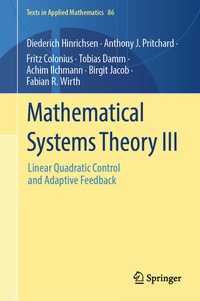
Mathematical Systems Theory III
Description

This is the third and final volume of Mathematical Systems Theory. Like the preceding volumes, it presents the mathematical foundations of systems and control theory in a self-contained, comprehensive, detailed, and mathematically rigorous manner. The exposition proceeds from the very general to the more specific, with rigorous mathematics complemented by numerous illustrations and explanatory remarks.
Volume III comprises two chapters and an appendix. In contrast to the first two volumes, only continuous-time systems are considered here. Chapter 9 addresses linear-quadratic optimal control and the Riccati equation, while Chapter 10 deals with zero dynamics and adaptive feedback regulation. Distinctive features include:
a comprehensive treatment of the linear-quadratic optimal control problem
a presentation of the bounded real and the Kalman-Yakubovich-Popov Lemma
a systematic development of spectral factorization
a study of the relative degree in state space and frequency domain
a detailed exposition of the Byrnes-Isidori form and zero dynamics
a development of the fundamentals of high-gain adaptive and funnel control.
The book combines the characteristics of a detailed introductory textbook with those of a reference source. The material should be accessible to mathematics students after two years of study, as well as to engineering students with a strong mathematical background. It will be of value to researchers in systems theory, as well as to mathematicians and engineers seeking to acquire a solid understanding of the mathematical foundations of the topics outlined above.
More details
Other editions
Additional editions
Persons
Diederich Hinrichsen is a retired Professor of Mathematical Systems Theory at the University of Bremen.
Anthony J. Pritchard (┼ 2007) was Professor of Mathematics and founder and director of the Control Theory Centre at the University of Warwick.
Fritz Colonius is a retired Professor of Applied Mathematics at the University of Augsburg. His main research interest is the interplay of control theory and dynamical systems theory.
Tobias Damm is Professor for Systems and Control Theory at RPTU University Kaiserslautern-Landau. His research interests include linear algebra and numerical analysis and the application of these to control theory.
Achim Ilchmann held a chair in Applied Mathematics at the Technical University of Ilmenau until his retirement in 2022. His research interests include the algebraic theory of time-varying linear systems, adaptive control, and Baroque architecture.
Birgit Jacob has been with the University of Wuppertal, Germany, since 2010, where she is a full professor in analysis. Her current research interests include the area of infinite-dimensional systems and operator theory, particularly well-posed linear systems and port-Hamiltonian systems.
Fabian R. Wirth is Professor for Dynamical Systems at the University of Passau. His research interests include stability theory, switched systems, infinite-dimensional and large-scale systems.
Content
Linear Quadratic Optimal Control and the Riccati Equation.- Zero Dynamics and Adaptive Feedback Regulation.- References.- Glossary.- Index .
