

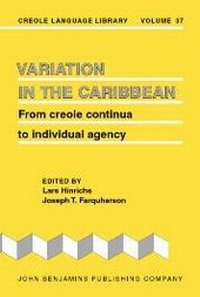
Variation in the Caribbean
From creole continua to individual agency
1st Edition
Published on 26. January 2011
VI, 276 pages
978-90-272-8739-7 (ISBN)
Description

The study of linguistic variation in the Caribbean has been central to the emergence of Pidgin and Creole Linguistics as an academic field. It has yielded influential theory, such as the (post-)creole continuum or the 'Acts of Identity' models, that has shaped sociolinguistics far beyond creole settings. This volume collects current work in the field and focuses on methodological and theoretical innovations that continue, expand, and update the dialog between Caribbean variation studies and general sociolinguistics.
More details
Other editions
Additional editions
Lars Hinrichs | Joseph T. Farquharson
Variation in the Caribbean
From creole continua to individual agency
Book
01/2011
John Benjamins Publishing Co
€104.94
Shipment within 10-15 days
Persons
Content
- Variation in the Caribbean
- Editorial page
- Title page
- LCC data
- Table of contents
- Introduction
- Acknowledgments
- References
- Part I. Variation and linguistic systems
- Revisiting variation between sa and o in Sranan
- 1. Introduction
- 2. Historical excursus
- 3. Previous analyses of sa versus o
- 4. Methodology
- 5. The uses of sa and o in contemporary Sranan
- 6. The meanings and uses of sa in Sranan
- 6.1 Cases where sa expresses dynamic modality
- 6.2 Epistemic uses of sa
- 6.3 Deontic uses of sa
- 6.4 Parallels between sa and Dutch zullen
- 7. Conclusion
- References
- Inherent variability and coexistent systems
- 1. Introduction
- 2. Negation in English, English-based creoles, and African American Vernacular English
- 3. Variation in negation on Bequia
- 3.1 Sociohistorical background
- 3.2 Defining the variable context
- 3.3 Factor groups coded
- 4. Results
- 4.1 The use of na
- 4.2 The use of ain't
- 5. Conclusion
- References
- Putting individuals back in contact
- 1. Introduction
- 2. Individual language change in adulthood
- 3. Methodology
- 4. Analysis
- 4.1 Linguistic factors
- 4.2 Social factors
- 5. Results
- 5.1 GOOSE vowel
- 5.2 TRAP and BATH vowels
- 5.3 LOT and THOUGHT vowels
- 6. Summary of results and discussion
- 7. Conclusion
- References
- Relative markers in spoken Standard Jamaican English
- 1. Introduction
- 2. Relativization in spoken standard English varieties
- 3. Relativization in Jamaican Creole and in SJE
- 4. Data and analysis
- 5. Results
- 5.1 Inventory of overt relative markers
- 5.2 Restrictive vs. non-restrictive relative clauses
- 5.3 Human vs. non-human antecedent
- 5.4 Syntactic function of relative marker
- 5.5 Prepositions in the relative clause
- 5.6 Relative clause constructions
- 6. Summary and discussion
- References
- Part II. Variation and identity
- "Flying at half-mast"? Voices, genres, and orthographies in Barbadian Creole
- 1. Introduction
- 2. Bajan and the Barbadian sociolinguistic situation
- 2.1 Writing Bajan
- 2.2 Reading Bajan
- 3. So, how funny is it? Orthographies, voices, and genres
- 4. Conclusions
- References
- 6. Appendix I
- The creole continuum and individual agency
- 1. Introduction
- 2. Quantitative analyses
- 2.1 Syntax and morphology
- 2.2 Lexis
- 3. Qualitative analyses
- 3.1 Inter-individual variation
- 3.2 Intra-individual variation
- 4. Conclusion
- References
- Language attitudes and linguistic awareness in Jamaican English
- 1. Introduction
- 2. Methodology
- 3. Survey results
- 3.1 Lexicon
- 3.2 Morphosyntax
- 4. Conclusions
- References
- 6. Appendix
- Part III. Variation and the community
- The varilingual repertoire of Tobagonian speakers
- 1. Introduction
- 2. Background
- 3. The language study
- 3.1 Informants and data collection
- 4. The data sample and data analysis
- 4.1 Findings
- 5. Summary and conclusions
- References
- On the emergence of new language varieties
- 1. Introduction
- 2. Social and linguistic situation in French Guiana
- 3. The (traditional) native view of the EM linguistic space
- 3.1 Ethnic or regional varieties
- 3.2 Social varieties
- 4. The EMC migrates to the coast
- 4.1 Changes in the linguistic repertoire and in-group linguistic practices
- 4.2 Toward koineization
- 4.3 Vehicularization
- 5. The role of social and linguistic processes in language diversification
- 5. Conclusion and implication
- References
- 'Creole' and youth language in a British inner-city community
- 1. Introduction
- 2. Background
- 3. Manchester
- 4. Our research site
- 5. Our study and its participants
- 6. Linguistic behaviour
- 7. The legacy of Creole
- 7.1 Language practice 1: MC-ing
- 7.2 Language practice 2: Murking (verbal duelling)
- 8. Global, local, and translocal
- 9. Conclusion
- References
- Le Page's theoretical and applied legacy in sociolinguistics and creole studies
- 1. Introduction
- 2. Le Page's theoretical legacy
- 2.1 Sociohistory
- 2.2 The Acts of Identity model
- 3. Le Page's applied work
- 4. Conclusion: Problems to be faced in building on Le Page's legacy
- References
- Name index
- Subject index
- The series Creole Language Library
