

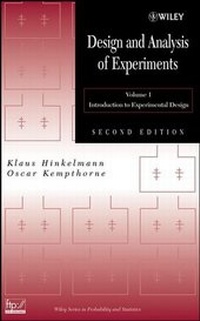
Design and Analysis of Experiments, Volume 1
Description

Reviews / Votes
"This user-friendly new edition reflects a modern andaccessible approach to experimental design andanalysis." (Landtechnik, 1 November 2012) "This book is an ideal textbook for graduate courses inexperimental design and also a practical reference book forstatisticians and researchers across a wide array of subject areas,including biological sciences, engineering and business."(Biometrical Journal, August 2008) "The revisions, reorganization, and addition certainly enhancethe value of this edition. Like the first edition, the currentedition will continue to play an important role in the arena ofstatistical design of experiments." (Technometrics, November2008) "The revisions, reorganization, and addition certainly enhancethe value of this edition. Like the first edition, the currentedition will continue to play an important role in the arena ofstatistical design of experiments." (Technometrics, Nov2008) "This book is an ideal textbook for graduate courses inexperimental design and also a practical reference book forstatisticians and researchers across a wide array of subject areas,including biological sciences, engineering and business."(Biometrical Journal, Aug 2008)More details
Other editions
Additional editions
Persons
Content
1.1 Introduction.
1.2 Development of Theory.
1.3 The Nature and Role of Theory in Science.
1.4 Varieties of Theory.
1.5 The Problem of General Science.
1.6 Causality.
1.7 The Upshot.
1.8 What Is An Experiment?.
1.9 Statistical Inference.
2. Principles of Experimental Design.
2.1 Confirmatory and Exploratory Experiments.
2.2 Steps of Designed Investigations.
2.3 The Linear Model.
2.4 Illustrating Individual Steps: Study 1.
2.5 Three Principles of Experimental Design.
2.6 The Statistical Triangle and Study 2.
2.7 Planning the Experiment.
2.8 Cooperation between Scientist and Statistician.
2.9 General Principle of Inference.
2.10 Other Considerations for Experimental Designs.
3. Survey of Designs and Analyses.
3.1 Introduction.
3.2 Error-Control Designs.
3.3 Treatment Designs.
3.4 Combining Ideas.
3.5 Sampling Designs.
3.6 Analysis and Statistical Software.
3.7 Summary.
4. Linear Model Theory.
4.1 Introduction.
4.2 Representation of Linear Models.
4.3 Functional and Classificatory Linear Models.
4.4 The Fitting Of Y .= X_.
4.5 The Moore-Penrose Generalized Inverse.
4.6 The Conditioned Linear Model.
4.7 The Two-Part Linear Model.
4.8 A Special Case of a Partitioned Model.
4.9 Three-Part Models.
4.10 The Two-Way Classification Without Interaction.
4.11 The K-Part Linear Model.
4.12 Balanced Classificatory Structures.
4.13 Unbalanced Data Structures.
4.14 Analysis of Covariance Model.
4.15 From Data Analysis to Statistical Inference.
4.16 The Simple Normal Stochastic Linear Model.
4.17 Distribution Theory with GMNLM.
4.18 Mixed Models.
5. Randomization.
5.1 Introduction.
5.2 The Tea Tasting Lady.
5.3 A Triangular Experiment.
5.4 The Simple Arithmetical Experiment.
5.5 Randomization Ideas for Intervention Experiments.
5.6 The General Idea of the Experiment Randomization Test.
5.7 Introduction to Subsequent.
6. The Completely Randomized Design.
6.1 Introduction and Definition.
6.2 The Randomization Process.
6.3 The Derived Linear Model.
6.4 Analysis Of Variance.
6.5 Statistical Tests.
6.6 Approximating the Randomization Test.
6.7 CRD with Unequal Numbers of Replications.
6.8 Number of Replications.
6.9 Subsampling In A CRD.
6.10 Transformations.
6.11 Examples Using SASR.
7. Comparisons of Treatments.
7.1 Introduction.
7.2 Comparisons for Qualitative Treatments.
7.3 Orthogonality and Orthogonal Comparisons.
7.4 Comparisons for Quantitative Treatments.
7.5 Multiple Comparison Procedures.
7.6 Grouping Treatments.
7.7 Examples Using SAS.
8. Use of Supplementary Information.
8.1 Introduction.
8.2 Motivation of the Procedure.
8.3 Analysis of Covariance Procedure.
8.4 Treatment Comparisons.
8.5 Violation of Assumptions.
8.6 Analysis of Covariance with Subsampling.
8.7 The Case of Several Covariates.
8.8 Examples Using SASR.
9. Randomized Block Designs.
9.1 Introduction.
9.2 Randomized Complete Block Design.
9.3 Relative Efficiency of the RCBD.
9.4 Analysis of Covariance.
9.5 Missing Observations.
9.6 Nonadditivity in the RCBD.
9.7 The Generalized Randomized Block Design.
9.8 Incomplete Block Designs.
9.9 Systematic Block Designs.
9.10 Examples Using SASR.
10. Latin Square Type Designs.
10.1 Introduction and Motivation.
10.2 Latin Square Design.
10.3 Replicated Latin Squares.
10.4 Latin Rectangles.
10.5 Incomplete Latin Squares.
10.6 Orthogonal Latin Squares.
10.7 Change-Over Designs.
10.8 Examples Using SAS.
11. Factorial Experiments: Basic Ideas.
11.1 Introduction.
11.2 Inferences from Factorial Experiments.
11.3 Experiments with Factors at Two Levels.
11.4 The Interpretation of Effects and Interactions.
11.5 Interactions: A Case Study.
11.6 2n Factorials in Incomplete Blocks.
11.7 Fractions of 2n Factorials.
11.8 Orthogonal Main Effect Plans for 2n Factorials.
11.9 Experiments with Factors at Three Levels.
11.10experimentswith Factors at Two and Three Levels.
11.11examples Using SAS.
12. Response Surface Designs.
12.1 Introduction.
12.2 Formulation of the Problem.
12.3 First-Order Models and Designs.
12.4 Second-Order Models and Designs.
12.5 Integrated Mean Squared Error Designs.
12.6 Searching For an Optimum.
12.7 Experiments with Mixtures.
12.8 Examples Using SAS.
13. Split-Plot Type Designs.
13.1 Introduction.
13.2 The Simple Split-Plot Design.
13.3 Relative Efficiency of Split-Plot Design.
13.4 Other Forms of Split-Plot Designs.
13.5 Split-Block Design.
13.6 The Split-Split-Plot Design.
13.7 Examples Using SAS.
14. Designs with Repeated Measures.
14.1 Introduction.
14.2 Methods for Analyzing Repeated Measures Data.
14.3 Examples Using SAS.
14.4 Exercises.
