

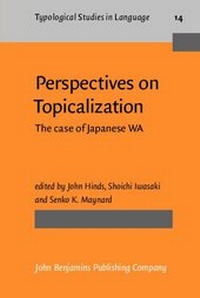
Perspectives on Topicalization
The case of Japanese <i>wa</i>
1st Edition
Published on 1. January 1987
XI, 307 pages
978-90-272-7881-4 (ISBN)
Description

Within the field of Japanese linguistics, few areas have generated as much controversy as the morpheme wa; traditionally described as a marker of old or contrasted information, its function as a discourse marker has also been studied. This work aims to deepen the understanding of wa through careful examination of the particle at both sentence and discourse levels in old Japanese as well as present-day Japanese. Previous studies have concentrated on syntactic analyses of wa. The contributors to this volume challenge the old approach and uncover new properties of wa. The four topics discussed are: wa in Narrative and Expository Discourse; wa and other Syntactic Phenomena; Historical Perspectives on wa and Pragmatic Perspectives on wa.
More details
Other editions
Additional editions
John Hinds | Shoichi Iwasaki | Senko K. Maynard
Perspectives on Topicalization
The case of Japanese wa
Book
01/1987
John Benjamins Publishing Co
€132.50
Shipment within 10-15 days
Content
- PERSPECTIVES ON TOPICALIZATION THE CASE OF JAPANESE WA
- Editorial page
- Title page
- Copyright page
- Table of contents
- PREFACE
- REFERENCES
- PART I: WA IN NARRATIVE AND EXPOSITORY DISCOURSE
- THE USE OF WA AS A COHESION MARKER IN JAPANESE ORAL NARRATIVES
- I. WA AS A GLOBAL COHESIVE DEVICE: "THEMATIC" WA-MARKING
- A. Wa's Position in the Paradigmatic Referential Progression
- B. Correlation Between Wa-Marking and Thematic Status
- 1) Wa and Character Prominence in the Cartoon Input
- 2) Wa and Character Persistence
- 3) Wa and Zero Switch Reference
- C. Loss of Thematic Status
- 1) Repeated Wa-Marking without Interference
- 2) Reversion from Wa to Ga
- D. Conclusions on Thematic Wa
- II. WAAS A LOCAL COHESIVE DEVICE: "CONTRASTIVE" WA-MARKING
- A. Parallel Activities/States
- B. Action/State Reaction
- C. Indirect Contrast Marking (Without Subject Switch)
- D. Re-Evaluation of "Thematic" Wa Patterns
- III. CONCLUSIONS
- NOTES
- REFERENCES
- THEMATIZATION AS A STAGING DEVICE IN THE JAPANESE NARRATIVE
- NOTES
- REFERENCES
- THEMATIZATION, ASSUMED FAMILIARITY, STAGING, AND SYNTACTIC BINDING IN JAPANESE1
- NOTES
- REFERENCES
- IDENTIFIABILITY, SCOPE-SETTING, AND THE PARTICLE WA: A STUDY OF JAPANESE SPOKEN EXPOSITORY DISCOURSE
- 1. DATA
- 2. DISCUSSION
- 2.1. Pragmatic Status of the wa marked phrase
- 2.1.1. Identifiability
- 2.1.2. Identifiability through anaphoricity
- 2.1.3. Identifiability through "frame
- 2.1.4. Identifiability of type III phrase
- 2.1.5. Summary.
- 2.2. Function of wa marked phrase
- 2.2.1. The scope-setting function.
- 2.2.2. Multi-predication
- 2.2.3. Summary.
- 3. CONCLUSION
- NOTES
- REFERENCES
- A STUDY OF THE SO-CALLED TOPIC WA IN PASSAGESFROM TOLSTOI, LAWRENCE, AND FAULKNER(OF COURSE, IN JAPANESE TRANSLATION)
- 1. In lieu of an introduction and a conclusion.
- NOTES
- REFERENCES
- PART II: WA AND OTHER SYNTACTIC PHENOMENA
- THE ROLE OF WA IN NEGATION
- 1. Introduction
- 2. Wa-marked vs. Non-wa-marked Negation
- 3. Wa and the Interpretation of Negative Sentences
- 4. The Position of Wa and the Interpretation of Negation
- 5. Summary
- NOTES
- REFERENCES
- WA AND THE WH PHRASE
- 1. Wa and the WH Phrase
- 1.1. Conditions on the occurrence of WH wa
- 1.2. Wa as "Set Anaphoric
- 1.3. Content of the Shared Set
- 2. Non-WH Phrase and Wa
- 2.1.Contrastive Wa
- 2.2. Thematic wa
- 2.3. Definite and Indefinite NPs with wa
- 2.4. Set-Contrast
- 3. On ga
- 3.1. Ga as Creater of Sets
- 3.2. The Source of "Descriptive" and "Exhaustive-Listing" Interpretations
- 3.3. On wa and ga
- 4. Summary and Discussion
- NOTES
- REFERENCES
- PART III: HISTORICAL PERSPECTIVES ON WA
- FUNCTIONSOF THE THEME MARKER WA FROM SYNCHRONIC AND DIACHRONIC PERSPECTIVES
- Introduction
- PART I: FUNCTIONS OF WA IN ITS SYNCHRONIC STAGE
- 1. Background discussion
- 2. Discourse functions of wa
- 2.1. Theme/frame on the level of discourse
- 2.2. Theme creation, theme maintenance and theme retrieval
- 2.3. Alternation between NP wa and NP ga
- 2.4. Themes on the sentence/clause level
- 2.5. Summary of part I
- PART II: HISTORICAL DEVELOPMENT OF THE PARTICLE
- 1. Examination of Taketori Monogatari "The Woodcutters Tale
- 2. The Study of Genji Monogatari "The Tale of Genji
- Conclusion
- NOTES
- REFERENCES
- WA IN DIACHRONIC PERSPECTIVE
- 1. Introduction
- 2. Typological and contrastive considerations
- 3. Origin and development of wa
- 3.1. Etymology
- 3.2. Pronunciation and orthography8
- 3.3. Function
- 4. The distribution and function of wa in MJ and OJ
- 5. Conclusion
- NOTES
- REFERENCES
- PART IV: PRAGMATIC PERSPECTIVES ON WA
- HOW RELEVANT IS A FUNCTIONAL NOTION OF COMMUNICATIVE ORIENTATION TO GA AND WA?
- NOTES
- REFERENCES
- ABBREVIATIONS
