

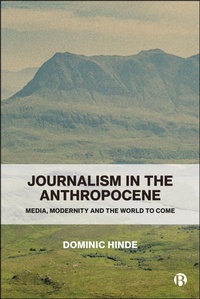
Journalism in the Anthropocene
Media, Modernity and the World to Come
1st Edition
Published on 26. February 2026
208 pages
978-1-5292-5673-4 (ISBN)
Description

What role does journalism play in shaping how we understand climate change and the planet we live on?
This thought-provoking book explores how media systems have helped construct our idea of the "human" Earth, from early nature reporting to today's digital climate dashboards. Drawing on insights from the humanities and social sciences, it offers a fresh look at how news, data and storytelling influence public thinking in the age of the Anthropocene.
Building on the work of influential thinkers, the book asks how journalism can evolve to meet the demands of a rapidly changing world.
This thought-provoking book explores how media systems have helped construct our idea of the "human" Earth, from early nature reporting to today's digital climate dashboards. Drawing on insights from the humanities and social sciences, it offers a fresh look at how news, data and storytelling influence public thinking in the age of the Anthropocene.
Building on the work of influential thinkers, the book asks how journalism can evolve to meet the demands of a rapidly changing world.
Reviews / Votes
'Much of our current approach to journalism was developed at the turn of the previous century, during the great age of industrialization and urbanization. As we deal with the environmental impact of the forces unleashed during that period, it's time we rethink what journalism is, and can be. Combining training and perspectives from Sociology, Science and Technology Studies, and Media, Dominic Hinde provides an excellent roadmap for this process.' Robert Gioielli, KTH Environmental Humanities Lab 'Blending sociology, urbanism and visual culture, Dominic Hinde deals with two interrelated crises: the future of journalism, and the future of the Anthropocene. He adroitly sets the scene, explores the necessary history and theory, and takes the reader through a series of rich case studies. Lucid, lively and highly original, it's essential reading for anyone concerned with our collective future, and how we want it represented.' Richard Williams, University of EdinburghMore details
Edition
First Edition
Language
English
Place of publication
Bristol
United Kingdom
Product notice
Reflowable
Illustrations
Not illustrated
File size
1,48 MB
ISBN-13
978-1-5292-5673-4 (9781529256734)
Copyright in bibliographic data and cover images is held by Nielsen Book Services Limited or by the publishers or by their respective licensors: all rights reserved.
Schweitzer Classification
Other editions
Additional editions
Book
02/2026
1st Edition
Bristol University Press
€25.00
Shipment within 3-4 weeks
Book
02/2026
1st Edition
Bristol University Press
€130.50
Shipment within 3-4 weeks
Person
Dominic Hinde is Lecturer in Sociology at the University of Glasgow, and a writer and foreign and environmental correspondent.
Content
Chapter 1: Journalism, modernity and the human
Chapter 2: The end of nature and the end of journalism
Chapter 3: The Anthropocene and the media
Chapter 4 Media hot and hotter
Chapter 5: Plotting the Anthropocene: Digital modernity and
charismatic data
Chapter 6 Reporting the climate city
Chapter 7: New times for journalism
Chapter 8 Resilience and the neverending shock of the present
Chapter 9 Media cosmopolitanism in the Anthropocene
Chapter 10: Global journalists in liquid worlds
Chapter 11: Journalism as eschatology and the world to come
Chapter 2: The end of nature and the end of journalism
Chapter 3: The Anthropocene and the media
Chapter 4 Media hot and hotter
Chapter 5: Plotting the Anthropocene: Digital modernity and
charismatic data
Chapter 6 Reporting the climate city
Chapter 7: New times for journalism
Chapter 8 Resilience and the neverending shock of the present
Chapter 9 Media cosmopolitanism in the Anthropocene
Chapter 10: Global journalists in liquid worlds
Chapter 11: Journalism as eschatology and the world to come
