

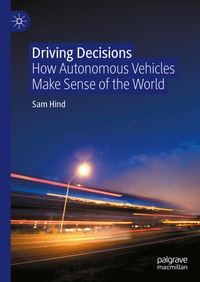
Driving Decisions
Description

Driving Decisions: How Autonomous Vehicles Make Sense of the World examines the phenomenon of autonomous driving, and the ongoing, complex, costly, and contentious quest to automate driving. Principally organized around the concept of algorithmic decision-making, the book considers how different mapping, sensing, and machine learning (ML)-dependent capabilities are gifted to autonomous vehicles through different kinds of technical work: from computer science students annotating visual data in industry-funded research centres to software engineers designing 'end-to-end' ML models at autonomous vehicle start-ups.
The book intends to complicate, and question, typical understandings of autonomous driving by going 'under the hood', challenging the technological determinism or 'decisionism' that advocates offer of an inevitable, fully automated, future. Drawing on seven years of research in a range of empirical contexts, the book will appeal to scholars and students in the fields of science and technology studies, media studies, digital sociology, human geography, and mobilities and transport studies.
Reviews / Votes
"Driving decisions is an insightful and timely examination of the world of autonomous vehicles. ... The book centers around the concept of algorithmic decision-making ... . The book is grounded in seven years of research and draws from diverse fields like media studies, science and technology studies (STS), and digital geography. Its strength lies in its methodical, behind-the-scenes look at how decisions are crafted--not made--by both humans and machines." (R. S. Chang, Computing Reviews, April 30, 2025)
More details
Other editions
Additional editions
Person
Sam Hind is a Lecturer in Digital Media and Culture at the University of Manchester, UK. He researches digital navigation, sensing, and automobility through the lens of algorithmic decision-making and AI. He has studied technological shifts in driving and automotive navigation for over 10 years, with a particular interest in how big tech companies have sought to disrupt the automotive industry.
Content
1. Introduction: The Making of Decisions and Technological Decisionism.- 2. Mapping Decisions: The Promise of Mapless-ness.- 3. Training Decisions: Ground-Truthing the Interesting.- 4. Sensing Decisions: Perceiving, Classifying, Finessing.- 5. Demonstrating Decisions: Waymo's World.- 6. Securing Decisions: Sovereignty and Semiconductors.- 7. Relaxing Decisions: Making Driving Chill.- 8. Resisting Decisions: Coneheads in California.
