

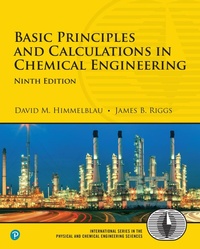
Basic Principles and Calculations in Chemical Engineering
9th Edition
Published on 22. August 2022
896 pages
978-0-13-732723-2 (ISBN)
Description

The #1 Guide to Chemical Engineering Principles, Techniques, Calculations, and Applications
Basic Principles and Calculations in Chemical Engineering, Ninth Edition, has been thoroughly revised, streamlined, and updated to reflect sweeping changes in the chemical engineering field. This introductory guide addresses the full scope of contemporary chemical, petroleum, and environmental engineering applications and contains extensive new coverage and examples related to biotech, nanotech, green/environmental engineering, and process safety, with many new MATLAB and Python problems throughout.
Authors David M. Himmelblau and James B. Riggs offer a strong foundation of skills and knowledge for successful study and practice, guiding students through formulating and solving material and energy balance problems, as well as describing gases, liquids, and vapors. Throughout, they introduce efficient, consistent, learner-friendly ways to solve problems, analyse data, and gain a conceptual, application-based understanding of modern processes.
This edition condenses coverage from previous editions to serve today's students and faculty more efficiently. In two entirely new chapters, the authors provide a comprehensive introduction to dynamic material and energy balances, as well as psychrometric charts.
Modular chapters designed to support introductory courses of any length
Introductions to unit conversions, basis selection, and process measurements
Strategies for solving diverse material and energy balance problems, including material balances with chemical reaction and for multi-unit processes, and energy balances with reaction
Clear introductions to key concepts ranging from stoichiometry to enthalpy
Coverage of ideal/real gases, multi-phase equilibria, unsteady-state material, humidity (psychrometric) charts, and more
Self-assessment questions to help readers identify areas they don't fully understand
Thought, discussion, and homework problems in every chapter
New biotech, bioengineering, nanotechnology, green/environmental engineering, and process safety coverage
Relevant new MATLAB and Python homework problems and projects
Extensive tables, charts, and glossaries in each chapter
Reference appendices presenting atomic weights and numbers, Pitzer Z^0/Z^1 factors, heats of formation and combustion, and more
Basic Principles and Calculations in Chemical Engineering, Ninth Edition, has been thoroughly revised, streamlined, and updated to reflect sweeping changes in the chemical engineering field. This introductory guide addresses the full scope of contemporary chemical, petroleum, and environmental engineering applications and contains extensive new coverage and examples related to biotech, nanotech, green/environmental engineering, and process safety, with many new MATLAB and Python problems throughout.
Authors David M. Himmelblau and James B. Riggs offer a strong foundation of skills and knowledge for successful study and practice, guiding students through formulating and solving material and energy balance problems, as well as describing gases, liquids, and vapors. Throughout, they introduce efficient, consistent, learner-friendly ways to solve problems, analyse data, and gain a conceptual, application-based understanding of modern processes.
This edition condenses coverage from previous editions to serve today's students and faculty more efficiently. In two entirely new chapters, the authors provide a comprehensive introduction to dynamic material and energy balances, as well as psychrometric charts.
Modular chapters designed to support introductory courses of any length
Introductions to unit conversions, basis selection, and process measurements
Strategies for solving diverse material and energy balance problems, including material balances with chemical reaction and for multi-unit processes, and energy balances with reaction
Clear introductions to key concepts ranging from stoichiometry to enthalpy
Coverage of ideal/real gases, multi-phase equilibria, unsteady-state material, humidity (psychrometric) charts, and more
Self-assessment questions to help readers identify areas they don't fully understand
Thought, discussion, and homework problems in every chapter
New biotech, bioengineering, nanotechnology, green/environmental engineering, and process safety coverage
Relevant new MATLAB and Python homework problems and projects
Extensive tables, charts, and glossaries in each chapter
Reference appendices presenting atomic weights and numbers, Pitzer Z^0/Z^1 factors, heats of formation and combustion, and more
More details
Series
Edition
9th edition
Language
English
Place of publication
Hoboken
United States
Publishing group
Pearson Education (US)
Target group
Professional and scholarly
File size
58,54 MB
ISBN-13
978-0-13-732723-2 (9780137327232)
Copyright in bibliographic data and cover images is held by Nielsen Book Services Limited or by the publishers or by their respective licensors: all rights reserved.
Schweitzer Classification
Other editions
Additional editions
David Himmelblau | David M. Himmelblau | James B. Riggs
Basic Principles and Calculations in Chemical Engineering
Book
09/2022
9th Edition
Pearson
€154.99
Shipment within 15-20 days
Previous edition
David Himmelblau | James Riggs
Basic Principles and Calculations in Chemical Engineering
E-Book
05/2012
8th Edition
Pearson
€149.99
Available for download
Persons
David M. Himmelblau was Paul D. and Betty Robertson Meek and American Petrofina Foundation Centennial Professor Emeritus in Chemical Engineering at the University of Texas, where he taught for forty-two years. He authored eleven books and more than two hundred articles on process analysis, fault detection, and optimization. He was president of the CACHE Corporation, and director of AIChE.
James B. Riggs was a university professor for thirty years. Twenty-five of those years were spent at Texas Tech University, where he founded and directed the Texas Tech Process Control and Optimization Consortium. He authored several popular textbooks, including Computational Methods for Engineers with MATLAB Applications, Thirteenth Edition; Programming with MATLAB for Engineers, Fourteenth Edition; and Chemical and Bio-Process Control, Fifth Edition.
James B. Riggs was a university professor for thirty years. Twenty-five of those years were spent at Texas Tech University, where he founded and directed the Texas Tech Process Control and Optimization Consortium. He authored several popular textbooks, including Computational Methods for Engineers with MATLAB Applications, Thirteenth Edition; Programming with MATLAB for Engineers, Fourteenth Edition; and Chemical and Bio-Process Control, Fifth Edition.
Content
Part I: Introduction
Chapter 1: Introduction to Chemical Engineering
Chapter 2: Introductory Concepts
Part II: Material Balances
Chapter 3: Material Balances
Chapter 4: Material Balances with Chemical Reaction
Chapter 5: Material Balances for Multiunit Processes
Part III: Gases, Vapors, and Liquids
Chapter 6: Ideal and Real Gases
Chapter 7: Multiphase Equilibrium
Part IV: Energy Balances
Chapter 8: Energy Balances without Reaction
Chapter 9: Energy Balances with Reaction
Part V: Combined Material and Energy Balances
Chapter 10: Humidity (Psychrometric) Charts
Chapter 11: Unsteady-State Material and Energy Balances
Chapter 12: Heats of Solution and Mixing
Chapter 13: Liquids and Gases in Equilibrium with Solids
Chapter 14: Solving Material and Energy Balances Using Process Simulators (Flowsheeting Codes)
Part VI: Supplementary Material--Appendixes
Appendix A: Atomic Weights and Numbers
Appendix B: Tables of the Pitzer Z^0 and Z^1 Factors
Appendix C: Heats of Formation and Combustion
Appendix D: Answers to Selected Problems
Chapter 1: Introduction to Chemical Engineering
Chapter 2: Introductory Concepts
Part II: Material Balances
Chapter 3: Material Balances
Chapter 4: Material Balances with Chemical Reaction
Chapter 5: Material Balances for Multiunit Processes
Part III: Gases, Vapors, and Liquids
Chapter 6: Ideal and Real Gases
Chapter 7: Multiphase Equilibrium
Part IV: Energy Balances
Chapter 8: Energy Balances without Reaction
Chapter 9: Energy Balances with Reaction
Part V: Combined Material and Energy Balances
Chapter 10: Humidity (Psychrometric) Charts
Chapter 11: Unsteady-State Material and Energy Balances
Chapter 12: Heats of Solution and Mixing
Chapter 13: Liquids and Gases in Equilibrium with Solids
Chapter 14: Solving Material and Energy Balances Using Process Simulators (Flowsheeting Codes)
Part VI: Supplementary Material--Appendixes
Appendix A: Atomic Weights and Numbers
Appendix B: Tables of the Pitzer Z^0 and Z^1 Factors
Appendix C: Heats of Formation and Combustion
Appendix D: Answers to Selected Problems
