

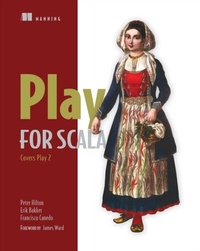
Play for Scala
Covers Play 2
1st Edition
Published on 3. October 2013
328 pages
978-1-63835-371-3 (ISBN)
Description

Summary
Play for Scala shows you how to build Scala-based web applications using the Play 2 framework. This book starts by introducing Play through a comprehensive overview example. Then, you'll look at each facet of a typical Play application both by exploring simple code snippets and by adding to a larger running example. Along the way, you'll deepen your knowledge of Scala as a programming language and work with tools like Akka.
About this Book
Play is a Scala web framework with built-in advantages: Scala's strong type system helps deliver bug-free code, and the Akka framework helps achieve hassle-free concurrency and peak performance. Play builds on the web's stateless nature for excellent scalability, and because it is event-based and nonblocking, you'll find it to be great for near real-time applications.
Play for Scala teaches you to build Scala-based web applications using Play 2. It gets you going with a comprehensive overview example. It then explores each facet of a typical Play application by walking through sample code snippets and adding features to a running example. Along the way, you'll deepen your knowledge of Scala and learn to work with tools like Akka.
Written for readers familiar with Scala and web-based application architectures. No knowledge of Play is assumed.
Purchase of the print book includes a free eBook in PDF, Kindle, and ePub formats from Manning Publications.
What's Inside
About the Authors
Peter Hiltonv, Erik Bakker, and Francisco Canedo, are engineers at Lunatech, a consultancy with Scala and Play expertise. They are contributors to the Play framework.
Table of Contents
Play for Scala shows you how to build Scala-based web applications using the Play 2 framework. This book starts by introducing Play through a comprehensive overview example. Then, you'll look at each facet of a typical Play application both by exploring simple code snippets and by adding to a larger running example. Along the way, you'll deepen your knowledge of Scala as a programming language and work with tools like Akka.
About this Book
Play is a Scala web framework with built-in advantages: Scala's strong type system helps deliver bug-free code, and the Akka framework helps achieve hassle-free concurrency and peak performance. Play builds on the web's stateless nature for excellent scalability, and because it is event-based and nonblocking, you'll find it to be great for near real-time applications.
Play for Scala teaches you to build Scala-based web applications using Play 2. It gets you going with a comprehensive overview example. It then explores each facet of a typical Play application by walking through sample code snippets and adding features to a running example. Along the way, you'll deepen your knowledge of Scala and learn to work with tools like Akka.
Written for readers familiar with Scala and web-based application architectures. No knowledge of Play is assumed.
Purchase of the print book includes a free eBook in PDF, Kindle, and ePub formats from Manning Publications.
What's Inside
- Intro to Play 2
- Play's MVC structure
- Mastering Scala templates and forms
- Persisting data and using web services
- Using Play's advanced features
About the Authors
Peter Hiltonv, Erik Bakker, and Francisco Canedo, are engineers at Lunatech, a consultancy with Scala and Play expertise. They are contributors to the Play framework.
Table of Contents
- Introduction to Play
- Your first Play application
- Deconstructing Play application architecture
- Defining the application's HTTP interface
- Storing data?the persistence layer
- Building a user interface with view templates
- Validating and processing input with the forms API
- Building a single-page JavaScript application with JSON
- Play and more
- Web services, iteratees, and WebSockets
More details
Other editions
Additional editions
Book
10/2013
Manning Publications
€47.00
Article exhausted; check different version
Persons
Peter Hilton is a senior solution architect at Lunatech Research in the Netherlands and a committer on the Play framework.
Erik Bakker, also at Lunatech, is a Play module contributor and regularly writes and presents about Play.
Erik Bakker, also at Lunatech, is a Play module contributor and regularly writes and presents about Play.
Content
- Intro
- Copyright
- Brief Table of Contents
- Table of Contents
- Foreword
- Preface
- Acknowledgments
- About this Book
- About the Cover Illustration
- Part 1. Getting started
- Chapter 1. Introduction to Play 2
- Chapter 2. Your first Play application
- Part 2. Core functionality
- Chapter 3. Deconstructing Play application architecture
- Chapter 4. Defining the application's HTTP interface
- Chapter 5. Storing data-the persistence layer
- Chapter 6. Building a user interface with view templates
- Chapter 7. Validating and processing input with the forms API
- Part 3. Advanced concepts
- Chapter 8. Building a single-page JavaScript application with JSON
- Chapter 9. Play and more
- Chapter 10. Web services, iteratees, and WebSockets
- Index
- List of Figures
- List of Tables
- List of Listings
