

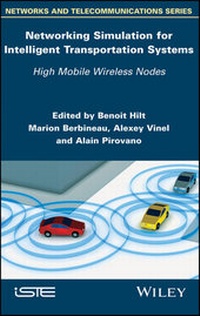
Networking Simulation for Intelligent Transportation Systems
Description

More details
Other editions
Additional editions
Persons
Benoit Hilt is Assistant Professor of computer networking at the University of Haute-Alsace, France. His current research focuses on high mobility wireless communication, realistic simulation in the ITS domain and cooperative communication for autonomous driving.
Marion Berbineau is Research Director at IFSTTAR, France in wireless communications for vehicular applications. Her research interests are mainly radio channel characterization and modeling, electromagnetic simulations, signal processing for telecommunications, performance evaluation at physical layers and GNSS applications.
Alexey Vinel is Full Professor in computer communications at Halmstad University, Sweden. His research interests include wireless communications and networking, cooperative intelligent transportation systems and autonomous driving.
Alain Pirovano is Professor at ENAC (French Civil Aviation University) and Head of the Communication Networks Research Group. His research activities focus on routine, reliable, and distributed systems particularly in the context of wireless ad hoc networks and aeronautical networks.
Content
Preface xi
Chapter 1 Simulation of Convergent Networks for Intelligent Transport Systems with VSimRTI 1
Robert PROTZMANN, Björn SCHÜNEMANN and Ilja RADUSCH
1.1 Introduction 1
1.2 Fundamentals of cooperative ITS 2
1.2.1 Message types 2
1.2.2 Application categories 3
1.2.3 Supporting facilities 4
1.3 Overall simulation framework 5
1.4 Simulation of cellular networks 6
1.4.1 Regions and cells 10
1.4.2 Delay models 11
1.4.3 PR-Model and PL-Model 12
1.4.4 Capacity Model 13
1.4.5 Topological and geographical messaging 14
1.5 Simulation study 14
1.5.1 Evaluation metrics 16
1.5.2 Simulation set-up 18
1.5.3 Simulation results 21
1.6 Conclusion 25
1.7 Bibliography 26
Chapter 2 Near-field Wireless Communications and their Role in Next Generation Transport Infrastructures: an Overview of Modelling Techniques 29
Christian PINEDO, Marina AGUADO, Lara RODRIGUEZ, Iñigo ADIN, Jaizki MENDIZABAL and Guillermo BISTUÉ
2.1 Near-field wireless technologies 30
2.1.1 Near-field versus far-field 30
2.1.2 Near-field-based technologies in transport 33
2.2 Characterization of near-field communications 36
2.2.1 Electrical models 37
2.2.2 Analysis of the mutual inductance of a squared inductive coupling 37
2.2.3 Computer-aided electromagnetic calculation 40
2.3 Discrete event simulators 42
2.3.1 Riverbed Modeler 43
2.3.2 OMNeT++ 44
2.3.3 ns-2 45
2.3.4 ns-3 45
2.3.5 Discrete event simulator comparison for near-field communication 46
2.4 Conclusions 47
2.5 Bibliography 48
Chapter 3 Trace Extraction for Mobility in Civil Aeronautical Communication Networks Simulation 51
Fabien GARCIA and Mickaël ROYER
3.1 Traffic regulations 52
3.1.1 General airspace 52
3.1.2 North Atlantic airspace 53
3.2 Mobility for network simulation 54
3.2.1 Types of mobility models for AANETs 54
3.2.2 Comparison of mobility model types 55
3.3 Example of mobility trace extraction 56
3.3.1 Extraction of information 57
3.3.2 Traces filtering 57
3.3.3 Enhancing traces 58
3.4 Toward cooperative trajectories 60
3.5 Bibliography 60
Chapter 4 Air-Ground Data Link Communications in Air Transport 61
Christophe GUERBER, Alain PIROVANO and José RADZIK
4.1 Introduction 61
4.1.1 Context 61
4.1.2 OMNeT++ 63
4.2 Continental air-ground data link communications and VDL mode 2 63
4.2.1 Communication system 63
4.2.2 Dimensioning parameters and bottlenecks 65
4.2.3 Simulation model 67
4.2.4 Analysis of simulation results 69
4.3 Oceanic air-ground data link communications and AMS(R)S 71
4.3.1 The aeronautical mobile satellite (route) service and Classic Aero 71
4.3.2 Dimensioning parameters and bottlenecks 73
4.3.3 Simulation model 74
4.3.4 Analysis of simulation results 75
4.4 Summary and further work 76
4.5 Bibliography 77
Chapter 5 A Virtual Laboratory as an Assessment Tool for Wireless Technologies in Railway Systems 79
Patrick SONDI, Eric RAMAT and Marion BERBINEAU
5.1 Introduction 80
5.2 ERTMS subsystems and related test beds 81
5.2.1 The functional subsystem of the ERTMS 81
5.2.2 The telecommunication subsystem of the ERTMS 84
5.3 A virtual laboratory based on co-simulation for ERTMS evaluation 86
5.3.1 Why a co-simulation approach? 86
5.3.2 Which data and processes must be modeled in each simulator? 87
5.3.3 Overall architecture of the ERTMS-OPNET virtual laboratory 89
5.3.4 Synchronization modes 90
5.3.5 Virtual laboratory implementations in the ERTMS simulator 92
5.3.6 Virtual laboratory implementations in OPNET 93
5.3.7 Virtual laboratory implementations in the co-simulation manager 95
5.4 Effective use of the ERTMS-OPNET virtual laboratory 97
5.4.1 A co-simulation scenario with the ERTMS-OPNET virtual laboratory 97
5.4.2 Efficiency of the co-simulation approach in the evaluation of railway systems 101
5.5 Conclusion 104
5.6 Bibliography 105
Chapter 6 Emulating a Realistic VANET Channel in Ns-3 107
Hervé BOEGLEN, Benoit HILT and Frédéric DROUHIN
6.1 Introduction 107
6.2 Influence of the channel propagation model on VANET simulation 107
6.2.1 A realistic IEEE802.11 PHY layer 108
6.2.2 Accurate VANET channel propagation modeling 109
6.3 A way to realistic channel modeling with ns-2 112
6.4 Realistic channel modeling with ns-3 114
6.4.1 The Yans WiFi model 114
6.4.2 The Physim Wi-Fi model emulating OFDM-based transmission 115
6.4.3 Data transmission at ns-3 PHY level 116
6.4.4 The internals of WiFi channel modeling 117
6.5 Case studies: emulation of realistic VANET channel models in ns-3 117
6.5.1 A simplified VANET channel model for an urban environment 118
6.5.2 A normalized VANET channel model for urban environments 121
6.6 Conclusion and discussion 123
6.7 Appendix A: The Abbas et al Model Implementation 125
6.8 Bibliography 130
Chapter 7 CONVAS: Connected Vehicle Assessment System for Realistic Co-simulation of Traffic and Communications 133
Justinian ROSCA, Ines UGALDE, Praprut SONGCHITRUKSA and Srinivasa SUNKARI
7.1 Introduction 133
7.2 Related work 135
7.3 CONVAS co-simulation platform 138
7.4 Realistic DSRC channel models 139
7.4.1 CONVAS propagation models 141
7.4.2 Model tuning based on real-world data 142
7.5 Channel model tuning 143
7.5.1 Michigan safety pilot model deployment data 143
7.5.2 Estimation of PDR 144
7.5.3 Model tuning 146
7.6 Connected vehicle applications 149
7.6.1 Intelligent dilemma zone avoidance 149
7.6.2 IDZA implementation in CONVAS 150
7.6.3 IDZA performance criteria 151
7.7 Experimental results 151
7.7.1 CONVAS setup 151
7.7.2 Co-simulation results 152
7.8 Conclusions 159
7.9 Acknowledgments 160
7.10 Bibliography 161
Chapter 8 Highway Road Traffic Modeling for ITS Simulation 165
Marco GRAMAGLIA, Marco FIORE, Maria CALDERON, Oscar TRULLOLS-CRUCES and Diala NABOULSI
8.1 Introduction 165
8.2 Road traffic models 166
8.2.1 Traffic input feeds 168
8.2.2 Mobility models 169
8.3 Fine-tuned measurement-based model 170
8.4 Comparative analysis of road traffic models 174
8.4.1 Case study scenarios 174
8.4.2 Connectivity metrics 175
8.4.3 Results 176
8.5 Fundamental properties of highway vehicular networks 178
8.6 Discussion and conclusions 181
8.7 Bibliography 182
Chapter 9 F-ETX: A Metric Designed for Vehicular Networks 185
Sébastien BINDEL, Benoit HILT and Serge CHAUMETTE
9.1 Introduction 185
9.2 Link quality estimators 187
9.2.1 Hardware-based LQE 188
9.2.2 Software-based 189
9.2.3 Discussion 190
9.3 Analysis of legacy estimation techniques 190
9.3.1 Type of window 191
9.3.2 Window analysis 193
9.4 The F-ETX metric 195
9.4.1 Window management algorithms 195
9.4.2 Multi-assessment approach 197
9.4.3 Routing integration framework 199
9.5 Simulation settings 201
9.5.1 First scenario 202
9.5.2 Second scenario 202
9.6 Simulation results 202
9.6.1 Performance of the multi-estimators 203
9.6.2 Performance of routing protocols 206
9.7 Conclusion 208
9.8 Bibliography 209
Chapter 10 Autonomic Computing and VANETs: Simulation of a QoS-based Communication Model 211
Nader MBAREK, Wahabou ABDOU and Benoît DARTIES
10.1 Introduction 211
10.2 Autonomic Computing within VANETs 212
10.2.1 Autonomic Computing 212
10.2.2 Autonomic vehicular communications 213
10.3 Broadcasting protocols for VANETs 213
10.3.1 Deterministic methods 215
10.3.2 Stochastic methods 216
10.4 Autonomic broadcasting within VANETs 218
10.4.1 Optimization of broadcasting protocols in VANETs 218
10.4.2 Self-management architecture 219
10.4.3 QoS-based broadcasting 221
10.5 Simulation of a QoS-based communication model 222
10.5.1 ADM: autonomic dissemination method 222
10.5.2 Simulation environment 228
10.5.3 Performance evaluation 229
10.6 Conclusion 231
10.7 Bibliography 232
List of Authors 235
Index 239
1
Simulation of Convergent Networks for Intelligent Transport Systems with VSimRTI
1.1. Introduction
For the realization of Intelligent Transportation Systems (ITS), ad hoc networks based on IEEE 802.11p have a long history in research. This technology envisions a decentralized information exchange between mobile vehicles, and also with stationary roadside stations to enable communication with central stations in the public data network (i.e. the Internet). This approach offers several advantages such as the direct exploitation of the broadcast characteristics of the radio channel, which is useful for short message broadcasting in the vehicle's vicinity. However, scalability is a big challenge in this approach, due to a limited communication range and a lack of deterministic quality of service (QoS). With the new generations of cellular networks (mobile phone networks), these drawbacks of vehicular ad hoc networks could be overcome. Cellular networks, e.g. 5G, are emerging as a capable solution not only for mobile Internet services, but also for ITS-specific traffic safety and efficiency matters. Cellular networks exhibit the major advantage of a nearly unlimited communication range, due to their architecture, with only a short wireless part between the mobile device and the base station, and the wired part through the backbone. However, this architecture introduces a particular delay overhead, which makes meeting the strong requirements of many safety applications questionable. A solution could be an intelligent combination of vehicular ad hoc networks and cellular networks to link the advantages of both approaches.
The multi-aspect simulation environment VSimRTI [SCH 11] is a comprehensive framework that connects various simulation tools together to cover all aspects needed for a proper evaluation of new cooperative mobility solutions for Intelligent Transportation Systems (ITS). Vehicle movements and sophisticated communication technologies can be modeled in detail. VSimRTI couples different simulators to allow for the simulation of various aspects of future ITS. In the following sections, we describe how we have extended the VSimRTI architecture to enable the simulation of cellular networks. Consequently, we have developed the novel cellular communication simulator VSimRTI_Cell that introduces a grade of abstraction of cellular networks. The developed simulation tool is lightweight and fast enough for larger scale scenarios. However, particularly from the vehicular application perspective, the simulator models important features which are not considered in other related frameworks [PRO 14a, PRO 14b]. Moreover, the new extended VSimRTI architecture not only allows for the analysis of vehicle networks based on cellular communication, but also novel hybrid solutions that combine ad hoc and cellular communication in an intelligent way.
This chapter is structured as follows. In section 1.2, we resume the fundamentals of the system of cooperative vehicles, such as message types, application categories and the specific concept of facilities. Then, section 1.4 introduces the new cellular simulator VSimRTI_Cell in closer detail. In section 1.5, we perform a short simulation study on generic safety and efficiency applications to present the individual advantages of ad hoc and cellular communication as well as a hybrid approach in converging networks in the context of ITS. Finally, section 1.6 concludes this chapter.
1.2. Fundamentals of cooperative ITS
1.2.1. Message types
The information exchange in ad hoc networks among vehicles, and among vehicles and infrastructure units is standardized to guarantee interoperability. The two most important message types are the Cooperative Awareness Message (CAM) [ETS 14a] and the Decentralized Environmental Notification Message (DENM) [ETS 14b].
Cooperative Awareness Messages (CAMs) are distributed within the ad hoc network, and provide information of presence, position and the basic status of a vehicle to neighboring vehicles that are located within a single-hop distance. Vehicles generate, send and receive CAMs, as long as they participate in the ad hoc network. By receiving CAMs, vehicles are aware of other vehicles in their vicinity and are informed about their positions, movements, basic attributes and basic sensor information. CAMs are generated and sent by a vehicle periodically.
Decentralized Environmental Notification Messages (DENMs) are used to alert road users to a detected dangerous situation, e.g. a hazardous location, roadworks or a risk of collision with another vehicle. In general, the processing procedure of sending a DENM is as follows: after the detection of a dangerous event, the vehicle immediately broadcasts a DENM to other vehicles which are concerned by the event and are located within the same geographical area. The transmission of the DENM is repeated with a certain frequency and persists as long as the event is present. According to the type of event detected, the DENM is relayed by other vehicles. The termination of the repeated DENM broadcasting is either achieved automatically once the event disappears, after a predefined expiry time, or by a vehicle that generates a special DENM to communicate that the event has disappeared. A vehicle, which receives a DENM, processes the information and, if the information in the DENM is relevant for the driver, it presents an appropriate warning or information on the vehicle's HMI (Human Machine Interface).
1.2.2. Application categories
Enhancing vehicle safety and improving traffic efficiency are the two most important aims of vehicular networks. Moreover, communication capabilities in vehicles also allows popular digital services to be provided to the users. The ETSI [ETS 09, ETS 10] and the Car2Car Communication Consortium Manifesto [CAR 07] define several scenarios and use cases for these objectives. The following section gives a brief overview of how vehicular networks are used to share information to advance vehicle safety, increase traffic efficiency or enable comfort applications.
1.2.2.1. Traffic safety applications
Vehicular safety applications are characterized, in general, by vehicular communication which is used to mitigate the occurrence of dangerous situations and accidents. Applications, installed in a vehicle, monitor the vehicle's state and the activities of the driver. Relevant pieces of information are transmitted after a relevance check to vehicles in the vicinity. For example, information about the position and speed of a vehicle via CAM or about dangerous locations on the roadway is transmitted via DENM. The received information is used by the safety applications in the vehicle to either inform the vehicle driver or automatically optimize the safety systems for the best possible reaction to a dangerous situation [SCH 11].
For improved vehicle safety, a Cooperative Awareness (CA) application and a Road Hazard Warning (RHW) application are specified. The CA application warns a vehicle driver if an emergency vehicle, a motorcycle, or a slow driving vehicle is approaching or if a vehicle runs the risk of a collision at an intersection. This application uses the information of the periodically broadcast CAMs for its detections. The RHW application informs drivers about hazardous locations in their close vicinity, e.g. about vehicles driving in the wrong direction, about accidents, roadworks or signal violations. Here, DENMs are used to disseminate information about the dangerous situations.
1.2.2.2. Traffic efficiency applications
By exchanging traffic-related information among vehicles and traffic infrastructure units, vehicular traffic efficiency applications improve the efficiency of the transportation network. The received information is analyzed and used, for example, to inform the driver about delays to be expected and to optimize the vehicle's speed and route depending on the traffic conditions [SCH 11].
For an improvement in traffic efficiency, the basic set of applications defined by the ETSI [ETS 10] proposes a Cooperative Speed Management (CSM) application and a Cooperative Navigation (CoNa) application. The CSM application aims to optimize the vehicle's speed for a better traffic flow. Thus, the application provides either regulatory speed limit information or transmits information necessary for an optimal speed calculation by vehicles at specific road segments or at intersections. Thus, a vehicle can optimize, for example, its speed to reach a traffic light system during the green signal phase. The CoNa application provides services and information, e.g. about the current traffic situation, to allow the vehicles to optimize their travel routes. This application offers a recommended itinerary based on traffic information, enhanced route guidance and navigation, as well as a limited access warning and detour notification.
1.2.2.3. Comfort applications
Comfort or infotainment applications are not directly related to the vehicles' mobility, but are part of today's digital lifestyle. This group includes applications like e-mailing, browsing or media streaming. An important aspect of this group is that these applications do not necessarily rely on cooperative M2M information exchange. They are mostly realized on an individual basis and should be evaluated individually. Hence, the evaluation in the later sections will not consider these applications.
