

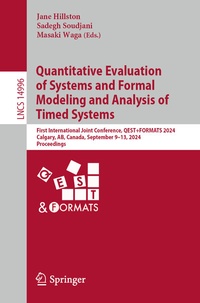
Quantitative Evaluation of Systems and Formal Modeling and Analysis of Timed Systems
Description

This book constitutes the proceedings of the First International Joint Conference on Quantitative Evaluation of Systems and Formal Modeling and Analysis of Timed Systems, QEST+Formats 2024, which took place in Calgary, AB, Canada, during September 2024. This year the 21th International Conference on Quantitative Evaluation of SysTems (QEST 2024) and the 22nd International Conference on Formal Modeling and Analysis of Timed Systems (FORMATS 2024) joint forces and took place as part of the CONFEST 2024 umbrella conference.
The 19 full papers presented in this book were carefully reviewed and selected from 33 submissions. They deal with up-to-date topics in quantitative evaluation and verification of systems, focusing on fundamental and practical aspects of systems with quantitative nature, such as probability, timing, and cost, and modeling, design and analysis of computational systems.
More details
Other editions
Additional editions
Content
- Intro
- Preface
- Organization
- Compositional Verification and Run-time Monitoring for Learning-Enabled Autonomous Systems - CONFEST 2024 (ABSTRACT OF THE INVITED TALK)
- Contents
- Certificates and Witnesses for Multi-objective Queries in Markov Decision Processes
- 1 Introduction
- 2 Preliminaries
- 3 Certificates and Witnesses for ReachInv-Queries
- 3.1 Farkas Certificates and Witnesses for Reach-Queries
- 3.2 Transferring Witnesses
- 4 Certificates and Witnesses for Metapost-Queries
- 5 Experiments
- 6 Conclusion
- References
- Diagnosis of Stochastic Systems: Optimising Costs and Delays
- 1 Introduction
- 2 Preliminaries
- 2.1 Probabilistic Labelled Transition System
- 2.2 Partial Observation and Ambiguity
- 2.3 Fault and Diagnosis
- 2.4 Diagnosability Under a Given Static Mask
- 2.5 Cost and Latency of Diagnosis
- 3 Optimising Static Diagnosis
- 3.1 Reducing Costs
- 3.2 Computing the Latency of S-FF-Diagnosis
- 4 Dynamic Diagnosis
- 5 Conclusion
- References
- A Framework for Optimisation Based Stochastic Process Discovery
- 1 Introduction
- 1.1 Related Work
- 2 Preliminaries
- 3 Method
- 3.1 Computation of Trace Probability of a Stochastic WN
- 3.2 Measuring the Distance Between Two Stochastic Languages
- 3.3 Weight Optimization
- 3.4 Execution Time
- 4 Results
- 5 Conclusion
- References
- QuADTool: Attack-Defense-Tree Synthesis, Analysis and Bridge to Verification
- 1 Introduction
- 2 Attack-Defense Trees
- 3 Tool Overview
- 3.1 Model Construction
- 3.2 ATBEST Benchmark Collection for Attack-Defense Trees
- 3.3 Obtaining PAC-Quantities for Attack-Defense Trees
- 3.4 Analyses
- 4 PAC-Quantitative ADT: Fighting the Uncertainty
- 4.1 Quantitative ADT and PAC-Quantitative ADT
- 4.2 PAC-Input Extension of Bottom-Up Analyses
- 4.3 Analysis Example
- 5 Experiments
- 6 Conclusion and Future Work
- A Quantitative Bottom-Up Analyses for Cost and Delays
- B Conversion Times
- References
- Adaption of Stochastic Models (ASMo) - A Tool for Input Modeling -
- 1 Introduction
- 2 Tool Structure
- 2.1 Module Structure
- 2.2 Graphical User Interface
- 3 Data Traces
- 4 Distributions
- 4.1 Standard Distributions
- 4.2 Mixture Distributions
- 4.3 Phase-Type Distributions
- 5 Examples
- 5.1 Fitting of Mixture Distributions
- 5.2 Fitting of Network Traces
- 6 Conclusion
- References
- Approximation of Cumulative Distribution Functions by Bernstein Phase-Type Distributions
- 1 Introduction
- 2 Background
- 2.1 Bernstein Polynomials
- 2.2 Bernstein Exponentials
- 2.3 Phase-Type Distributions
- 3 Approximation of Cumulative Density Functions by Bernstein Phase-Type Distributions
- 4 Stochastically Smaller and Larger Approximation
- 5 Numerical Investigations
- 6 Conclusions
- References
- On Parametric DBMs and Their Applications to Time Petri Nets
- 1 Introduction
- 2 Definitions
- 2.1 Preliminaries
- 2.2 Tropical Semi-ring
- 2.3 Parametric Time Petri Nets
- 2.4 Parametric Reachability Problems
- 2.5 Parametric State Classes
- 2.6 An Efficient State Class Successor for TPNs
- 3 Tropical PDBM
- 3.1 Reachability Algorithm
- 3.2 Successor Operator
- 3.3 Inclusion
- 3.4 Splitting and Classical PDBMs
- 4 Case Studies
- 4.1 Fischer's Mutual-Exclusion Protocol
- 4.2 Level Crossing
- 4.3 Producerconsumer
- 4.4 Discussion
- 5 Conclusion
- A Proposition 2
- B Proposition 3
- C Proposition 5
- D Models for the Experiments
- References
- Dissimilarity for Linear Dynamical Systems
- 1 Introduction
- 2 Preliminaries and Notation
- 3 Backward Dissimilarity
- 4 Computation of Backward Dissimilarity
- 5 Related Work
- 6 Applications: The Thermostat Case Study
- 7 Experimental Comparison with LCS Bisimulation
- 8 Conclusion
- References
- MMLT/ik: Efficiently Learning Mealy Machines with Local Timers by Using Imprecise Symbol Filters
- 1 Introduction
- 2 Related Work
- 3 Preliminaries
- 3.1 Mealy Machines with Local Timers
- 3.2 Learning MMLTs
- 4 Symbol Filters for MMLTs
- 5 The MMLT/ik Method
- 5.1 Transition Output Validation
- 5.2 Extended Timed Counterexample Analysis
- 5.3 Silent-Change Search
- 5.4 Savings Potential
- 6 Practical Evaluation
- 7 Conclusion and Future Work
- References
- An Expressive Timed Modal Mu-Calculus for Timed Automata
- 1 Introduction
- 2 Timed Automata
- 2.1 Clocks, Clock Constraints and Clock Valuations
- 2.2 Syntax of Timed Automata
- 2.3 Semantics of Timed Automata
- 3 Timed Modal Mu-Calculi
- 3.1 Timed Modal Mu-Calculus Lrel,
- 3.2 Other Timed Modal Mu-Calculi
- 3.3 Mu-Calculus Expressiveness Results
- 4 Timed Computation Tree Logic (TCTL)
- 4.1 Syntax of TCTL
- 4.2 Semantics of TCTL
- 5 TCTL Expressiveness Results
- 5.1 TCTL# L,, TCTL# T
- 5.2 TCTLLrel,
- 6 Conclusion and Directions for Future Work
- References
- Efficiently Computable Distance-Based Robustness for a Practical Fragment of STL
- 1 Introduction
- 2 Preliminaries
- 2.1 Boolean Signals
- 2.2 Signal Temporal Logic
- 3 The Distance d
- 3.1 Algorithm to Compute d Efficiently
- 4 Distance-Based Temporal Robustness
- 4.1 Hardness of Computing
- 4.2 A Tractable Fragment of STL
- 5 Related Work
- 6 Conclusion
- References
- Rare-Event Guided Analysis of Infinite-State Chemical Reaction Networks
- 1 Introduction
- 1.1 Related Work
- 2 Background
- 2.1 Chemical Reaction Networks
- 2.2 Probabilistic Guarded Command Language
- 3 Methods
- 3.1 Generating K-Bounded Constraints
- 3.2 Probabilistic Program Conforming to K-Bounded Constraints
- 4 Experiments
- A Appendix A
- References
- Transient Evaluation of Non-Markovian Models by Stochastic State Classes and Simulation
- 1 Introduction
- 2 Background
- 2.1 Stochastic Time Petri Nets
- 2.2 Transient Evaluation by the Method of Stochastic State Classes
- 2.3 Monte Carlo Simulation and Importance Sampling
- 3 Switch from Stochastic State Classes to Simulation
- 3.1 Approach Overview
- 3.2 Conditioning Stochastic State Classes on Fired Transition
- 3.3 Sampling Methods
- 4 Collecting Results and Obtaining Confidence Intervals
- 5 Experimental Evaluation
- 5.1 Four Overlapping Activities
- 5.2 Repairable Dynamic Fault Tree
- 6 Conclusion
- A Stochastic Time Petri Net of Dynamic Fault Tree
- B Implementation Details of Sampling Methods
- References
- Probabilistic Loop Synthesis from Sequences of Moments
- 1 Introduction
- 2 Related Work
- 3 Preliminaries
- 4 Synthesis Algorithm
- 4.1 Programming Model
- 4.2 Specification
- 4.3 Matching the Means
- 4.4 Matching the (Co-)variances
- 4.5 Matching Third Mixed Moments
- 4.6 Random Variable Construction
- 5 Case Studies
- 5.1 Improving Moment-Matching for Loops
- 5.2 Reconstructing Loops from Moments
- 5.3 Specification from Data
- 6 Discussion and Conclusion
- References
- IMPaCT: Interval MDP Parallel Construction for Controller Synthesis of Large-Scale STochastic Systems
- 1 Introduction
- 1.1 Original Contributions
- 1.2 Related Literature
- 1.3 Overview of IMPaCT
- 2 Discrete-Time Stochastic Control Systems
- 3 Interval Markov Decision Processes
- 3.1 Complexity Analysis for Serial Construction of IMDP
- 3.2 Temporal Logic Specifications
- 4 Parallel Construction of IMDP
- 4.1 Complexity Analysis for Parallel Construction of IMDP
- 4.2 Low-Cost Abstraction
- 5 Controller Synthesis with Interval Iteration
- 6 Parallel Controller Synthesis with Interval Iteration
- 7 Loading and Saving Files
- 8 Benchmarking and Case Studies
- 8.1 Comparisons
- 9 Conclusion
- References
- Controller Synthesis in Timed Büchi Automata: Robustness and Punctual Guards
- 1 Introduction
- 2 Partial Robustness Semantics
- 3 Preliminaries
- 4 Robustness of a Finite Path
- 5 Robustness of an Infinite Path
- 6 Slicing Regions
- 7 Proof of Theorem 8
- 8 Conclusion
- References
- A Floyd-Warshall Approach to Value Computation in Markov Decision Processes
- 1 Introduction
- 2 Framework and Notations
- 3 Floyd-Warshall Path Integrator
- 3.1 Weighted Automata and Path Integrals
- 3.2 Floyd-Warshall Recursion
- 3.3 Expected Discounted Reward as an Integral over Paths
- 4 Progressive Floyd-Warshall Integration
- 4.1 A Progressive Algorithm
- 4.2 Approximation by Early Stopping
- 5 Case Study
- 6 Conclusion
- References
- Multi-agent Path Finding for Timed Tasks Using Evolutionary Games
- 1 Introduction
- 2 Preliminaries
- 3 Reward Shaping for Timed Multi-agent Reach-Avoid Problems
- 4 Policy Optimization
- 4.1 Algorithmic Framework Using Evolutionary Game Theory
- 5 Experiments and Results
- 5.1 Results and Discussion
- 6 Related Work
- 7 Conclusion
- References
- What is Your Discount Factor?
- 1 Introduction
- 2 Related Work
- 3 Problem Definition
- 4 Optimal Policy Regions
- 5 Computing Discount Factor Ranges
- 5.1 Approach Using Root Isolation
- 6 Near-Optimal Policy Regions
- 7 Eliciting Discount Factor for Varying Environments
- 8 Conclusion
- References
- Author Index
