

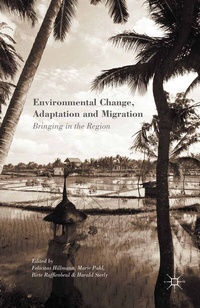
Environmental Change, Adaptation and Migration
Bringing in the Region
Published on 22. September 2015
XX, 299 pages
978-1-137-53891-8 (ISBN)
Description

The contributors present empirical and theoretical insights on current debates on environmental change, adaptation and migration. While focusing on countries subject to environmental degradation, it calls for a regional perspective that recognises local actors and a systematic link between development studies and migration research.
Reviews / Votes
"This book contributes to the literature about environmental change by framing migration as an important and relevant climate change adaptation strategy. . This book also highlights positive aspects of climate change and environmental change induced migration. . This book takes a special place in the literature: unlike other books dedicated to the environment-migration nexus, it is not only about post-disaster mobility, but allows for a more sophisticated and diversified definition of climate change impacts on population dynamics." (Karin Ingold, TESG - Tijdschrift voor Economische en Sociale Geografie, July, 2017)"The presentation allows learning relatively easy the basic techniques of modeling by those coming to the subject for the first time. This effect is achieved by keeping notations as elementary as possible. It is addressed to interdisciplinary graduate/undergraduate students and to interdisciplinary young researchers. Some chapters are available to Bachelor students who have passed introductory courses in algebra, calculus, and probability." (Tadeusz Aleksander Radzik and Krzysztof Józef Szajowski, Mathematica Applicanda, Vol. 45 (2), 2017)
More details
Other editions
Additional editions
Felicitas Hillmann | Marie Pahl | Birte Rafflenbeul
Environmental Change, Adaptation and Migration
Bringing in the Region
Book
09/2015
Palgrave Macmillan
€106.99
Shipment within 10-20 days
Persons
Felicitas Hillmann
is Professor at the Technische Universität Berlin, Germany, and leads the research unit "Regeneration of Cities" at the Leibniz Institute for Regional Development and Structural Planning in Erkner. She is Head of the Migration Unit for the project 'New regional formations: rapid environmental change and migration'. She has published in the field of international migration, migrant entrepreneurship and urban transformation.
Marie Pahl is a researcher in the 'Megacities-Megachallenge. Informal Dynamics of Global Change' programme at the University of Cologne, Germany. Her research investigates the competition for high-skilled migrants in Chinese city with a focus on urban transformation.
Birte Rafflenbeul is a researcher in the 'Megacities-Megachallenge. Informal Dynamics of Global Change' programme and a research associate at the University of Cologne. She conducts research on highly-skilled international migration and its impact on urban development in Guangzhou, China.
Harald Sterly is Scientific Coordinator of the research programme 'Megacities-Megachallenge. Informal Dynamics of Global Change' at the University of Cologne. Current research interests include translocality and social change in South Asia and Western Africa.
Marie Pahl is a researcher in the 'Megacities-Megachallenge. Informal Dynamics of Global Change' programme at the University of Cologne, Germany. Her research investigates the competition for high-skilled migrants in Chinese city with a focus on urban transformation.
Birte Rafflenbeul is a researcher in the 'Megacities-Megachallenge. Informal Dynamics of Global Change' programme and a research associate at the University of Cologne. She conducts research on highly-skilled international migration and its impact on urban development in Guangzhou, China.
Harald Sterly is Scientific Coordinator of the research programme 'Megacities-Megachallenge. Informal Dynamics of Global Change' at the University of Cologne. Current research interests include translocality and social change in South Asia and Western Africa.
Content
Introduction: (Re-)locating the Nexus of Migration, Environmental Change and Adaptation; Felicitas Hillmann, Marie Pahl, Birte Rafflenbeul and Harald Sterly
PART I: FRAMING THE DEBATE
1. Climate Mobilities from a Human Geography Perspective - Considering the Spatial Dimensions of Climate Change; Johannes Herbeck
2. Human Mobility and Adaptation: Reducing Susceptibility to Climate Stressors and Mainstreaming; Koko Warner, Juan Hoffmaister and Andrea Milan
PART II: UNDERSTANDING REGIONAL VULNERABILITIES
3. 'Migration as adaptation': new perspective for migration research or dead-end?; Sabine Dorloechter-Sulser
4. Migration and Social Protection as Adaptation in Response to Climate-related Stressors: The Case of Zacatecas in Mexico; Mustafa Aksakal and Kerstin Schmidt
5. The Role of a Priori Cross-border Migration after Extreme Climate Events: The Case of the Philippines after Typhoon Haiyan; Cleovi Mosuela and Denise Margaret Matias
6. Migration as Future Adaptive Capacity: the Case of Java - Indonesia; Wiwandari Handayani and Novia Riska Kumalasari
PART III: EXTREME REGIONAL SITUATIONS: BANGLADESH
7. Indigenous Women's Migration to Cities: Root Causes, Coping Mechanisms and Gendered Transformations; Meghna Guhathakurta
8. Disaster-induced Migration and Adaptation Discourse in Bangladesh; Bishawjit Mallick and Tamanna Siddiqui
Climate Change Induced Migration and Post Disaster Remittance Responses through a Gender Lens; Priyanka Debnath
PART IV: EXTREME REGIONAL SITUATIONS: GHANA
9. Changing Reproductive Behaviour and Migration in Response to Environmental Change: Evidence from Rural Northern Ghana; Stephen A. Adaawen
10. Dealing with Climate Change in the Coastal Savannah Zone of Ghana: In Situ Adaptation Strategies and Migration; Joseph Kofi Teye and Kwadwo Owusu
11. Finding the Right Path: Climate Change and Migration in Northern Ghana; Francis Xavier Jarawura and Lothar Smith
12. Beyond Adaptation? The Changing Nature of Seasonal Migration in Northern Ghana in the Context of Climate Change, Agricultural Decline and Food Insecurity; Benjamin Schraven and Christina Rademacher-Schulz
PART V: BRINGING THINGS TOGETHER: CONCLUSIONS
13. Conclusion: Linking Migration, Environmental Change and Adaptation - Lessons Learnt (Felicitas Hillmann, Marie Pahl, Birte Rafflenbeul, Harald Sterly)
Index
PART I: FRAMING THE DEBATE
1. Climate Mobilities from a Human Geography Perspective - Considering the Spatial Dimensions of Climate Change; Johannes Herbeck
2. Human Mobility and Adaptation: Reducing Susceptibility to Climate Stressors and Mainstreaming; Koko Warner, Juan Hoffmaister and Andrea Milan
PART II: UNDERSTANDING REGIONAL VULNERABILITIES
3. 'Migration as adaptation': new perspective for migration research or dead-end?; Sabine Dorloechter-Sulser
4. Migration and Social Protection as Adaptation in Response to Climate-related Stressors: The Case of Zacatecas in Mexico; Mustafa Aksakal and Kerstin Schmidt
5. The Role of a Priori Cross-border Migration after Extreme Climate Events: The Case of the Philippines after Typhoon Haiyan; Cleovi Mosuela and Denise Margaret Matias
6. Migration as Future Adaptive Capacity: the Case of Java - Indonesia; Wiwandari Handayani and Novia Riska Kumalasari
PART III: EXTREME REGIONAL SITUATIONS: BANGLADESH
7. Indigenous Women's Migration to Cities: Root Causes, Coping Mechanisms and Gendered Transformations; Meghna Guhathakurta
8. Disaster-induced Migration and Adaptation Discourse in Bangladesh; Bishawjit Mallick and Tamanna Siddiqui
Climate Change Induced Migration and Post Disaster Remittance Responses through a Gender Lens; Priyanka Debnath
PART IV: EXTREME REGIONAL SITUATIONS: GHANA
9. Changing Reproductive Behaviour and Migration in Response to Environmental Change: Evidence from Rural Northern Ghana; Stephen A. Adaawen
10. Dealing with Climate Change in the Coastal Savannah Zone of Ghana: In Situ Adaptation Strategies and Migration; Joseph Kofi Teye and Kwadwo Owusu
11. Finding the Right Path: Climate Change and Migration in Northern Ghana; Francis Xavier Jarawura and Lothar Smith
12. Beyond Adaptation? The Changing Nature of Seasonal Migration in Northern Ghana in the Context of Climate Change, Agricultural Decline and Food Insecurity; Benjamin Schraven and Christina Rademacher-Schulz
PART V: BRINGING THINGS TOGETHER: CONCLUSIONS
13. Conclusion: Linking Migration, Environmental Change and Adaptation - Lessons Learnt (Felicitas Hillmann, Marie Pahl, Birte Rafflenbeul, Harald Sterly)
Index
