

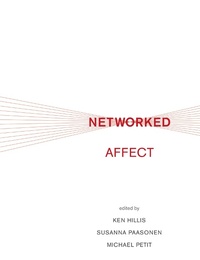
Networked Affect
Description

Our encounters with websites, avatars, videos, mobile apps, discussion forums, GIFs, and nonhuman intelligent agents allow us to experience sensations of connectivity, interest, desire, and attachment—as well as detachment, boredom, fear, and shame. Some affective online encounters may arouse complex, contradictory feelings that resist dualistic distinctions. In this book, leading scholars examine the fluctuating and altering dynamics of affect that give shape to online connections and disconnections. Doing so, they tie issues of circulation and connectivity to theorizations of networked affect. Their diverse investigations—considering subjects that range from online sexual dynamics to the liveliness of computer code—demonstrate the value of affect theories for Internet studies.
The contributors investigate networked affect in terms of intensity, sensation, and value. They explore online intensities that range from Tumblr practices in LGBTQ communities to visceral reactions to animated avatars; examine the affective materiality of software in such platforms as steampunk culture and nonprofit altporn; and analyze the ascription of value to online activities including the GTD ("getting things done”) movement and the accumulation of personal digital materials.
Contributors James Ash, Alex Cho, Jodi Dean, Melissa Gregg, Ken Hillis, Kylie Jarrett, Tero Karppi, Stephen Maddison, Susanna Paasonen, Jussi Parikka, Michael Petit, Jennifer Pybus, Jenny Sundén, Veronika Tzankova
More details
Other editions
Additional editions
Persons
Susanna Paasonen is Professor of Media Studies at the University of Turku in Finland. She is the coauthor of NSF: Sex, Humor, and Risk in Social Media (MIT Press).
Michael Petit is Director of Media Studies and the Joint Program in New Media Studies, Department of Arts, Culture, and Media, at the University Of Toronto Scarborough, and the author of Google and the Culture of Search.
Susanna Paasonen is Professor of Media Studies at the University of Turku in Finland. She is the coauthor of NSF: Sex, Humor, and Risk in Social Media (MIT Press).
Ken Hillis is Professor in the Department of Communication Studies at the University of North Carolina at Chapel Hill and the author of Online a Lot of the Time: Ritual, Fetish, Sign.
Michael Petit is Director of Media Studies and the Joint Program in New Media Studies, Department of Arts, Culture, and Media, at the University Of Toronto Scarborough, and the author of Google and the Culture of Search.
Susanna Paasonen is Professor of Media Studies at the University of Turku in Finland. She is the coauthor of NSF: Sex, Humor, and Risk in Social Media (MIT Press).
Ken Hillis is Professor in the Department of Communication Studies at the University of North Carolina at Chapel Hill and the author of Online a Lot of the Time: Ritual, Fetish, Sign.
Jussi Parikka is Professor of Technological Culture and Aesthetics at University of Southampton's Winchester School of Art and Docent in Digital Culture Theory at the University of Turku, Finland. He is the author of What Is Media Archaeology? and other books.
Jenny Sundén is Professor of Gender Studies at Södertörn University in Sweden.
Michael Petit is Director of Media Studies and the Joint Program in New Media Studies, Department of Arts, Culture, and Media, at the University Of Toronto Scarborough, and the author of Google and the Culture of Search.
Kylie Jarrett is Head of the Department of Media Studies at Maynooth University, Ireland, and author of Feminism, Labour and Digital Media: The Digital Housewife.
