

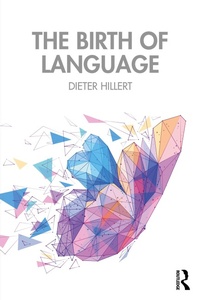
The Birth of Language
Published on 27. January 2026
316 pages
978-1-040-82695-9 (ISBN)
Description

The Birth of Language traces the gradual evolution of human language over two million years, uncovering the intricate interplay between biological adaptations and cultural innovations. It distinguishes language from speech-often conflated-showing how both emerged as distinct, yet intertwined processes shaped by specialized brain networks. The book engages with the ongoing scholarly debate on language origins, examining the roles of brain architecture, social cohesion, group dynamics, and fundamental behaviors such as toolmaking.
Drawing on the latest genetic research, as well as groundbreaking neurobiological discoveries, it reveals how our linguistic abilities mirror broader cognitive advances in human evolution. Evidence-based insights are woven seamlessly into a rich narrative of humanity's intertwined cultural and biological history.
Essential reading for anyone intrigued by the origins of language, The Birth of Language offers valuable perspectives for readers in psychology, neuroscience, linguistics, and anthropology-bridging disciplines to tell the compelling story of our species' most defining trait.
Drawing on the latest genetic research, as well as groundbreaking neurobiological discoveries, it reveals how our linguistic abilities mirror broader cognitive advances in human evolution. Evidence-based insights are woven seamlessly into a rich narrative of humanity's intertwined cultural and biological history.
Essential reading for anyone intrigued by the origins of language, The Birth of Language offers valuable perspectives for readers in psychology, neuroscience, linguistics, and anthropology-bridging disciplines to tell the compelling story of our species' most defining trait.
Reviews / Votes
"Delving into a large body of literature, Dieter Hillert provides in The Birth of Language a richly textured account of the origin and subsequent evolution of the human language faculty. The author's accessible discussion of the complex biological strands of these processes is a major merit of this book. Both scholars and curious general readers should find reading The Birth of Language a congenial experience, its account written in a sober yet engaging way."Rudolf Botha, Emeritus Professor of General Linguistics at Stellenbosch University, and former Honorary Professor of Linguistics at Utrecht University
"The topic of how humans developed their advanced communication system, language, has fascinated researchers and the general public for centuries. Dieter Hillert has added to the growing literature on this exciting topic by proposing original and highly intriguing ideas that deserve to be read, and which reward the reader by enriching thought about the origins of this uniquely human capability."
Daniel L. Everett, Trustee Professor of Cognitive Sciences, Bentley University. Author of "How Language Began"
"Studies of language origins and evolution are a highly interdisciplinary endeavour to delve into human nature. In this very exciting book, Dieter Hillert presents a vivid, panoramic view of how our linguistic capacity first came into being. The book covers practically every relevant field in a well-balanced manner. Each chapter is a rich treasury of insights and information for every interested reader."
Koji Fujita, Professor Emeritus at Kyoto University
"The Birth of Language delves into the extraordinarily important topic of how the mind creates language. Whether you are a scholar or a curious general reader, you'll learn a great deal about how culture and language emerged, and about how it is that humans develop the ability to speak and process language, and much more. Cognitive Scientist Dieter Hillert, well known for his superb work on the neurobiology of language, has treated us with a unique and highly informative book."
Elizabeth Loftus, Distinguished Professor, University of California, Irvine. Past President, Association for Psychological Science. Author of "Eyewitness Testimony"
"Language is a product of both biology and culture. Yet in contemporary discourse, these two realms have splintered into opposing views, each asserting its claim to the study of authentic language. Dieter Hillert reestablishes the connection between these perspectives, as Darwin intended when he considered evolution of language. Hillert proposes a novel idea, biological grammar, that serves as the foundation for not only language but other cognitive functions as well. To make his arguments, he demonstrates a remarkable command of diverse scholarly fields, including archaeology, linguistics, neuroscience, and primatology, all conveyed in prose that is accessible to both professional scholars and the general public curious about the nature of language."
Shigeru Miyagawa, Professor Emeritus of Linguistics at MIT
More details
Language
English
Place of publication
London
United Kingdom
Publishing group
Taylor & Francis Ltd
Target group
College/higher education
Illustrations
4 Tables, black and white; 17 Line drawings, black and white; 37 Halftones, black and white; 54 Illustrations, black and white
File size
20,09 MB
ISBN-13
978-1-040-82695-9 (9781040826959)
Copyright in bibliographic data and cover images is held by Nielsen Book Services Limited or by the publishers or by their respective licensors: all rights reserved.
Schweitzer Classification
Other editions
Additional editions
Dieter Hillert
The Birth of Language
Book
approx. 01/2026
1st Edition
Routledge
€211.80
Not yet published
Dieter Hillert
The Birth of Language
Book
01/2026
1st Edition
Routledge
€39.30
Shipment within 15-20 days
Person
Dieter Hillert is a linguist and cognitive scientist whose work spans language, cognition, and evolution. He studied at Gutenberg University Mainz and Goethe University Frankfurt and was trained in neurolinguistics at the Medical School of RWTH Aachen University. He earned his PhD from Goethe University Frankfurt and, as a postdoctoral researcher, investigated brain and language at the Centre Paul Broca in Paris, Boston University, and MIT. After returning to Europe, he lectured at the University of Manchester and earned his Habilitation (venia legendi) at Goethe University Frankfurt. He subsequently joined the University of California, San Diego. Currently, he is an Adjunct Professor at San Diego State University. He has received multiple awards from the Alexander von Humboldt Foundation and the Japan Society for the Promotion of Science. His research covers a broad range of topics in the cognitive and language sciences, including the neurobiology and genetics of language, the evolution of language and cognition, and mental capacities in nonhuman animals.
Content
Preface. Notable Sayings. Prologue. Part I. The Dawn of Humanity: Chap. 1 The Tale of Language, Chap. 2 Biological Grammar, Chap. 3 Evolutionary Path, Chap. 4 Culture Shapes Words, Chap. 5 A World of Languages, Chap. 6 The Bigger Picture. Part II. The Evolving Brain: Chap. 7 Human Ancestors, Chap. 8 Linguistic Diversity, Chap. 9 Prehistoric Artefacts, Chap. 10 Mastering Sounds, Chap. 11 The Speech-Ready Brain, Chap. 12 The Brain Circuits. Part III. Critical Milestones: Chap. 13 Layered Dynamics, Chap. 14 Using Structures, Chap. 15 Brain Comparisons, Chap. 16 The Dawn of Talking, Chap. 17 Rewiring the Brain, Chap. 18 Homo erectus. Epilogue. Index. Notes.
