

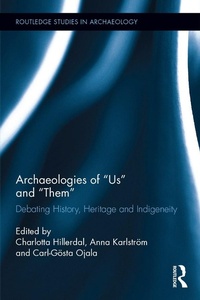
Archaeologies of Us and Them
Debating History, Heritage and Indigeneity
Published on 17. February 2017
322 pages
978-1-317-28168-9 (ISBN)
Description

Archaeologies of "Us" and "Them" explores the concept of indigeneity within the field of archaeology and heritage and in particular examines the shifts in power that occur when 'we' define 'the other' by categorizing 'them' as indigenous. Recognizing the complex and shifting distinctions between indigenous and non-indigenous pasts and presents, this volume gives a nuanced analysis of the underlying definitions, concepts and ethics associated with this field in order to explore Indigenous archaeology as a theoretical, ethical and political concept.
Indigenous archaeology is an increasingly important topic discussed worldwide, and as such critical analyses must be applied to debates which are often surrounded by political correctness and consensus views. Drawing on an international range of global case studies, this timely and sensitive collection significantly contributes to the development of archaeological critical theory.
Indigenous archaeology is an increasingly important topic discussed worldwide, and as such critical analyses must be applied to debates which are often surrounded by political correctness and consensus views. Drawing on an international range of global case studies, this timely and sensitive collection significantly contributes to the development of archaeological critical theory.
Reviews / Votes
"In common with other postcolonial archaeology publications, this one emphasizes that "Indigenous" tends to be equated with timeless, tradition-bound, non-Western, endangered-in a word, a euphemism for "primitive". That colonized peoples are generally poor tends to be glossed over. A strength of this book is that many authors make this clear. Most of the chapters are well written, interesting, and deepen understanding of what "indigenous" may entail."A. B. Kehoe, Marquette University
More details
Series
Language
English
Place of publication
London
United Kingdom
Publishing group
Taylor & Francis Ltd
Target group
College/higher education
Professional and scholarly
Illustrations
24 Illustrations, black and white
File size
4,08 MB
ISBN-13
978-1-317-28168-9 (9781317281689)
Copyright in bibliographic data and cover images is held by Nielsen Book Services Limited or by the publishers or by their respective licensors: all rights reserved.
Schweitzer Classification
Other editions
Additional editions
Charlotta Hillerdal | Anna Karlstroem | Carl-Goesta Ojala
Archaeologies of Us and Them
Debating History, Heritage and Indigeneity
Book
12/2019
1st Edition
Routledge
€55.79
Shipment within 15-20 days
Charlotta Hillerdal | Anna Karlstroem | Carl-Goesta Ojala
Archaeologies of Us and Them
Debating History, Heritage and Indigeneity
Book
02/2012
1st Edition
Routledge
€232.20
Shipment within 10-20 days
Persons
Charlotta Hillerdal is Lecturer in Archaeology at the University of Aberdeen, Scotland, UK.
Anna Karlstroem is Lecturer and Researcher in Heritage Studies at the Department of Art History, Uppsala University, Sweden.
Carl-Goesta Ojala is a Researcher in Archaeology at the Department of Archaeology and Ancient History, Uppsala University, Sweden.
Anna Karlstroem is Lecturer and Researcher in Heritage Studies at the Department of Art History, Uppsala University, Sweden.
Carl-Goesta Ojala is a Researcher in Archaeology at the Department of Archaeology and Ancient History, Uppsala University, Sweden.
Content
Foreword
Lynette Russell
Introduction
Charlotta Hillerdal, Anna Karlstroem and Carl-Goesta Ojala
Part I - Politics of Indigeneity
1. Collective Rights and the Construction of Heritage
Ronald Niezen
2. Naming the Indigenous
Nick Shepherd
3. Stakeholder in Practice: "Us", "Them" and the Problem of Expertise
Trinidad Rico
4. Extractive Industries, Corporate Discourse and Indigenous Heritage
Melissa F. Baird
5. Integrating the Past in the Present: Archaeology as Part of Living Yup'ik Heritage
Charlotta Hillerdal
6. Us and Whom? Representations of Indigenousness in the Archaeological Site of Avdat, Israel
Menachem Shiff
7. The Archaeological Construction of Aboriginality: The Inuit Case
Robert McGhee
Part II - Spaces Between "Us" and "Them"
8. Envisioning a Different Notion of "Indigenous Archaeology" From the Perspective of Sub-Saharan Africa
Paul J. Lane
9. Who is Indigenous? Migration Theories and Notions of Indigeneity in Southern African Archaeology
Edward Matenga
10. Reading Indigeneity Without Race: Colour, Representation and Uncertainty in Photographic Evidence
Celmara Pocock
11. How History Controls the Past: "Discovering" the Unconventional and Underground History of Setauket, New York's Native and African American Community
Christopher N. Matthews
12. Bronze Drums and the Contestations of Indigenous Heritage in Laos
Anna Karlstroem
13. Indigeneity, Knowledge and Archaeology on Both Sides of the Mirror
Alejandro F. Haber
Part III - Indigeneity and Heritage
14. Culture, Rights, Indigeneity and Intervention: Addressing Inequality in Indigenous Heritage Protection and Control
George P. Nicholas
15. Archaeological Heritage and Hokkaido Ainu: Ethnicity and Research Ethics
Hirofumi Kato
16. Power Relations and the Management of Heritage in South Africa
Ndukuyakhe Ndlovu
17. Performing "Indigenous" for International Tourists who Tour the Rural Poor
John Giblin
18. Contested Colonial History and Heritage in Sapmi: Archaeology, Indigeneity and Local Communities in Northern Sweden
Carl-Goesta Ojala
19. Reindeer Herding as Heritage in the Kola Peninsula, North-Western Russia
Vladislava Vladimirova
Lynette Russell
Introduction
Charlotta Hillerdal, Anna Karlstroem and Carl-Goesta Ojala
Part I - Politics of Indigeneity
1. Collective Rights and the Construction of Heritage
Ronald Niezen
2. Naming the Indigenous
Nick Shepherd
3. Stakeholder in Practice: "Us", "Them" and the Problem of Expertise
Trinidad Rico
4. Extractive Industries, Corporate Discourse and Indigenous Heritage
Melissa F. Baird
5. Integrating the Past in the Present: Archaeology as Part of Living Yup'ik Heritage
Charlotta Hillerdal
6. Us and Whom? Representations of Indigenousness in the Archaeological Site of Avdat, Israel
Menachem Shiff
7. The Archaeological Construction of Aboriginality: The Inuit Case
Robert McGhee
Part II - Spaces Between "Us" and "Them"
8. Envisioning a Different Notion of "Indigenous Archaeology" From the Perspective of Sub-Saharan Africa
Paul J. Lane
9. Who is Indigenous? Migration Theories and Notions of Indigeneity in Southern African Archaeology
Edward Matenga
10. Reading Indigeneity Without Race: Colour, Representation and Uncertainty in Photographic Evidence
Celmara Pocock
11. How History Controls the Past: "Discovering" the Unconventional and Underground History of Setauket, New York's Native and African American Community
Christopher N. Matthews
12. Bronze Drums and the Contestations of Indigenous Heritage in Laos
Anna Karlstroem
13. Indigeneity, Knowledge and Archaeology on Both Sides of the Mirror
Alejandro F. Haber
Part III - Indigeneity and Heritage
14. Culture, Rights, Indigeneity and Intervention: Addressing Inequality in Indigenous Heritage Protection and Control
George P. Nicholas
15. Archaeological Heritage and Hokkaido Ainu: Ethnicity and Research Ethics
Hirofumi Kato
16. Power Relations and the Management of Heritage in South Africa
Ndukuyakhe Ndlovu
17. Performing "Indigenous" for International Tourists who Tour the Rural Poor
John Giblin
18. Contested Colonial History and Heritage in Sapmi: Archaeology, Indigeneity and Local Communities in Northern Sweden
Carl-Goesta Ojala
19. Reindeer Herding as Heritage in the Kola Peninsula, North-Western Russia
Vladislava Vladimirova
