

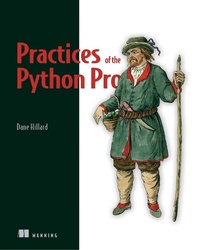
Practices of the Python Pro
1st Edition
Published on 22. December 2019
248 pages
978-1-63835-013-2 (ISBN)
Description

Summary
Professional developers know the many benefits of writing application code that's clean, well-organized, and easy to maintain. By learning and following established patterns and best practices, you can take your code and your career to a new level.
With Practices of the Python Pro, you'll learn to design professional-level, clean, easily maintainable software at scale using the incredibly popular programming language, Python. You'll find easy-to-grok examples that use pseudocode and Python to introduce software development best practices, along with dozens of instantly useful techniques that will help you code like a pro.
Purchase of the print book includes a free eBook in PDF, Kindle, and ePub formats from Manning Publications.
About the technology
Professional-quality code does more than just run without bugs. It's clean, readable, and easy to maintain. To step up from a capable Python coder to a professional developer, you need to learn industry standards for coding style, application design, and development process. That's where this book is indispensable.
About the book
Practices of the Python Pro teaches you to design and write professional-quality software that's understandable, maintainable, and extensible. Dane Hillard is a Python pro who has helped many dozens of developers make this step, and he knows what it takes. With helpful examples and exercises, he teaches you when, why, and how to modularize your code, how to improve quality by reducing complexity, and much more. Embrace these core principles, and your code will become easier for you and others to read, maintain, and reuse.
What's inside
- Organizing large Python projects
- Achieving the right levels of abstraction
- Writing clean, reusable code Inheritance and composition
- Considerations for testing and performance
More details
Other editions
Additional editions
Dane Hillard
Practices of the Python Pro
Book
03/2020
Manning Publications
€57.50
Shipment within 10-20 days
Person
Dane Hillard
Content
- Intro
- Copyright
- Brief Table of Contents
- Table of Contents
- Preface
- Acknowledgments
- About this book
- About the Author
- About the cover illustration
- Part 1. Why it all matters
- Chapter 1. The bigger picture
- 1.1. Python is an enterprise language
- 1.2. Python is a teaching language
- 1.3. Design is a process
- 1.4. Design enables better software
- 1.5. When to invest in design
- 1.6. New beginnings
- 1.7. Design is democratic
- 1.8. How to use this book
- Summary
- Part 2. Foundations of design
- Chapter 2. Separation of concerns
- 2.1. Namespacing
- 2.2. The hierarchy of separation in Python
- Summary
- Chapter 3. Abstraction and encapsulation
- 3.1. What is abstraction?
- 3.2. Encapsulation
- 3.3. Try it out
- 3.4. Programming styles are an abstraction too
- 3.5. Typing, inheritance, and polymorphism
- 3.6. Recognizing the wrong abstraction
- Summary
- Chapter 4. Designing for high performance
- 4.1. Hurtling through time and space
- 4.2. Performance and data types
- 4.3. Make it work, make it right, make it fast
- 4.4. Tools
- 4.5. Try it out
- Summary
- Chapter 5. Testing your software
- 5.1. What is software testing?
- 5.2. Functional testing approaches
- 5.3. Statements of fact
- 5.4. Unit testing with unittest
- 5.5. Testing with pytest
- 5.6. Beyond functional testing
- 5.7. Test-driven development: A primer
- Summary
- Part 3. Nailing down large systems
- Chapter 6. Separation of concerns in practice
- 6.1. A command-line bookmarking application
- 6.2. A tour of Bark
- 6.3. An initial code structure, by concern
- Summary
- Chapter 7. Extensibility and flexibility
- 7.1. What is extensible code?
- 7.2. Solutions for rigidity
- 7.3. An exercise in extension
- Summary
- Chapter 8. The rules (and exceptions) of inheritance
- 8.1. The inheritance of programming past
- 8.2. The inheritance of programming present
- 8.3. Inheritance in Python
- 8.4. Inheritance and composition in Bark
- Summary
- Chapter 9. Keeping things lightweight
- 9.1. How big should my class/function/module be?
- 9.2. Breaking down complexity
- 9.3. Decomposing classes
- Summary
- Chapter 10. Achieving loose coupling
- 10.1. Defining coupling
- 10.2. Recognizing coupling
- 10.3. Coupling in Bark
- 10.4. Addressing coupling
- Summary
- Part 4. What's next?
- Chapter 11. Onward and upward
- 11.1. What now?
- 11.2. Design patterns
- 11.3. Distributed systems
- 11.4. Take a Python deep dive
- 11.5. Where you've been
- Summary
- Appendix Installing Python
- A.1 What version of Python should I use?
- A.2 The "system" Python
- A.3 Installing other versions of Python
- A.4 Verifying the installation
- Index
- List of Figures
- List of Listings
