

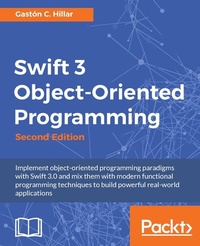
Swift 3 Object-Oriented Programming
Implement object-oriented programming paradigms with Swift 3.0 and mix them with modern functional programming techniques to build powerful real-world applications
2nd Edition
Published on 8. July 2025
370 pages
978-1-78712-099-0 (ISBN)
Description

Implement object-oriented programming paradigms with Swift 3.0 and mix them with modern functional programming techniques to build powerful real-world applications
Key Features
[*] Leverage the most efficient object-oriented design patterns in your Swift applications
[*] Write robust, safer, and better code using the blueprints that generate objects
[*] Build a platform with object-oriented code using real-world elements and represent them in your apps
Book DescriptionSwift has quickly become one of the most-liked languages and developers' de-facto choice when building applications that target iOS and macOS. In the new version, the Swift team wants to take its adoption to the next level by making it available for new platforms and audiences. This book introduces the object-oriented paradigm and its implementation in the Swift 3 programming language to help you understand how real-world objects can become part of fundamental reusable elements in the code. This book is developed with XCode 8.x and covers all the enhancements included in Swift 3.0. In addition, we teach you to run most of the examples with the Swift REPL available on macOS and Linux, and with a Web-based Swift sandbox developed by IBM capable of running on any web browser, including Windows and mobile devices. You will organize data in blueprints that generate instances. You'll work with examples so you understand how to encapsulate and hide data by working with properties and access control. Then, you'll get to grips with complex scenarios where you use instances that belong to more than one blueprint. You'll discover the power of contract programming and parametric polymorphism. You'll combine generic code with inheritance and multiple inheritance. Later, you'll see how to combine functional programming with object-oriented programming and find out how to refactor your existing code for easy maintenance. What you will learn
[*] Write high-quality and easy-to-maintain reusable object-oriented code to build applications for iOS, macOS, and Linux
[*] Work with encapsulation, abstraction, and polymorphism using Swift 3.0
[*] Work with classes, instances, properties, and methods in Swift 3.0
[*] Take advantage of inheritance, specialization, and the possibility to overload or override members
[*] Implement encapsulation, abstraction, and polymorphism
[*] Explore functional programming techniques mixed with object-oriented code in Swift 3.0
[*] Understand the differences between Swift 3.0, previous Swift versions, and Objective-C code
Who this book is forThis book is for iOS and macOS developers who want to get a detailed practical understanding of object-oriented programming with the latest version of Swift: 3.0.
Key Features
[*] Leverage the most efficient object-oriented design patterns in your Swift applications
[*] Write robust, safer, and better code using the blueprints that generate objects
[*] Build a platform with object-oriented code using real-world elements and represent them in your apps
Book DescriptionSwift has quickly become one of the most-liked languages and developers' de-facto choice when building applications that target iOS and macOS. In the new version, the Swift team wants to take its adoption to the next level by making it available for new platforms and audiences. This book introduces the object-oriented paradigm and its implementation in the Swift 3 programming language to help you understand how real-world objects can become part of fundamental reusable elements in the code. This book is developed with XCode 8.x and covers all the enhancements included in Swift 3.0. In addition, we teach you to run most of the examples with the Swift REPL available on macOS and Linux, and with a Web-based Swift sandbox developed by IBM capable of running on any web browser, including Windows and mobile devices. You will organize data in blueprints that generate instances. You'll work with examples so you understand how to encapsulate and hide data by working with properties and access control. Then, you'll get to grips with complex scenarios where you use instances that belong to more than one blueprint. You'll discover the power of contract programming and parametric polymorphism. You'll combine generic code with inheritance and multiple inheritance. Later, you'll see how to combine functional programming with object-oriented programming and find out how to refactor your existing code for easy maintenance. What you will learn
[*] Write high-quality and easy-to-maintain reusable object-oriented code to build applications for iOS, macOS, and Linux
[*] Work with encapsulation, abstraction, and polymorphism using Swift 3.0
[*] Work with classes, instances, properties, and methods in Swift 3.0
[*] Take advantage of inheritance, specialization, and the possibility to overload or override members
[*] Implement encapsulation, abstraction, and polymorphism
[*] Explore functional programming techniques mixed with object-oriented code in Swift 3.0
[*] Understand the differences between Swift 3.0, previous Swift versions, and Objective-C code
Who this book is forThis book is for iOS and macOS developers who want to get a detailed practical understanding of object-oriented programming with the latest version of Swift: 3.0.
More details
Edition
2nd Revised edition
Language
English
Place of publication
Birmingham
United Kingdom
Target group
Professional and scholarly
US School Grade: College Graduate Student
Edition type
Revised edition
File size
23,84 MB
ISBN-13
978-1-78712-099-0 (9781787120990)
Copyright in bibliographic data and cover images is held by Nielsen Book Services Limited or by the publishers or by their respective licensors: all rights reserved.
Schweitzer Classification
Other editions
Additional editions
Gastón C. Hillar
Swift 3 Object Oriented Programming
Book
02/2017
Packt Publishing
€51.70
Shipment within 3-4 weeks
Person
C. Hillar Gaston :
Gaston C. Hillar is Italian and has been working with computers since he was 8 years old. Gaston has a Bachelor's degree in computer science (graduated with honors) and an MBA. Currently, Gaston is an independent IT consultant and a freelance author who is always looking for new adventures anywhere in the world. He was a senior contributing editor at Dr. Dobb's, and has written more than a hundred articles on software development topics. He has received the prestigious Intel Black Belt Software Developer award eight times. He has written many articles about Java for Oracle Java Magazine. Gaston was also a former Microsoft MVP in technical computing. He lives with his wife, Vanesa, and his two sons, Kevin and Brandon.
Gaston C. Hillar is Italian and has been working with computers since he was 8 years old. Gaston has a Bachelor's degree in computer science (graduated with honors) and an MBA. Currently, Gaston is an independent IT consultant and a freelance author who is always looking for new adventures anywhere in the world. He was a senior contributing editor at Dr. Dobb's, and has written more than a hundred articles on software development topics. He has received the prestigious Intel Black Belt Software Developer award eight times. He has written many articles about Java for Oracle Java Magazine. Gaston was also a former Microsoft MVP in technical computing. He lives with his wife, Vanesa, and his two sons, Kevin and Brandon.
Content
Table of Contents
Objects from the real-word to the Playground
Structures, Classes and Instances
Encapsulation of data with properties
Inheritance, Abstraction, and Specialization
Contract Programming with Protocols
Maximization of code reuse with generic code
Object-Oriented and Functional Programming
Extending and bulding object-oriented code
Objects from the real-word to the Playground
Structures, Classes and Instances
Encapsulation of data with properties
Inheritance, Abstraction, and Specialization
Contract Programming with Protocols
Maximization of code reuse with generic code
Object-Oriented and Functional Programming
Extending and bulding object-oriented code
