

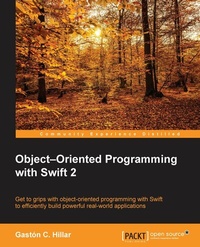
Object???Oriented Programming with Swift 2
Get to grips with object-oriented programming in Swift to efficiently build powerful real-world applications
Published on 8. July 2025
332 pages
978-1-78588-480-1 (ISBN)
Description

Get to grips with object-oriented programming in Swift to efficiently build powerful real-world applications
Key Features
[*]Leverage the most efficient object-oriented design patterns in your Swift applications
[*]Write robust, safer, and better code using the blueprints that generate objects
[*]Build a platform with object-oriented code by using real-world elements and represent them in your app
Book DescriptionObject-Oriented Programming (OOP) is a programming paradigm based on the concept of objects; these are data structures that contain data in the form of fields, often known as attributes and code. Objects are everywhere, and so it is very important to recognize elements, known as objects, from real-world situations and know how they can easily be translated into object-oriented code. Object-Oriented Programming with Swift is an easy-to-follow guide packed full of hands-on examples of solutions to common problems encountered with object-oriented code in Swift. It starts by helping you to recognize objects using real-life scenarios and demonstrates how working with them makes it simpler to write code that is easy to understand and reuse. You will learn to protect and hide data with the data encapsulation features of Swift. Then, you will explore how to maximize code reuse by writing code capable of working with objects of different types. After that, you'll discover the power of parametric polymorphism and will combine generic code with inheritance and multiple inheritance. Later, you move on to refactoring your existing code and organizing your source for easy maintenance and extensions. By the end of the book, you will be able to create better, stronger, and more reusable code, which will help you build better applications. What you will learn
[*] Build solid, stable, and reliable applications using Swift
[*] Work with encapsulation, abstraction, and polymorphism using Swift 2.0
[*] Customize constructors and destructors based on your needs
[*] Develop Swift 2.0 with classes, instances, properties, and methods
[*] Take advantage of generic code to maximize code reuse and generalize behaviors
[*] Use state of inheritance, specialization, and the possibility to overload members
[*] Write high quality object-oriented code to build apps for iOS or Mac OS X
Who this book is forIf you are an iOS developer who has a basic idea of object-oriented programming and want to incorporate its concepts with Swift to optimize your application's code and create reusable and easily to understand building blocks, then this book is for you. This is a very useful resource for developers who want to shift from Objective C, C#, Java, Python, JavaScript, or other object-oriented languages to Swift
Key Features
[*]Leverage the most efficient object-oriented design patterns in your Swift applications
[*]Write robust, safer, and better code using the blueprints that generate objects
[*]Build a platform with object-oriented code by using real-world elements and represent them in your app
Book DescriptionObject-Oriented Programming (OOP) is a programming paradigm based on the concept of objects; these are data structures that contain data in the form of fields, often known as attributes and code. Objects are everywhere, and so it is very important to recognize elements, known as objects, from real-world situations and know how they can easily be translated into object-oriented code. Object-Oriented Programming with Swift is an easy-to-follow guide packed full of hands-on examples of solutions to common problems encountered with object-oriented code in Swift. It starts by helping you to recognize objects using real-life scenarios and demonstrates how working with them makes it simpler to write code that is easy to understand and reuse. You will learn to protect and hide data with the data encapsulation features of Swift. Then, you will explore how to maximize code reuse by writing code capable of working with objects of different types. After that, you'll discover the power of parametric polymorphism and will combine generic code with inheritance and multiple inheritance. Later, you move on to refactoring your existing code and organizing your source for easy maintenance and extensions. By the end of the book, you will be able to create better, stronger, and more reusable code, which will help you build better applications. What you will learn
[*] Build solid, stable, and reliable applications using Swift
[*] Work with encapsulation, abstraction, and polymorphism using Swift 2.0
[*] Customize constructors and destructors based on your needs
[*] Develop Swift 2.0 with classes, instances, properties, and methods
[*] Take advantage of generic code to maximize code reuse and generalize behaviors
[*] Use state of inheritance, specialization, and the possibility to overload members
[*] Write high quality object-oriented code to build apps for iOS or Mac OS X
Who this book is forIf you are an iOS developer who has a basic idea of object-oriented programming and want to incorporate its concepts with Swift to optimize your application's code and create reusable and easily to understand building blocks, then this book is for you. This is a very useful resource for developers who want to shift from Objective C, C#, Java, Python, JavaScript, or other object-oriented languages to Swift
All prices
More details
Edition
Digital original
Language
English
Place of publication
Birmingham
United Kingdom
Target group
Professional and scholarly
US School Grade: College Graduate Student
Edition type
Digital original
File size
13,15 MB
ISBN-13
978-1-78588-480-1 (9781785884801)
Copyright in bibliographic data and cover images is held by Nielsen Book Services Limited or by the publishers or by their respective licensors: all rights reserved.
Schweitzer Classification
Other editions
Additional editions
Gastón C. Hillar
Object Oriented Programming with Swift
Book
01/2016
Packt Publishing
€56.30
Shipment within 3-4 weeks
Person
C. Hillar Gaston :
Gaston C. Hillar is Italian and has been working with computers since he was 8 years old. Gaston has a Bachelor's degree in computer science (graduated with honors) and an MBA. Currently, Gaston is an independent IT consultant and a freelance author who is always looking for new adventures anywhere in the world. He was a senior contributing editor at Dr. Dobb's, and has written more than a hundred articles on software development topics. He has received the prestigious Intel Black Belt Software Developer award eight times. He has written many articles about Java for Oracle Java Magazine. Gaston was also a former Microsoft MVP in technical computing. He lives with his wife, Vanesa, and his two sons, Kevin and Brandon.
Gaston C. Hillar is Italian and has been working with computers since he was 8 years old. Gaston has a Bachelor's degree in computer science (graduated with honors) and an MBA. Currently, Gaston is an independent IT consultant and a freelance author who is always looking for new adventures anywhere in the world. He was a senior contributing editor at Dr. Dobb's, and has written more than a hundred articles on software development topics. He has received the prestigious Intel Black Belt Software Developer award eight times. He has written many articles about Java for Oracle Java Magazine. Gaston was also a former Microsoft MVP in technical computing. He lives with his wife, Vanesa, and his two sons, Kevin and Brandon.
Content
Table of Contents
Objects from the real-world to the playground
Structures, Classes and Instances
Encapsulation of data with properties and subscripts
Inheritance and typecasting
Contract Programming with Protocols
Maximization of Code Reuse with Generic Code
Maximization of code reuse with generic code
Object-oriented programming and functional programming
Objects from the real-world to the playground
Structures, Classes and Instances
Encapsulation of data with properties and subscripts
Inheritance and typecasting
Contract Programming with Protocols
Maximization of Code Reuse with Generic Code
Maximization of code reuse with generic code
Object-oriented programming and functional programming

