

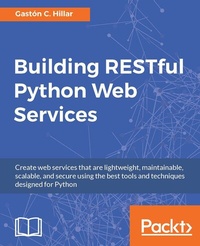
Building RESTful Python Web Services
Create web services that are lightweight, maintainable, scalable, and secure using the best tools and techniques designed for Python
1st Edition
Published on 3. June 2024
418 pages
978-1-78646-425-5 (ISBN)
Description

Create web services that are lightweight, maintainable, scalable, and secure using the best tools and techniques designed for PythonKey Features - [*] Develop RESTful Web Services using the most popular frameworks in Python
- [*] Configure and fine-tune your APIs using the best tools and techniques available
- [*] This practical guide will help you to implement complete REST-based APIs from scratch
Book DescriptionPython is the language of choice for millions of developers worldwide, due to its gentle learning curve as well as its vast applications in day-to-day programming. It serves the purpose of building great web services in the RESTful architecture. This book will show you the best tools you can use to build your own web services. Learn how to develop RESTful APIs using the popular Python frameworks and all the necessary stacks with Python, Django, Flask, and Tornado, combined with related libraries and tools. We will dive deep into each of these frameworks to build various web services, and will provide use cases and best practices on when to use a particular framework to get the best results. We will show you everything required to successfully develop RESTful APIs with the four frameworks such as request handling, URL mapping, serialization, validation, authentication, authorization, versioning, ORMs, databases, custom code for models and views, and asynchronous callbacks. At the end of each framework, we will add authentication and security to the RESTful APIs and prepare tests for it. By the end of the book, you will have a deep understanding of the stacks needed to build RESTful web services. What you will learn - [*] Develop complex RESTful APIs from scratch with Python combined with and without data sources
- [*] Choose the most appropriate (micro) framework based on the specific requirements of a RESTful API / web service
- [*] Debug, test, and profile RESTful APIs with each of the frameworks
- [*] Develop a complex RESTful API that interacts with a PostgreSQL database
- [*] Add authentication and permissions to a RESTful API built in each of the frameworks
- [*] Map URL patterns to request handlers and check how the API works
- [*] Profile an existing API and refactor it to take advantage of asynchronous code
Who this book is forThis book is for web developers who have working knowledge of Python and would like to build amazing web services by taking advantage of the various frameworks of Python. You should have some knowledge of RESTful APIs.
- [*] Configure and fine-tune your APIs using the best tools and techniques available
- [*] This practical guide will help you to implement complete REST-based APIs from scratch
Book DescriptionPython is the language of choice for millions of developers worldwide, due to its gentle learning curve as well as its vast applications in day-to-day programming. It serves the purpose of building great web services in the RESTful architecture. This book will show you the best tools you can use to build your own web services. Learn how to develop RESTful APIs using the popular Python frameworks and all the necessary stacks with Python, Django, Flask, and Tornado, combined with related libraries and tools. We will dive deep into each of these frameworks to build various web services, and will provide use cases and best practices on when to use a particular framework to get the best results. We will show you everything required to successfully develop RESTful APIs with the four frameworks such as request handling, URL mapping, serialization, validation, authentication, authorization, versioning, ORMs, databases, custom code for models and views, and asynchronous callbacks. At the end of each framework, we will add authentication and security to the RESTful APIs and prepare tests for it. By the end of the book, you will have a deep understanding of the stacks needed to build RESTful web services. What you will learn - [*] Develop complex RESTful APIs from scratch with Python combined with and without data sources
- [*] Choose the most appropriate (micro) framework based on the specific requirements of a RESTful API / web service
- [*] Debug, test, and profile RESTful APIs with each of the frameworks
- [*] Develop a complex RESTful API that interacts with a PostgreSQL database
- [*] Add authentication and permissions to a RESTful API built in each of the frameworks
- [*] Map URL patterns to request handlers and check how the API works
- [*] Profile an existing API and refactor it to take advantage of asynchronous code
Who this book is forThis book is for web developers who have working knowledge of Python and would like to build amazing web services by taking advantage of the various frameworks of Python. You should have some knowledge of RESTful APIs.
All prices
More details
Person
C. Hillar Gaston :
Gaston C. Hillar is Italian and has been working with computers since he was 8 years old. Gaston has a Bachelor's degree in computer science (graduated with honors) and an MBA. Currently, Gaston is an independent IT consultant and a freelance author who is always looking for new adventures anywhere in the world. He was a senior contributing editor at Dr. Dobb's, and has written more than a hundred articles on software development topics. He has received the prestigious Intel Black Belt Software Developer award eight times. He has written many articles about Java for Oracle Java Magazine. Gaston was also a former Microsoft MVP in technical computing. He lives with his wife, Vanesa, and his two sons, Kevin and Brandon.
Gaston C. Hillar is Italian and has been working with computers since he was 8 years old. Gaston has a Bachelor's degree in computer science (graduated with honors) and an MBA. Currently, Gaston is an independent IT consultant and a freelance author who is always looking for new adventures anywhere in the world. He was a senior contributing editor at Dr. Dobb's, and has written more than a hundred articles on software development topics. He has received the prestigious Intel Black Belt Software Developer award eight times. He has written many articles about Java for Oracle Java Magazine. Gaston was also a former Microsoft MVP in technical computing. He lives with his wife, Vanesa, and his two sons, Kevin and Brandon.
Content
Table of Contents - Developing RESTful APIs with Django
- Working with class based views and hyperlinked APIs in Django
- Secure, Test and Deploy the API
- Developing RESTful APIs with Flask
- Working with Models, SQLAlchemy, and hyperlinked APIs
- Secure, Test and Deploy the API
- Developing RESTful APIs with Pyramid
- Working with RAML (RESTful API Modeling Language), Ramses and Pyramid
- Developing RESTful APIs with Tornado
- Working with Asynchronous code, securing and testing APIs
- Working with class based views and hyperlinked APIs in Django
- Secure, Test and Deploy the API
- Developing RESTful APIs with Flask
- Working with Models, SQLAlchemy, and hyperlinked APIs
- Secure, Test and Deploy the API
- Developing RESTful APIs with Pyramid
- Working with RAML (RESTful API Modeling Language), Ramses and Pyramid
- Developing RESTful APIs with Tornado
- Working with Asynchronous code, securing and testing APIs

