

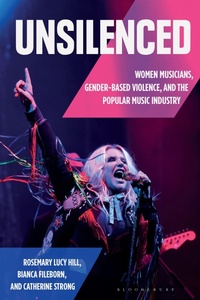
Unsilenced
Women Musicians, Gender-Based Violence, and the Popular Music Industry
Published on 9. January 2025
160 pages
979-8-7651-0172-8 (ISBN)
Description

2026 PROSE Award Finalist in Music & The Performing Arts
This book explores gender-based violence within the music industry, and how women who have experienced violence represent it in their music.
Using the key case studies of music by Kesha, Lingua Ignota, and Alice Glass, as well as many other examples from across the musical landscape, the book examines how the artists represent their experiences of gender-based violence in their music, lyrics, and music videos; how they narrate and describe their experiences; how they incorporate these experiences into their public personas; and how the music industry itself might be facilitating or perpetuating the violence.
The analysis sheds light on how survivors construct their experiences, and how the songs and videos inscribe new understandings of gender-based violence. The book argues that men's control of women's creativity can be considered a form of musical abuse, and that through its structures and systems the music industry itself can be classed as inherently abusive. And yet, women musicians can sing back to the violence they've experienced and create powerful new representations that have the potential to change the way we listen to music, if we are prepared to develop our feminist ears.
This book explores gender-based violence within the music industry, and how women who have experienced violence represent it in their music.
Using the key case studies of music by Kesha, Lingua Ignota, and Alice Glass, as well as many other examples from across the musical landscape, the book examines how the artists represent their experiences of gender-based violence in their music, lyrics, and music videos; how they narrate and describe their experiences; how they incorporate these experiences into their public personas; and how the music industry itself might be facilitating or perpetuating the violence.
The analysis sheds light on how survivors construct their experiences, and how the songs and videos inscribe new understandings of gender-based violence. The book argues that men's control of women's creativity can be considered a form of musical abuse, and that through its structures and systems the music industry itself can be classed as inherently abusive. And yet, women musicians can sing back to the violence they've experienced and create powerful new representations that have the potential to change the way we listen to music, if we are prepared to develop our feminist ears.
More details
Language
English
Place of publication
New York
United States
Publishing group
Bloomsbury Publishing Plc
Target group
College/higher education
File size
2,22 MB
ISBN-13
979-8-7651-0172-8 (9798765101728)
Copyright in bibliographic data and cover images is held by Nielsen Book Services Limited or by the publishers or by their respective licensors: all rights reserved.
Schweitzer Classification
Other editions
Additional editions

Rosemary Lucy Hill | Bianca Fileborn | Catherine Strong
Unsilenced
Women Musicians, Gender-Based Violence, and the Popular Music Industry
Book
02/2025
Bloomsbury Academic USA
€22.50
Shipment within 10-20 days
Persons
Rosemary Lucy Hill is an independent scholar, formerly of the University of Huddersfield, UK. She is the author of Gender, Metal and the Media: Women Fans and the Gendered Experience of Music (2016) and many articles about feminism, music and big data. She is the co-series editor of Advances in Metal Music and Culture. She is the lead vocalist in a feminist folk metal band and currently writing her first novel.
Bianca Fileborn is an Associate Professor in Criminology, School of Social and Political Sciences at the University of Melbourne, Australia. Their work is broadly concerned with interrogating the intersections of identity, space, place, culture and experiences of violence and justice. They are the author of Reclaiming the Night-Time Economy: Unwanted Sexual Attention in Pubs and Clubs (2016) and co-editor of #MeToo and the Politics of Social Change (2019).
Catherine Strong is an Associate Professor in the Music Industry program at RMIT in Melbourne, Australia. Among her publications are Grunge: Music and Memory (2011), Music City Melbourne (2022), and Towards Gender Equality in the Music Industry (2021, edited with Sarah Raine). Her research deals with various aspects of memory, nostalgia and gender in rock music, popular culture and the media. She is co-editor of Popular Music History journal and an associate editor for DIY, Alternative Cultures and Society journal.
Bianca Fileborn is an Associate Professor in Criminology, School of Social and Political Sciences at the University of Melbourne, Australia. Their work is broadly concerned with interrogating the intersections of identity, space, place, culture and experiences of violence and justice. They are the author of Reclaiming the Night-Time Economy: Unwanted Sexual Attention in Pubs and Clubs (2016) and co-editor of #MeToo and the Politics of Social Change (2019).
Catherine Strong is an Associate Professor in the Music Industry program at RMIT in Melbourne, Australia. Among her publications are Grunge: Music and Memory (2011), Music City Melbourne (2022), and Towards Gender Equality in the Music Industry (2021, edited with Sarah Raine). Her research deals with various aspects of memory, nostalgia and gender in rock music, popular culture and the media. She is co-editor of Popular Music History journal and an associate editor for DIY, Alternative Cultures and Society journal.
Content
1. Introduction
2. Musicians Negotiating Post-Abuse Identities
3. Music Industry as the Abuser
4. Musical Responses to Gender-Based Violence
5. Conclusion
2. Musicians Negotiating Post-Abuse Identities
3. Music Industry as the Abuser
4. Musical Responses to Gender-Based Violence
5. Conclusion
