

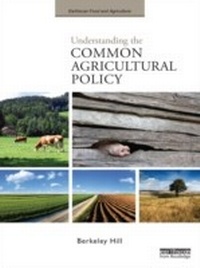
Understanding the Common Agricultural Policy
1st Edition
Published on 29. March 2012
352 pages
978-1-136-53789-9 (ISBN)
Description

The majority of recent publications on the Common Agricultural Policy (CAP) of the European Union address current issues and specific applications. There is little available which attempts to increase understanding of the nature of existing policies, their development, intentions, problems and successes.
The aim of this book is to improve knowledge and understanding of the 'policy process' and its application to the CAP, focussing on the principles of policy analysis. For while the details of agricultural and environmental policies evolve, the principles upon which they are based endure. The author uses economics as a basis for his exploration, as fairly simple economics holds the key to understanding many of the fundamental pressures to which agriculture and rural areas are subject. He explains the importance of the political and administrative context in which the process occurs, acknowledging the influence of environmental and sociological concerns.
Such knowledge of the conceptual framework of the 'policy process' and its application to the CAP is essential for all concerned with agriculture and rural livelihoods, both within the European Union and in those countries trading with the EU. This includes both students and professionals. The book provides an understanding of these principles in terms of how and why policy changes, thus increasing the efficiency and efficacy of the process.
The aim of this book is to improve knowledge and understanding of the 'policy process' and its application to the CAP, focussing on the principles of policy analysis. For while the details of agricultural and environmental policies evolve, the principles upon which they are based endure. The author uses economics as a basis for his exploration, as fairly simple economics holds the key to understanding many of the fundamental pressures to which agriculture and rural areas are subject. He explains the importance of the political and administrative context in which the process occurs, acknowledging the influence of environmental and sociological concerns.
Such knowledge of the conceptual framework of the 'policy process' and its application to the CAP is essential for all concerned with agriculture and rural livelihoods, both within the European Union and in those countries trading with the EU. This includes both students and professionals. The book provides an understanding of these principles in terms of how and why policy changes, thus increasing the efficiency and efficacy of the process.
Reviews / Votes
"Berkeley Hill's Understanding the Common Agricultural Policy fills a gap in the agricultural policy literature with his comprehensive approach to the policy process and his deep understanding of its past and present. The book combines the up-to-date factual developments of the CAP with the critical views of the author. It is an essential reading for scholars, the policy community and the general public interested to understand why and how Europe transfer public money to farmers." - Sophia Davidova, Professor of European Agricultural Policy, School of Economics, University of Kent"Books on the CAP typically set out to explain what the CAP is. This book instead addresses what is meant by 'policy' and 'policy process', in order to demonstrate why there is a policy and why it is the way it is. It provides a novel analysis of the CAP as an example of a complex public policy and is thus an important complement to works that provide only a description of the CAP and its instruments." - Professor Rob Ackrill, Nottingham Trent University, UK
"The Common Agricultural Policy (CAP) is a complicated set of measures used to pursue a range of policy objectives. Its complexity has increased over time as EU policymakers have sought to respond to an expanding array of issues facing food, agriculture and rural areas. It is extremely difficult to provide a comprehensive, integrated and understandable analysis of the whys and wherefores of the CAP. Berkeley Hill's volume succeeds admirably in this task. It is essential reading for those who want to understand a policy that remains central to the identity of the European Union." - David Blandford, Professor of Agricultural and Environmental Economics, The Pennsylvania State University
"This comprehensive and understandable analysis by Emeritus Professor of Policy Analysis at Imperial College London goes behind the Pillar I & II modulation and agri-environment schemes of current reform, to explain the problems that the CAP is intended to address. It looks at the conflicts, trade offs and unintended consequences involved, before putting the present policy in its historical perspective." - SD, Food Ethics, the magazine of the Food Ethics Council
More details
Series
Language
English
Place of publication
London
United Kingdom
Publishing group
Taylor & Francis Ltd
Target group
College/higher education
Illustrations
71 s/w Abbildungen, 20 s/w Tabellen
20 Tables, black and white; 71 Illustrations, black and white
File size
7,28 MB
ISBN-13
978-1-136-53789-9 (9781136537899)
Copyright in bibliographic data and cover images is held by Nielsen Book Services Limited or by the publishers or by their respective licensors: all rights reserved.
Schweitzer Classification
Other editions
Additional editions
Berkeley Hill
Understanding the Common Agricultural Policy
Book
11/2011
1st Edition
Earthscan Ltd
€259.97
Shipment within 3-4 weeks
Berkeley Hill
Understanding the Common Agricultural Policy
Book
11/2011
1st Edition
Earthscan Ltd
€84.80
Shipment within 3-4 weeks
Person
Berkeley Hill is Emeritus Professor of Policy Analysis at Imperial College London, and was President of the Agricultural Economics Association for 2008/9. He is well-known internationally for consultancy, research and publication on the analysis of agricultural and rural policy.
Content
1. Understanding the Policy Process: What is Policy? 2. Understanding the Agricultural Problems and Policy Objectives of the European Union 3. Understanding the Policy Decision-Making Process in the European Union 4. Evidence-Based Policy: Information and Statistics for Policy Decisions 5. Understanding the Mechanisms used to Implement the CAP 6. Understanding the Support of Agriculture in the EU: Pillar 1 of the CAP (Direct Payments and Market Support) 7. Understanding the Support of Agriculture and Rural Development in the EU: Pillar 2 of the CAP 8. Understanding CAP and the Environment: The Environmental Part of Pillar 2 9. The European Union and Agricultural Trade and Development 10. Understanding the Costs of the CAP: Budget and Finance 11. Understanding the Assessment (Evaluation) of the CAP and Rural Policy 12. Understanding the History of the CAP and European Policy 12a. Annex to Chapter 12: A Chronology of the EU and CAP
