

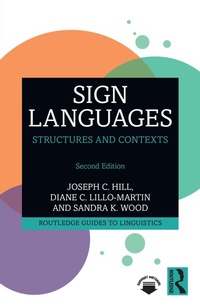
Sign Languages
Structures and Contexts
2nd Edition
Published on 30. April 2025
240 pages
978-1-040-31171-4 (ISBN)
Description

Sign Languages: Structures and Contexts provides a succinct summary of major findings in the linguistic study of natural sign languages. Focusing on American Sign Language (ASL), this book offers a comprehensive introduction to the basic grammatical components of phonology, morphology, and syntax with examples and illustrations.
Revised throughout, this new edition:
demonstrates how sign languages are acquired by Deaf children with varying degrees of input during early development, including no input where children create a language of their own
discusses the contexts of sign languages, including how different varieties are formed and used, attitudes toward sign languages, and how language planning affects language use
includes a new chapter on the similarities between signed and spoken languages
offers additional visuals and explanations as well as more coverage of signed languages other than ASL
is accompanied by updated online support material, which hosts links to video clips
This engaging and accessible introduction to sign languages is essential reading for students studying this topic for the first time with little or no background in linguistics.
Revised throughout, this new edition:
demonstrates how sign languages are acquired by Deaf children with varying degrees of input during early development, including no input where children create a language of their own
discusses the contexts of sign languages, including how different varieties are formed and used, attitudes toward sign languages, and how language planning affects language use
includes a new chapter on the similarities between signed and spoken languages
offers additional visuals and explanations as well as more coverage of signed languages other than ASL
is accompanied by updated online support material, which hosts links to video clips
This engaging and accessible introduction to sign languages is essential reading for students studying this topic for the first time with little or no background in linguistics.
More details
Series
Edition
2nd edition
Language
English
Place of publication
London
United Kingdom
Publishing group
Taylor & Francis Ltd
Target group
College/higher education
Illustrations
4 Tables, black and white; 4 Line drawings, black and white; 86 Halftones, black and white; 90 Illustrations, black and white
File size
4,78 MB
ISBN-13
978-1-040-31171-4 (9781040311714)
Copyright in bibliographic data and cover images is held by Nielsen Book Services Limited or by the publishers or by their respective licensors: all rights reserved.
Schweitzer Classification
Other editions
Additional editions

Book
04/2025
2nd Edition
Routledge
€174.50
Shipment within 10-20 days
Book
04/2025
2nd Edition
Routledge
€56.80
Shipment within 10-20 days

Book
03/2025
Routledge
Unfortunately, price unknown
Available (delivery time upon request)
Persons
Joseph C. Hill is Professor of Deaf Studies and Linguistics and Director of the Center for Black Deaf Studies at Gallaudet University in Washington, D.C., USA.
Diane C. Lillo-Martin is Board of Trustees Distinguished Professor and Head of the Department of Linguistics at the University of Connecticut, USA.
Sandra K. Wood is Assistant Professor of Linguistics and ASL Program Coordinator at the University of Southern Maine, USA.
Diane C. Lillo-Martin is Board of Trustees Distinguished Professor and Head of the Department of Linguistics at the University of Connecticut, USA.
Sandra K. Wood is Assistant Professor of Linguistics and ASL Program Coordinator at the University of Southern Maine, USA.
Content
List of Figures
List of Tables
Acknowledgments
Chapter 1: Introduction
Chapter 2: Phonology
Chapter 3: Morphology
Chapter 4: Syntax
Chapter 5: Modality and language
Chapter 6: Children with input from birth
Chapter 7: Contexts of later language development
Chapter 8: Homesign systems
Chapter 9: Variation
Chapter 10: Language Attitudes
Chapter 11: Language Policy and Planning
Chapter 12: Conclusion
Index
List of Tables
Acknowledgments
Chapter 1: Introduction
Chapter 2: Phonology
Chapter 3: Morphology
Chapter 4: Syntax
Chapter 5: Modality and language
Chapter 6: Children with input from birth
Chapter 7: Contexts of later language development
Chapter 8: Homesign systems
Chapter 9: Variation
Chapter 10: Language Attitudes
Chapter 11: Language Policy and Planning
Chapter 12: Conclusion
Index
