

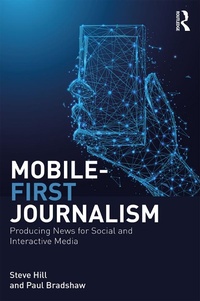
Mobile-First Journalism
Producing News for Social and Interactive Media
Published on 10. October 2018
240 pages
978-1-351-97239-0 (ISBN)
Description

Media publishers produce news for a full range of smart devices - including smartphones, tablets and watches. Combining theory and practice, Mobile-First Journalism examines how audiences view, share and engage with journalism on internet-connected devices and through social media platforms.
The book examines the interlinked relationship between mobile technology, social media and apps, covering the entire news production process - from generating ideas for visual multimedia news content, to skills in verification and newsgathering, and outputting interactive content on websites, apps and social media platforms. These skills are underpinned with a consideration of ethical and legal concerns involving fake news, online trolling and the economics of mobile journalism.
Topics include:
understanding how mobile devices, social media platforms and apps are interlinked;
making journalistic content more engaging and interactive;
advice on how successful news publishers have developed mobile and social media strategies;
adopting an approach that is entrepreneurial and user-centered;
expert interviews with journalists, academics and software developers;
learning key skills to launch and develop news websites, apps and social media outputs.
Mobile-First Journalism is essential reading for journalism students and media professionals and of interest to those studying on courses in social and new media.
The book examines the interlinked relationship between mobile technology, social media and apps, covering the entire news production process - from generating ideas for visual multimedia news content, to skills in verification and newsgathering, and outputting interactive content on websites, apps and social media platforms. These skills are underpinned with a consideration of ethical and legal concerns involving fake news, online trolling and the economics of mobile journalism.
Topics include:
understanding how mobile devices, social media platforms and apps are interlinked;
making journalistic content more engaging and interactive;
advice on how successful news publishers have developed mobile and social media strategies;
adopting an approach that is entrepreneurial and user-centered;
expert interviews with journalists, academics and software developers;
learning key skills to launch and develop news websites, apps and social media outputs.
Mobile-First Journalism is essential reading for journalism students and media professionals and of interest to those studying on courses in social and new media.
More details
Language
English
Place of publication
London
United Kingdom
Publishing group
Taylor & Francis Ltd
Target group
College/higher education
Illustrations
3 Tables, black and white; 17 Line drawings, black and white; 12 Halftones, color
File size
26,48 MB
ISBN-13
978-1-351-97239-0 (9781351972390)
Copyright in bibliographic data and cover images is held by Nielsen Book Services Limited or by the publishers or by their respective licensors: all rights reserved.
Schweitzer Classification
Other editions
Additional editions
Book
09/2018
1st Edition
Routledge
€207.60
Shipment within 10-20 days
Book
09/2018
1st Edition
Routledge
€60.20
Shipment within 10-20 days
Persons
Steve Hill is Course Leader of the MA in Multimedia Journalism at Westminster University, London. Previously, he lectured at Southampton Solent University, UK, and has a background in technology journalism. His books include Online Journalism: The Essential Guide (with Dr. Paul Lashmar, 2013).
Paul Bradshaw is Course Leader for both the MA in Multiplatform and Mobile Journalism and the MA in Data Journalism at Birmingham City University, UK. He also works as a consulting data journalist with the BBC England Data Unit. His books include Magazine Editing (with John Morrish, 2011), Snapchat for Journalists (2016), and the Online Journalism Handbook (2018).
Paul Bradshaw is Course Leader for both the MA in Multiplatform and Mobile Journalism and the MA in Data Journalism at Birmingham City University, UK. He also works as a consulting data journalist with the BBC England Data Unit. His books include Magazine Editing (with John Morrish, 2011), Snapchat for Journalists (2016), and the Online Journalism Handbook (2018).
Content
Preface
Acknowledgements
Introduction: Mobile and social media journalism - past, present and future
Chapter 1: Understanding the user
Chapter 2: The Mojo skillset
Chapter 3: Fake news and trolling
Chapter 4: Finding the story: verifying the news
Chapter 5: The art of storytelling
Chapter 6: Visual journalism, video and audio
Chapter 7: Publishing directly to social media
Chapter 8: Publishing news to the Web
Chapter 9: Building news apps
Acknowledgements
Introduction: Mobile and social media journalism - past, present and future
Chapter 1: Understanding the user
Chapter 2: The Mojo skillset
Chapter 3: Fake news and trolling
Chapter 4: Finding the story: verifying the news
Chapter 5: The art of storytelling
Chapter 6: Visual journalism, video and audio
Chapter 7: Publishing directly to social media
Chapter 8: Publishing news to the Web
Chapter 9: Building news apps
