

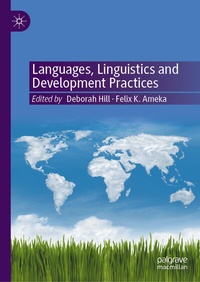
Languages, Linguistics and Development Practices
Description

This edited book presents case-studies and reflections on the role of languages and their analytic study in development practices across four regions: Africa, Asia, Australia, and the Pacific. The authors highlight the importance of conceptual studies of languages and cultures, as well as language choice, for enhancing development practices, demonstrating the value that language analysis and the humanities can add to the already multi-disciplinary field of Development Studies. The chapters draw on the fields of linguistics, human geography, education, diverse economies, community learning, sociology, and anthropology, and topics covered include some significant areas of interest to sustainable human development: education, work, finances, age, gender; as well as a key approach to development (asset-based community development). Chapters on informal adult learning provide opportunities to explore how and why language and linguistic analysis is relevant to development projects. The volume aims to promote collaboration and interdisciplinary dialogue and should be of interest to academics, practitioners and students of language and development, and to those working in the field of development globally.
Reviews / Votes
"A volume like this is long overdue. It shows how development studies needs to embrace an agenda that prioritises community-led approaches and builds on what communities themselves want, how they themselves conceptualise the challenges of development, how they talk about it, and what are the channels along which information passes most effectively in the local culture. Hill and Ameka's volume is impressively broad, bringing together researchers, development practitioners and educators with experience in Africa, Asia, Australia, and the Pacific, on a broad range of development topics. This thoughtful and original volume provides a powerful argument that development projects will not succeed without a deep and sensitive appreciation of how local languages lie at the heart of development challenges."-Nicholas Evans , Director, CoEDL (ARC Centre of Excellence for the Dynamics of Language), Distinguished Professor of Linguistics, Australian National University
"The book comes out at a time when the role of language in sustainable and human development is growingly explored. It critically analyses the affordances of linguistic analysis in development initiatives to promote inter-disciplinary dialogues and shared understanding. Drawing in grassroots-level experiences and collaborative perspectives in development practises, it provides a valuable direction to language and development studies."
-Qumrul Hasan Chowdhury , Department of English, University of Dhaka, Bangladesh
More details
Other editions
Additional editions
Persons
Deborah Hill is Associate Professor in TESOL and Linguistics at the University of Canberra, Australia. Her interests are language and culture, language description, semantics, and language in development. She has published on the grammar and (ethno-)semantics of Longgu, Solomon Islands. She is currently leading an agricultural research for development project in the Solomon Islands.
Felix K. Ameka is a socio-cultural-cognitive linguist, and Chair Professor Ethnolinguistic Vitality and Diversity at Leiden University, The Netherlands. He is a Fellow of the Ghana Academy of Arts and Sciences, Australian Academy of Humanities and Academia Europaea. His interests are language documentation and description, language and culture, and sociolinguistics of development. He has published on the lexicon, grammar, (ethno-)semantics, (ethno-)pragmatics, and language contact of West African languages.
