

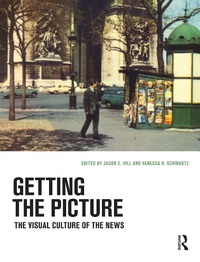
Getting the Picture
The Visual Culture of the News
1st Edition
Published on 8. September 2020
320 pages
978-1-000-21132-0 (ISBN)
Description

Powerful and often controversial, news pictures promise to make the world at once immediate and knowable. Yet while many great writers and thinkers have evaluated photographs of atrocity and crisis, few have sought to set these images in a broader context by defining the rich and diverse history of news pictures in their many forms.
For the first time, this volume defines what counts as a news picture, how pictures are selected and distributed, where they are seen and how we critique and value them. Presenting the best new thinking on this fascinating topic, this book considers the news picture over time, from the dawn of the illustrated press in the nineteenth century, through photojournalism's heyday and the rise of broadcast news and newsreels in the twentieth century and into today's digital platforms. It examines the many kinds of images: sport, fashion, society, celebrity, war, catastrophe and exoticism; and many mediums, including photography, painting, wood engraving, film and video.
Packed with the best research and full colour-illustrations throughout, this book will appeal to students and readers interested in how news and history are key sources of our rich visual culture.
For the first time, this volume defines what counts as a news picture, how pictures are selected and distributed, where they are seen and how we critique and value them. Presenting the best new thinking on this fascinating topic, this book considers the news picture over time, from the dawn of the illustrated press in the nineteenth century, through photojournalism's heyday and the rise of broadcast news and newsreels in the twentieth century and into today's digital platforms. It examines the many kinds of images: sport, fashion, society, celebrity, war, catastrophe and exoticism; and many mediums, including photography, painting, wood engraving, film and video.
Packed with the best research and full colour-illustrations throughout, this book will appeal to students and readers interested in how news and history are key sources of our rich visual culture.
Reviews / Votes
"These 49 essays are far-ranging and cogent, and shed new and needed light on the visual culture of the news. The essays address topics as varied as technology, style, fashion as news, veracity, the myth of the decisive moment, censorship, and photojournalism as art. Mostly, this work is not about the specific, and sometimes iconic, photographs cited but instead uses the pictures to illustrate larger cultural and professional issues. In ""Street Execution of a Viet Cong Prisoner, Saigon, 1968,"" Robert Hariman and John Louis Locates supply needed background information on Eddie Adams's photograph, but more importantly argue that ""the significance of 'Saigon Execution' was not that it represented or misrepresented an execution but that it embodied the moral ambiguity of violence that characterized US involvement in the Vietnam War. Its continued circulation suggests that in more ways than one, the war is not over."" Regarding celebrity, Ryan Linkof makes the case that ""photojournalism plays an inseparable role in making celebrities, but also works to drag them into a court of public opinion; it is at once a condition of celebrity and a consequence of it."" This book is an important and timely addition to the literature of visual media. Summing Up: Highly recommended. All readership levels."--C. Baker, Baylor University, USA, CHOICE
"An immensely rich collection of essays that will change the way that we understand and study the visual culture of the news."
--Lynda Nead, Birkbeck University of London, UK
"The representation of the news in pictures has a complex history that extends from early print-making through the industrial revolution to the contemporary digital device. It is amazing that this is the first book to attempt an in-depth account of this history, which is not just about images, but about editorial practices, technologies, censorship, authenticity, and styles of seeing and showing. Assembling a team of experts on everything from lithography to the laptop, the editors have created an essential scholarly compendium that will have a major impact on the general study of media and visual culture, as well as the specific fields of photography and art history."
--W. J. T. Mitchell, The University of Chicago, USA
"Getting the Picture is a fresh examination of the visual media that bring us the news. Its editors and contributors excel at drawing attention to moments of modernity captured, interpreted, disseminated and undergirded by the visual practices of the popular press. Historically grounded, theoretically informed, stylistically elegant and interpretively challenging, this anthology is an excellent foundational text."
--Laura Wexler, Yale University, USA
More details
Edition
1. Auflage
Language
English
Place of publication
London
United Kingdom
Publishing group
Taylor & Francis Ltd
Target group
Professional and scholarly
ISBN-13
978-1-000-21132-0 (9781000211320)
Copyright in bibliographic data and cover images is held by Nielsen Book Services Limited or by the publishers or by their respective licensors: all rights reserved.
Schweitzer Classification
Other editions
Additional editions
Book
06/2025
1st Edition
Routledge
€230.27
Shipment within 10-20 days
Book
02/2015
Bloomsbury Academic
€112.85
Article exhausted; check different version
Book
02/2015
1st Edition
Bloomsbury Academic
€71.98
Shipment within 15-20 days
Persons
Jason E. Hill is a 2014-15 Andrew W. Mellon Foundation Fellow at the New-York Historical Society and was previously the Terra Foundation Postdoctoral Fellow in American Art at the Institut National d'Histoire de l'Art in Paris, France.
Vanessa R. Schwartz is Professor of History, Art History and Film at the University of Southern California, where she directs the Visual Studies Research Institute and Graduate Program. She is the author of several books including Spectacular Realities (1998) and It's So French! (2007). Her most recent book project is Jet Age Aesthetics: Media and the Glamour of Motion.
Vanessa R. Schwartz is Professor of History, Art History and Film at the University of Southern California, where she directs the Visual Studies Research Institute and Graduate Program. She is the author of several books including Spectacular Realities (1998) and It's So French! (2007). Her most recent book project is Jet Age Aesthetics: Media and the Glamour of Motion.
Content
General Introduction Part I: Big Pictures Part Introduction 1. Patricia Mainardi, Dupinade, French caricature, 1831 2. Martha A. Sandweiss, General Wool and His Troops in the Streets of Saltillo, 1847 3. Matthew Fox-Amato, An Abolitionist Daguerreotype, New York, 1850 4. Anthony Lee, Antietam Sketches and Photographs, 1862 5. Jeannene Przyblyski, Barricades of Paris Commune, 1871 6. Thierry Gervais, Interview of Chevreul, France, 1886 7. John Mraz, Zapata and Salinas, Mexico, 1911 and 1991 8. Caitlin Patrick, Photographer on the Western Front, 1917 9. Michel Frizot, Sports Photomontage, France, 1926 10. Richard Meyer, Public Execution of Ruth Meyer, Sing-Sing Prison, 1928 11. Daniel Magilow, Photo of Kellogg-Briand Pact Meeting, Paris, 1931 12. Catherine Clark, A Decisive Moment, France, 1932 13. Sally Stein, Republican Soldier, Spanish Civil War, 1936 14. Barbie Zelizer, Child in Warsaw Ghetto, 1943 15. Alexander Nemerov, Flag-Raising, Iwo Jima, 1945 16. David Shneer, Soviet War Photo, Crimea, 1942 17. Vanessa Schwartz, New York in Color, 1953 18. Martin Berger, Rosa Parks Fingerprinted, Montgomery, Alabama, 1956 19. Mary Panzer, An Essay on Success in the USA, 1962 20. Diane Winston, Burning Monk, Saigon, 1963 21. David Lubin, Assassination of John F. Kennedy, Dallas, 1963 22. Victoria Gao, Chinese Political Persecution, Red Square, Harbin, 1966 23. Robert Hariman and John Lucaites, Street Execution of a Vietcong Prisoner, Saigon, 1968 24. Gennifer Weisenfeld, Industrial Poisoning, Minamata, 1972 25. Christian Delage, Police Beating, Los Angeles, 1992 26. Liam Kennedy, The Situation Room, Washington, DC, 2011 Part II: Re-Thinking the History of News Pictures 1. Justine de Young, Not Just a Pretty Picture: Fashion as News 2. Ryan Linkof, Celebrity Photos and Stolen Moments: Witnessing the Lives of Others 3. Ulrich Keller, Pictorial Press Reportage and Censorship in the First World War 4. Thierry Gervais, Illustrating Sports, or the Invention of the Magazine 5. Will Straw, After the Event: The Challenges of Crime Photography b) News Picture Media 6. Michael Leja, News Pictures in the Early Years of Mass Visual Culture in New York: Lithographs and the Penny Press 7. Jordana Mendelson, Beautiful Contradictions: News Pictures and Modern Magazines 8. Joe Clark, "Public Forum of the Screen": Modernity, Mobility, and Debate at the Newsreel Cinema 9. Mike Conway, "See it Now": Television News 10. Abigail Solomon-Godeau, Collective Self-Representation and the News: Torture at Abu-Ghraib c) News Picture Time 11. Jordan Bear, Adrift: The Time and Space of the News in Gericault's Le Radeau de La Meduse 12. Jason Hill, Snap-Shot After Bullet Hit Gaynor 13. Andres Zervigon, Rotogravure and the Modern Aesthetic of News Reporting 14. Zeynep Gursel, A Short History of Wire Service Photography d) Speaking of News Pictures 15. Jennifer Tucker, "Famished for News Pictures": Mason Jackson, The Illustrated London News, and the Pictorial Spirit 16. Patricia Goldsworthy, Staying Close to Power: Picturing the King's Entourage in Turn-of-the-Century Morocco 17. Nadya Bair, A Photojournalist is Never Alone: Photo Editing and Collaboration in the History of News Pictures 18. Kim Timby, Look at those Lollipops!: Integrating Color into News Pictures e) News Picture Connoisseurship 19. Katie Hornstein, Horace Vernet's Capture of the Smahla: Reportage and Actuality in the Early French Illustrated Press 20. Vincent Lavoie, Appraising News Pictures: Awarding a Multifaceted Icon 21. Kristen Gresh, An Era of Photographic Controversy: Edward Steichen at the MoMA 22. Gaelle Morel, Photojournalism as Formal Paradigm in Contemporary Art 23. Erina Duganne, Adam Broomberg, Oliver Chanarin, and World Press Photo: Contemporary Art and Contemporary Photojournalism
