

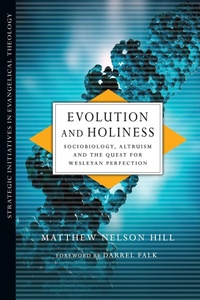
Evolution and Holiness
Description

Theology needs to engage what recent developments in the study of evolution mean for how we understand moral behavior. How does the theological concept of holiness connect to contemporary understandings of evolution? If genetic explanations of altruism fall short, what role should we give to environmental explanations and free will? Likewise, how do genetic explanations relate to theological accounts of human goodness and holiness?In this groundbreaking work, Matthew Hill uses the lens of Wesleyan ethics to offer a fresh assessment of the intersection of evolution and theology. He shows that what is at stake in this conversation is not only the future of the church but also the fine-tuning of human evolution.
More details
Other editions
Additional editions
Person
Falk is professor of biology, associate provost, and dean of graduate studies and continuing education at Point Loma Nazarene University in Point Loma, California.
Matthew Nelson Hill (PhD, Durham University) is assistant professor of philosophy in the department of theology at Spring Arbor University. He is an ordained elder in the Free Methodist Church and previously served as a pastor in the Genesis Conference while teaching at Roberts Wesleyan College.
Content
Foreword by Darrel R. Falk Acknowledgments Chapter 1: Introduction 1.1 The Aim of This Study 1.2 Brief Summary of Main Chapters 1.3 What Is at Stake? 1.4 Brief Clarifications Before Main Chapters Chapter 2: Sociobiological Explanations of Altruism 2.1 An Introduction to Biological Altruism 2.2 Sociobiological Altruism: From Darwin to Dawkins 2.3 Moving Forward Chapter 3: Altruism and the Explanatory Limitations of Evolution 3.1 The Environment and Its Influence on Human Behavior 3.2 Problematic Language 3.3 Reductionism and Its Relationship to the Explanation of Altruism 3.4 A Reductionist-Driven False Opposition Between Philosophy/Theologyand Sociobiology 3.5 Conclusion Chapter 4: Overcoming Genetic and Environmental Constraints on Altruism 4.1 The Determined Human Person? 4.2 The Human Person as Influenced but Not Determined 4.3 Humans Are Genuinely Free and Consequently Responsible 4.4 Conclusion Chapter 5: Wesleyan Holiness Against a Backdrop of Evolution 5.1 The Quest for Holiness 5.2 Genetic Selfishness and Its Implications for Wesleyan Ethics 5.3 Conclusion Chapter 6: How Wesley Nurtured Altruism Despite Biological Constraints 6.1 Wesley?s Structure and Organization 6.2 How Wesley Understood and Nurtured Altruism by Way of Holiness 6.3 Environmental Constraints That TemperBiological Constraints 6.4 Conclusion Chapter 7: A Lifestyle of Holiness 7.1 Brief Summary of Main Chapters 7.2 Holiness Outside the Wesleyan Community 7.3 Practical Implications and Further Explorations 7.4 Conclusion Appendix 1:Excerpt from "Principles of a Methodist" on the Topic of Christian Perfection Appendix 2: Excerpt from "A Plain Account of Christian Perfection" Appendix 3: Rules of the Band Societies--Drawn Up Dec. 25, 1738 Bibliography General Index
