

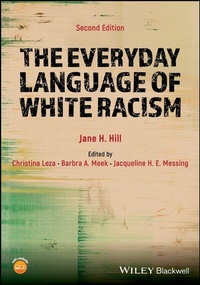
The Everyday Language of White Racism
Description

A groundbreaking critical discourse analysis of everyday language, reveals the underlying racist stereotypes circulating in American culture
In The Everyday Language of White Racism, prominent linguist Jane H. Hill provides an incisive analysis of the relationship between language, race, and culture. First published in 2008, this classic textbook employs an innovative framework to reveal the underlying racist stereotypes that continue to persist in White American culture and sustain structures of White Supremacy. Detailed yet accessible chapters integrate a broad range of literature from across disciplines, including sociology, social psychology, critical legal studies, anthropology, and sociolinguistics. Throughout the book, students are encouraged to engage with the linguistic data available through observation of racialized communication in their everyday lives.
Edited by a team of leading scholars, the second edition of The Everyday Language of White Racism brings Hill's contributions to the study of racism into conversation with the most current literature on language and racism in the United States. Topics such as racial profiling, police violence, the Black Lives Matter movement, White nationalism, White fragility, and various forms of institutional racism are addressed within Hill's broader framework of White racial projects and the "White folk" theory of race and racism. New chapter-by-chapter annotations clarify and contextualize theoretical concepts, accompanied by new discussion questions that offer guidance for analytical conversations in classrooms.
- Provides resources for critical discussions on contemporary racial issues that continue to limit and endanger BIPOC (Black, Indigenous, and People of Color) individuals and communities
- Dispels the common assumption that White racism is fading in the US and the Western world
- Illustrates how racist effects can be produced in interaction without any single person intending discrimination
- Contains an overview of the theory of race and racism, with definitions of terms and concepts
- Includes recent statistical data on U.S. racial gaps across a variety of categories and access to a companion website with additional resources
The Everyday Language of White Racism, Second Edition remains an indispensable resource for undergraduate and graduate students in Critical Race Studies and Linguistic Anthropology courses across the Humanities and Social Sciences.
More details
Other editions
Additional editions
Persons
JANE H. HILL was Regents' Professor of Anthropology and Linguistics at the University of Arizona. She was a Fellow of the American Association for the Advancement of Science, a member of the American Academy of Arts and Sciences, and past President of the American Anthropological Association. She was awarded the Viking Fund Medal in Anthropology in 2005.
CHRISTINA LEZA is Associate Professor of Anthropology at Colorado College. She is a linguistic anthropologist and Yoeme-Chicana activist scholar whose scholarship focuses on Indigenous rights and lifeways, social justice movements, racial discourse, and the U.S.-Mexico border.
BARBRA A. MEEK is a Comanche citizen and Professor of Anthropology, Linguistics, and Native American Studies at the University of Michigan, where she is currently serving as Associate Dean for the Social Sciences in the College of Literature, Science and the Arts.
JACQUELINE H. E. MESSING is Lecturer of Anthropology at the University of Maryland-College Park. Her publications have appeared in journals including Language in Society, International Journal of the Sociology of Language, and several edited volumes.
Content
Editors' Acknowledgments viii
Editors' Preface to the Second Edition ix
Preface and Acknowledgments xiv
About the Companion Website xviii
1 The Persistence of White Racism 1
2 Language in White Racism: An Overview 38
3 The Social Life of Slurs 56
4 Gaffes: Racist Talk Without Racists 93
5 Covert Racist Discourse: Metaphors, Mocking, and the Racialization of Historically Spanish-speaking Populations in the United States 124
6 Linguistic Appropriation: The History of White Racism Is Embedded in American English 165
7 Everyday Language, White Racist Culture, Respect, and Civility 184
Notes 193
The Social Life of Slurs Revisited 205
Adam Hodges Copyrighted Material
Cosmopolitan Affectations, Codeswitching Ideologies, and Counterfeit Immigrants in the Hilaria Baldwin "Cucumber" Affair 218
Norma Mendoza-Denton
The Possibilities and Perils of Mock Spanish 231
Elaine W. Chun
Linguistic Appropriation: Admiration, Hatred, and Exploitation in Racial Relief 240
John Baugh
Index 250
