

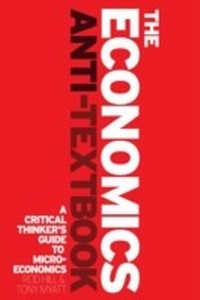
The Economics Anti-Textbook
A Critical Thinker's Guide to Microeconomics
1st Edition
Published on 11. March 2010
316 pages
978-1-84813-548-2 (ISBN)
Description

Mainstream textbooks present economics as an objective science free from value judgements; that settles disputes by testing hypotheses; that applies a pre-determined body of principles; and contains policy prescriptions supported by a consensus of professional opinion. The Economics Anti-Textbook argues that this is a myth - one which is not only dangerously misleading but also bland and boring. It challenges the mainstream textbooks' assumptions, arguments, models and evidence. It puts the controversy and excitement back into economics to reveal a fascinating and a vibrant field of study - one which is more an 'art of persuasion' than it is a science.
The Economics Anti-Textbook's chapters parallel the major topics in the typical text, beginning with a boiled-down account of them before presenting an analysis and critique. Drawing on the work of leading economists, the Anti-Textbook lays bare the blind spots in the texts and their sins of omission and commission. It shows where hidden value judgements are made and when contrary evidence is ignored. It shows the claims made without any evidence and the alternative theories that aren't mentioned. It shows the importance of power, social context and legal framework.
The Economics Anti-Textbook is the students' guide to decoding the textbooks and shows how real economics is much more interesting than most economists are willing to let on.
The Economics Anti-Textbook's chapters parallel the major topics in the typical text, beginning with a boiled-down account of them before presenting an analysis and critique. Drawing on the work of leading economists, the Anti-Textbook lays bare the blind spots in the texts and their sins of omission and commission. It shows where hidden value judgements are made and when contrary evidence is ignored. It shows the claims made without any evidence and the alternative theories that aren't mentioned. It shows the importance of power, social context and legal framework.
The Economics Anti-Textbook is the students' guide to decoding the textbooks and shows how real economics is much more interesting than most economists are willing to let on.
Reviews / Votes
Rod Hill and Tony Myatt have written one of the best critical texts of neoclassical microeconomics that I have ever seen. It is a great text to assign along with an introductory or intermediate microeconomics text. * Frederic S. Lee, American Journal of Economics and Sociology * Hill and Myatt's timely book should be compulsory reading for every student of economics. * Alan Freeman, UK Association for Heterodox Economics * What humankind needs second most (first is a cure for global warming), is a means of defusing the lethal ideological superstitions implanted in the educated masses by Samuelson/Mankiw type economics textbooks. Hill and Myatt's "anti-textbook" goes a long way toward providing it. * Edward Fullbrook * I highly recommend Hill and Myatt's "anti-textbook." It is not so much an outright rejection of traditional treatments of introductory microeconomics as it is an exercise in laying bare the premises on which they are based and then suggesting alternative assumptions and methodologies. This approach leaves the student with a much deeper understanding of economic theory and it shows our discipline for what it truly is: an ongoing conversation among competing paradigms. I urge instructors to amend their courses so that time can be made for this important critique. * John. T. Harvey, author of Currencies, Capital Flows and Crises * Every honest economics teacher absolutely must make this book a compulsory reading for their students. * Samir Amin, United Nations African Institute for Planning *More details
Edition
1. Auflage
Language
English
Place of publication
London
United Kingdom
Publishing group
Bloomsbury Publishing PLC
Target group
College/higher education
Professional and scholarly
ISBN-13
978-1-84813-548-2 (9781848135482)
Copyright in bibliographic data and cover images is held by Nielsen Book Services Limited or by the publishers or by their respective licensors: all rights reserved.
Schweitzer Classification
Other editions
Additional editions
Book
03/2010
Zed Books Ltd
€113.00
Article exhausted; check different version
Book
03/2010
Zed Books Ltd
€37.90
Shipment within 3-4 weeks
Persons
Rod Hill has taught at the University of Windsor, University of Regina and the University of New Brunswick, where he has been a Professor of Economics since 2003. He's a member of Economists for Peace and Security and the Progressive Economics Forum.
Tony Myatt has taught at McMaster University, Western University, Nipissing University College, the University of Toronto, and the University of New Brunswick, where he has been Professor of Economics since 1992. He has developed several different introductory courses as vehicles for teaching principles of economics, including Economics of Everyday Life, Economics in the Real World, and Economics Through Film. Professor Myatt was the recipient of UNB's Arts Faculty Award for Excellence in Teaching in 2008.
Tony Myatt has taught at McMaster University, Western University, Nipissing University College, the University of Toronto, and the University of New Brunswick, where he has been Professor of Economics since 1992. He has developed several different introductory courses as vehicles for teaching principles of economics, including Economics of Everyday Life, Economics in the Real World, and Economics Through Film. Professor Myatt was the recipient of UNB's Arts Faculty Award for Excellence in Teaching in 2008.
Content
Introduction - Our Goals, Audience, and Principal Themes
1. What is economics? Where you start influences where you go
2. Introducing economic models
3. How markets work (in an imaginary world)
4. People as consumers
5. The firm
6. Market Structure and Efficiency - or why perfect competition isn't so perfect after all.
Addendum - What about the efficiency of asset markets?
7. Externalities and the ubiquity of market failure
8. The marginal productivity theory of income distribution - or you're worth what you can get
9. Government, taxation, and the (re)distribution of income: is a just society just too expensive?
10. Trade and globalization without the rose-tinted glasses
Conclusion
Postscript - A Case Study on the Global Financial Meltdown
1. What is economics? Where you start influences where you go
2. Introducing economic models
3. How markets work (in an imaginary world)
4. People as consumers
5. The firm
6. Market Structure and Efficiency - or why perfect competition isn't so perfect after all.
Addendum - What about the efficiency of asset markets?
7. Externalities and the ubiquity of market failure
8. The marginal productivity theory of income distribution - or you're worth what you can get
9. Government, taxation, and the (re)distribution of income: is a just society just too expensive?
10. Trade and globalization without the rose-tinted glasses
Conclusion
Postscript - A Case Study on the Global Financial Meltdown
