

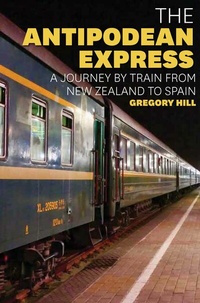
The Antipodean Express
Description

The journey of The Antipodean Express takes in 89 days of travel, on 33 trains, through 19 countries. It begins in New Zealand's North Island, weaves past the volcanoes of Java, through East Asia and on into Europe. From hilarious miscommunications in China to cultural immersion at the Bolshoi Ballet, there are stop-offs with half a world's worth of impressions, people, history, food, music and culture. Hill also describes most of the great trains of the Eurasian hemisphere, from New Zealand's Northern Explorer to the Eurostar, and everything in between.
The culmination is a day spent in the obscure Spanish village of Alaejos, locating the exact antipode of the author's living room. The perfect end to a vast adventure.
Reviews / Votes
Inspiring and unexpected, The Antipodean Express is a delightful account of a New Zealand couple's extraordinary adventures to reach the other side of the globe. -- Kristen Rabe * Foreword Review * "Hill's book is well illustrated, and he writes in a highly engaging and descriptive style with a wonderful irreverence for which the word flippant might be generously mild, of the numerous towns and villages one would never see any other way" * The Otago Daily Times * "Well written and a thoroughly enjoyable story. Gregory Hill has a most wonderful sense of humour as he describes situations and people's foibles that they met on this epic journey. There were many times that I laughed, smiled or was sitting on the edge of my seat. It certainly is an enjoyable page turner." * School Days Magazine * "Well illustrated with maps and photos, The Antipodean Express is a fun armchair journey with Gregory and Anne, with musical interludes, and a vivid travel chronicle filled with surprising global insights and fascinating railway anecdotes. A captivating travel log has been converted into an expressive reminder of the privilege and enjoyment that can be derived from setting out on a grand railway exploration. Always making sure to keep on the right track(s) - so to speak!" * Public Service News * "Hill displays an infectious enthusiasm and engaging wide-eyed innocence. The Antipodean Express provides an amiable dollop of armchair travel with a genial companion who ends his long expedition with... what else but a refreshing sangria and victory dinner in Salamanca." * NZ Listener * "For lovers of train travel it's all about the journey. And what a journey Gregory Hill and his wife Anne Loeser took - 89 days of travel, on 33 trains through 19 countries. The journey is chronicled rather beautifully in Gregory's book The Antipodean Express which is subtitled A Journey by Train from New Zealand to Spain. To my mind this trip is right up there with some of the great rail journeys I have followed involving Michael Portillo, Paul Theroux, Joanna Lumley, and, among others, Michael Palin." * InReview * "A railway adventure tracing a journey from the author's home in New Zealand to its exact antipodes in rural Spain. The narrative recounts 89 consecutive days of travel with 33 trains through 19 countries. It describes most of the great trains of the Eurasian hemisphere, from New Zealand's Northern Explorer to the Eurostar and everything in between. Full of people, memories, history, and places - anyone interested in travel, trains, food, music, and cultures will love taking this armchair journey." * Our Generation Magazine * "The most interesting book I have read for a long time." * Flax Roots * "The Indian Pacific and the Ghan are like luxurious cruise ships on rails" * ABC Melbourne Afternoons with Trevor Chapel (Broadcast Statewide in Victoria) * "The trip was not about getting to the destination. It was about the journey itself," * Travel Writer's Radio - author Greg Hill. * "Enjoy travelling vicariously with some quirky companions? How about a journey from New Zealand to Spain undertaken almost entirely by train? Meet amusingly eccentric French horn player Gregory Hill and his German violinist wife Anne. Well-illustrated with maps and photos, this is a fun armchair journey with Gregory and Anne with musical interludes including the Bolshoi Ballet and the Paris Opera * Gourmet On The Road *All prices
More details
Other editions
Additional editions
Person
Content
Dramatis personae 1
Introduction 4
Sunday, 31 March Wellington to Auckland 6
Monday, 1 April Auckland to Sydney 11
Tuesday, 2 April Sydney and the Blue Mountains 13
Wednesday, 3 April Sydney to Bogan Gate 15
Thursday, 4 April Broken Hill to Adelaide 18
Friday, 5 April Adelaide and Hahndorf 20
Saturday, 6 April Adelaide and Kangaroo Island 22
Sunday, 7 April Adelaide to Mabel Creek 24
Monday, 8 April Marla and Alice Springs 26
Tuesday, 9 April Tennant Creek to Katherine and Darwin 28
Wednesday, 10 April Darwin 30
Thursday, 11 April Darwin to Denpasar 32
Friday,12 April Denpasar to Banyuwangi 34
Saturday, 13 April Banyuwangi and Kawah Ijen 38
Sunday, 14 April Banyuwangi to Surabaya 41
Monday, 15 April Surabaya to Borobudur 44
Tuesday, 16 April Borobudur and Yogyakarta 46
Wednesday, 17 April Yogyakarta 50
Thursday, 18 April Yogyakarta to Jakarta 53
Good Friday, 19 April Jakarta 55
Saturday, 20 April At sea 59
Easter Sunday, 21 April Bintan, Singapore and Malacca 61
Monday, 22 April Malacca 65
Tuesday, 23 April Malacca to Kuala Lumpur 68
Wednesday, 24 April Kuala Lumpur to George Town 72
Thursday, 25 April George Town 75
Friday, 26 April George Town to Hat Yai and beyond 78
Saturday, 27 April Bangkok 83
Sunday, 28 April Bangkok to Siem Reap 86
Monday, 29 April Siem Reap to Phnom Penh 90
Tuesday, 30 April Phnom Penh to Ho Chi Minh City 93
May Day, Wednesday, 1 May Ho Chi Minh City 97
Thursday, 2 May The Unification Express, Vietnam 101
Friday, 3 May Hanoi 104
Saturday, 4 May Hanoi and Ninh Binh 107
Sunday, 5 May Dong Dang to Hong Kong 110
Monday, 6 May Hong Kong 115
Tuesday, 7 May Hong Kong to Hangzhou 119
Wednesday, 8 May West Lake 122
Thursday, 9 May Hangzhou to Xi'an 125
Friday, 10 May Xi'an 128
Saturday, 11 May Xi'an to Xining 131
Sunday, 12 May Xining to Lhasa 136
Monday, 13 May Lhasa 139
Tuesday, 14 May Lhasa 142
Wednesday, 15 May Lhasa to Shigatse 145
Thursday, 16 May Shigatse to Rongbuk 149
Friday, 17 May Rongbuk to Shigatse 153
Saturday, 18 May Shigatse to Lhasa 155
Sunday, 19 May Lhasa to Tongtianheyan 158
Monday, 20 May Tongtianheyan to Liangzhen 161
Tuesday, 21 May Beijing 163
Wednesday, 22 May Beijing to Erenhot 166
Thursday, 23 May Erenhot to Sukhbaatar 171
Friday, 24 May Naushki to Irkutsk 174
Saturday, 25 May Irkutsk to Listvyanka 181
Sunday, 26 May Listvyanka 187
Monday, 27 May Listvyanka to Nizhneudinsk 190
Tuesday, 28 May Nizhneudinsk to Tatarsk 193
Wednesday, 29 May Omsk to Kirov 197
Thursday, 30 May Kirov to Suzdal 200
Friday, 31 May Suzdal 205
Saturday, 1 June Suzdal to Moscow 210
Sunday, 2 June Moscow 214
Monday, 3 June Moscow 220
Tuesday, 4 June Moscow to Smolensk 225
Wednesday, 5 June Orsha to Gotha 228
Thursday, 6 June Eisenach to Paris 233
Friday, 7 June Paris 237
Saturday, 8 June Anne's birthday in Paris 240
Sunday, 9 June Paris to Figueres 243
Monday, 10 June Figueres to Cadaques 246
Tuesday, 11 June Cadaques and Far de Cala Nans 250
Wednesday, 12 June Cadaques and Cap de Creus 253
Thursday, 13 June Cadaques to Barcelona 256
Friday, 14 June Barcelona 259
Saturday, 15 June Barcelona to Salamanca 263
Sunday, 16 June Alaejos 267
Monday, 17 to Salamanca to Wellington 275
Friday, 28 June
MAPS
Route of the Antipodean Express viii New Zealand North Island 9
Eastern Australia 16
Central Indonesia 35
Singapore 62
Peninsular Malaysia 69
Thailand 79
Cambodia 91
Vietnam 100
China and Mongolia 111
Hong Kong 116
Central Russia 177
Primorsky Slyudyanka 179
Western Russia and Belarus 196
Poland 230
Germany 232
France 234
Spain 247
Index 279
Wednesday, 22 May
Beijing to Erenhot
We were up and out the door before 6 am, ready for our rehearsed walk to the station as Beijing woke up. We got to the forecourt flagpole rendezvous with time to spare, and found our anxious but efficient young Chinese minder, courtesy of Monkey Business. Including us, he was putting six tourists on the Trans-Mongolian Express today. There was quite a crowd gathering in the big expanse of the forecourt, with the Chinese-Socialist-Realist twin clock towers of Beijing Station rearing above us. The excitement of people about to depart on a very long train journey was palpable all around us.
The Trans-Mongolian Express goes all the way to Moscow, but we would be going only to Irkutsk in Siberia on this train, 2680 kilometres, in 55 hours. Tickets finally in hand, our guide ushered us through security into the big spacious station.
In its day Beijing station was the largest in China; it must have been very impressive when it was built by a desperately poor nation in 1959. Up to a waiting area in one of the upstairs galleries; then we had plenty of time to kill and an opportunity for breakfast. There were a few Chinese fast-food joints and I found a really good breakfast of wonton soup with seaweed, and a youtiao fried bread stick, the same as a Vietnamese qu?y. This was followed, I'm sorry to say, by a KFC cappuccino which lived down to expectations. The station filled up with people as the day got going, but it was never as busy as the frantic monster-stations in Nanning and Guangzhou. The big blue departure board had only five departures in the next three hours on it. Soon we were on our way down the escalator to our next long green train, Train K3 to Moscow. Each carriage had a plaque on it in Russian Cyrillic, Chinese characters, and Mongolian Cyrillic, announcing Beijing-Ulaanbaatar-Moscow.
Once, eleven years previously, I had been at the same station and I saw one lonely carriage with this plaque on it. Back then it seemed impossibly exotic, and I wondered if I would ever get into a carriage like that.
Now here we were, it was happening, and it was hugely exciting. The whole business of boarding was very easy and stress-free compared with most of our experience so far. What a luxury to have a two-berth cabin to ourselves again. Two bunks, one above the other, lying transversely across one side of the cabin, and one comfortable seat next to the window, facing the bottom bunk, on the other side. Dark wood-veneer panelling, plush red velvet curtains and trimmings, and carpet on the floor. In an odd arrangement, we shared a bathroom with our neighbours. A basin and handheld shower, no toilet, situated between our cabin and the one next door, with access from each cabin. Our neighbours were friendly Cheryl and Yip from Singapore, fellow Monkey Business travellers.
The thumps and exclamations of people moving into their accommodation for the next few days carried on for a while, so I took the opportunity for a stroll to the front of the train for a look at the locomotive, a big brutal blue rectangular block of a thing with pantographs up to the overhead wires. The railway through north-east China and Mongolia to Ulan-Ude on Russia's Trans-Siberian line was opened in 1956 just after I was born. The entire route through to Moscow basically follows the ancient Beijing to Moscow tea-caravan route which used to take 40 very bumpy horse-drawn days, until 1898 when the western half of the Trans-Siberian railway was opened.
Everybody on board, doors closed, we left Beijing Station exactly on time at 7.27. One and a half hours ago the streets had been almost empty and now we were in the midst of the rush hour, crossing on viaducts over six-lane highways packed with traffic: cars, taxis, vans and a few buses.
On my first visit to Beijing, or Peking as we were still calling it then, in 1975, there was, if anything, more congestion, and it was all bicycles. Absolutely no private cars, a few belching heavy trucks, and carts pulled by strange two-wheeled tractors with long handlebars stretching back to the driver sitting on the cart. And a slow-moving dark jungle of black bicycles ridden by an army of people in Mao jackets. You could express your individuality through your choice of dark blue or dark grey.
This time around, the city of 20 million thinned out surprisingly quickly and after 30 minutes we were following a large river, maybe the Sanggan, westwards through a mountainous gorge with countless other railways and bridges and tunnels going off in every direction. Being a lot older than the Tibet railway, the engineering scars on the landscape had had time to soften, no longer the gaping wounds on the land that constantly confronted us on the Tibet train. This was all stunningly beautiful, and in fact the Great Wall was supposed to be an occasional companion up on the rugged skyline. I looked and looked but I didn't see it. Standing, or sitting on the fold-down seats, in the corridor was a treat because the top half of the windows on that side opened all the way, and it was great for photography and a breeze in your hair.
Passengers had been allocated seating times in the dining car, and our lunch sitting was rather early at eleven o'clock. Another pleasant modern Chinese dining car, this time with quite a few white faces, offered rice, celery, and a sausage and carrot stew. It wasn't very good. There was no choice, so there were no problems with translating the menu. The lunch did, however, have the added attraction of being free. Well, included in the ticket-price anyway. After lunch we went back to the luxurious privacy of our own room, and we arrived in Datong for our first stop at 1.30. We didn't get out. Datong was originally set up as an army outpost, part of the Great Wall defences, and much more recently its claim to fame was as one of the last manufacturing centres in the world for steam locomotives, until 1989.
The landscape gradually flattened out to a dull green featureless plain, the precursor, I guess, of the Gobi Desert. Distant mountains disappeared. Camels materialized in the nearer distance. Dusk came on around seven o'clock, the sky and the desert slowly transformed to a glowing orange; it was quite magical.
The sun disappeared in a blaze of glory at ten to eight and we pulled into Erenhot, the Chinese stop for the Mongolian border, in the very last of the dusk at 8.15. Chinese emigration was a relaxed and rather slow affair. We stayed on the train and pleasantly polite Chinese border guard ladies visited each cabin and took our passports away. The train stayed put for an hour or so after that.
Mongolia was just a couple of kilometres away, but there is a major impediment for trains travelling from China to Mongolia. In China the rail gauge is 1.435 metres, known as Standard Gauge throughout China, Europe, America and Australia. Standard Gauge was invented by the Englishman George Stephenson, of 'Rocket' fame, in the early nineteenth century. He measured the axle-widths of 100 horse-carts and came up with an average of 4 feet 8.5 inches. That's 1.435 metres. In Mongolia they use the slightly wider Russian gauge of 1.52 metres, meaning a train cannot run unchecked between China and Mongolia. The solution is to separate all the carriages, lift them up individually, and replace all the wheels with new sets of wheels, or bogies, of the correct gauge for the new country.
Now the train was broken up into separate units, an endless process of bangs and jerks, starting in the distance and getting closer and closer like a thunderstorm, until it was our turn. Then we were shunted into an enormous brick shed, and banged back and forth until we were lined up with the big hydraulic jacks that would lift us up. All this took forever, and other carriages in front and behind and parallel beside us went through the process at the same time.
The Trans-Mongolian Express awaits new bogies at Erenhot on the China-Mongolia border.
A train crew member appeared in our corridor, tapping and patting the carpet, looking for something. Dissatisfied, he lifted the carpet, still to no avail. He went away and brought back someone else, and a heated discussion ensued, with lots of pointing into our cabin, at me. Our man then indicated that he wanted to lift the carpet of our cabin, and I started to wonder what was hidden under there and how uncomfortable Erenhot jail might be. But all was in order, and under the carpet, just inside our cabin door, was the vertical pivot of the wheel bogie, the pivot which allows the four-wheeled bogie to turn for curves in the track. The pivot had to be unlocked with a large wrench, then lifted up out of the bogie, through our cabin floor.
The pivot was a thick, greasy steel shaft maybe a metre long. Our man couldn't budge it at first, and it took lots of banging and grunting before he finally got the shaft out and laid it neatly and greasily on the carpet, making a nice mess in the process. Someone must have gone through the same business at the other end of the carriage, and now we were ready to be jacked up, leaving the disconnected bogies on the ground. After a whole lot more banging and jerking, we were imperceptibly slowly lifted about one and a half metres.
I could watch all this in better detail by observing the carriage next to us. The abandoned bogie sat on quadruple tracks which accommodated both gauges. The Chinese bogie was wheeled out and then a Mongolian one was wheeled in and lined up. The carriage was then gently lowered. Everything had to be perfectly aligned for the pivot shaft in our room to be reinserted; that took several attempts and lots more banging. Then once we were down the brakes and other linkages all had to...
