

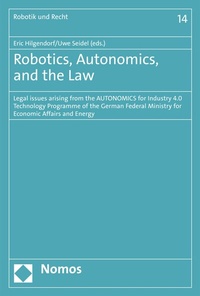
Robotics, Autonomics, and the Law
Legal issues arising from the AUTONOMICS for Industry 4.0 Technology Programme of the German Federal Ministry for Economic Affairs and Energy
1st Edition
Published on 5. September 2017
267 pages
978-3-8452-8465-1 (ISBN)
Description

Autonomous Systems are a hot topic. Their development is being driven by advances in networking, sensor technology and machine learning. Countries like the USA, Korea, Japan, China and Germany, are taking the lead. Technology develops internationally but the law is shaped and made at a national level. Tension between the two disciplines are almost inevitable, especially since technology is advancing at such a fast pace.
The research papers collected in this volume focus on fundamental questions of how the law should deal not only with new technologies in general, but also with some special issues, such as autonomous vehicles and drones. These texts were generated by the AUTONOMICS for Industry 4.0 technology program of the German Federal Ministry of Economics and Technology.
With contributions by:
Prof. Dr. Dr. Eric Hilgendorf; Uwe Seidel; Prof. Dr. Amedeo Santosuosso; Prof. Dr. Ryan Calo; Xiaoyan Huang; Minkyu Kim; Takayuki Matsuo, Prof. Dr. Kristen Thomasen; Prof. Dr. Susanne Beck; Berthold Haustein, Jochen Feldle
More details
Other editions
Additional editions
Eric Hilgendorf | Uwe Seidel
Robotics, Autonomics, and the Law
Legal issues arising from the AUTONOMICS for Industry 4.0 Technology Programme of the German Federal Ministry for Economic Affairs and Energy
Book
08/2017
1st Edition
Nomos
€69.00
Shipment within 7-9 days
Persons
Content
- Cover
- Industry 4.0 and Law - Experiences from AUTONOMICS
- A. Introduction
- B. Industry 4.0 - New Legal Challenges in Value Chain Networks
- C. Supporting the Development of Compliance Rules for Technology
- D. Examples from the AUTONOMICS Projects
- E. Engineering Networked Production Facilities
- F. Autonomous Systems in Intralogistics
- G. Industrial Service Robotics
- H. Human Workers in Manufacturing
- I. Areas of Law that Relate to Autonomous Systems
- J. Civil Law
- K. General Provisions of Civil Law
- I. Section 437 German Civil Code
- II. Section 280 German Civil Code
- III. Section 823 German Civil Code
- IV. Section 1 Product Liability Act
- V. Section 3 Product Liability Act
- L. Criminal Law
- M. Fundamental Issues Relating to Liability for Defective Products
- N. Duties Regarding the Design of Products
- O. Duties Regarding Production
- P. Duties Relating to the Use of Products (Requirement for User Information)
- Q. Duties that Producers have after a Product has been brought into Circulation
- R. Data Protection Law
- Autonomous Systems and the Law: Why Intelligence Matters
- A. Robotics and the Law Today: What is Changing
- I. From Robotics to Autonomous Systems: The Meaning of a Terminological Change
- II. The Case for Embodiment
- III. Intelligence
- IV. AI and Actions
- V. Autonomy
- 1.6. From Robots to Autonomous Systems
- B. The EU Regulatory Framework
- I. The Robot as a Machine: Directive 2006/42/EC on Machinery
- II. The Robot as a Product: Directive 2001/95/EC, Decision 768/2008/EC and Regulation (EC) 765/2008 on General Product Safety and Marketing of Products
- III. The Robot and the Consumer: Directive 1999/44/EC on the Sale of Consumer Goods
- C. Fields of Application of Autonomous Systems
- I. The Transnational Debate in Europe
- II. Industry 4.0 and Innovation in the Workplace
- 1. New Technologies Driving Innovation
- 2. The Legal Challenges
- (1) Electronic Correspondence and Privacy in the Workplace.
- (2) Data Collection and Monitoring & Surveillance in the Workplace.
- (3) Employability, and a New Organisation of Work
- 3.3. Robotics and Health Care
- 4. Why Intelligence Matters in Autonomous Systems
- Robots in American Law
- INTRODUCTION
- A. ROBOTS AS LEGAL OBJECTS
- I. Appropriation by Robot
- II. Robotic Performance
- III. Animate Objects
- IV. Robot Possession
- V. The Robot Burglar
- VI. The Unreliable Robot
- B. ROBOTS AS LEGAL SUBJECTS
- I. The Robot Judge
- II. The Robot Juror or Witness
- III. The Defendant's Robot
- C. THE MEANING OF ROBOT CASE LAW
- I. Robotics Law: An Early Agenda
- II. Law and Contemporary Robotics
- CONCLUSION
- Technology Law in China: Computer Hacking, Cloud Computing and Robotics as Examples
- A. Introduction: The Relationship between Technology and Law
- B. A Newly Emerging Legal Field: Technology Law
- C. Legal Challenges in Industrie 4.0 - Developing Legal Solutions Relevant to Made in China 2025?
- D. The Example of Computer Hacking and Criminal Law
- I. Internet Crime and Computer Hacking
- II. Criminal Law Provisions in China to Combat Hacking and Associated Problems
- III. Prospects for Future Criminal Law Provisions against Computer Hacking in China
- E. The Example of Cloud Computing and Data Protection Law
- I. Data Related to Persons
- II. Cloud Computing and Personal Privacy Issues
- III. The Legal Situation and Problems of Data Protection Law in China
- IV. The Outlook for Future Legislation on Data Protection in China
- F. The Example of Robotics and Law
- G. Summary and Outlook
- New Legislation and the Reform of the Rules on Robots in Korea
- A. The Current Situation in Korea
- B. Legal Challenges posed by the Control of New Technology
- I. Legislation and an Ethics Charter for the Development of the Robot Industry
- 1. The Charter on Intelligent Robot Ethics
- 2. Intelligent Robots Development and Distribution Promotion Act
- C. Related Legislation
- I. Acts on Road Safety
- 1. Motor Vehicle Management Act
- 2. Road Traffic Act
- II. Aviation Act and Aviation Ordinance Regarding Autonomous Aircraft
- 1. Definitions of Unmanned Aircraft and Ultra-Light Flying Devices
- 2. Commercial Uses for Ultra-Light Flying Devices
- 3. Compliance Conditions for Unmanned Aircraft
- III. Medical Devices Act and Medical Service Act
- 1. Data Protection Law
- 2. Civil Law
- 3. Criminal Law
- IV. Proposals for Existing Legislation
- 1. Proposals to Change Existing Rules
- 2. Debate on Road and Air Traffic Safety
- 3. Proposals for Telemedicine Robots
- 4. Debate on Software in Respect of the Product Liability Act
- D. Conclusion
- The Current Status of Japanese Robotics Law: Focusing on Automated Vehicles
- A. Introduction
- B. Research on Robotics Law in General
- I. Research by the Ministry of Internal Affairs and Communications
- II. Summary of Foreign Research
- III. Artificial Intelligence
- IV. International Public Law
- V. Drones
- VI. Other Research
- C. Discussions of Automated Vehicles and the Law
- I. Recent Discussions of Automated Vehicles in Japan
- II. Discussions on Automated Vehicles and the Civil Law
- III. Discussions on Automated Vehicles and the Criminal Law
- D. A Brief Analysis of Automated Vehicles Law in Japan
- I. The Difficulty of Allocating Liability because of Multiple Parties Involved
- II. The Necessity of Striking a Balance between Over-Attribution and Under-Attribution
- III. Tools to Strike a Balance in the Field of Civil Law
- IV. Tools to Strike a Balance in the Field of Criminal Law
- Automated Driving and the Law
- A. Terminology
- B. Convergence of Technologies
- C. The Advantages and Disadvantages of Automated Road Transport
- D. Constitutional Provisions
- E. Legal Issues of Licensing and Vehicle Operation
- F. Civil Liability
- G. The Criminal Law
- H. Provider Liability
- I. Data Protection and Privacy Law
- J. Insurance Law
- K. New Challenges
- I. Dealing with the "Control Dilemma
- II. Writing Computer Algorithms that Prevent Accidents
- III. Further Problems in the Future
- L. Summary
- Delicate Decisions: Legally Compliant Emergency Algorithms for Autonomous Cars
- A. Introduction
- B. Prevention of Harm
- C. Defining a Hierarchy of Legal Interests
- D. Collision of two Legal Interests of Equal Weight
- I. Decision by Numbers
- II. Decision via a Random Generator
- E. Conclusions
- Flying Between the Lines: Drone Laws and the (Re)Production of Public Spaces
- A. Introduction
- B. Law and Geography
- C. The Production of a "Public" Airspace
- I. From Private to Public Airspace
- II. The Tenuous Legal Designation of Low-Altitude Drone-Accessible Airspace
- III. The "Public" Nature of Drone-Accessible Airspace
- IV. Considerations for Public Space on the Ground
- D. Conclusion
- Google Cars, Software Agents, Autonomous Weapons Systems - New Challenges for Criminal Law?
- A. Introduction
- B. Semi- and Fully Autonomous Machines and the Internet
- I. Networking of People with Embodied Machines
- II. Networking of Autonomous Machines
- C. Potential for Conflict in this Development
- I. With Human Involvement
- II. Without Human Involvement
- D. Possible Solutions in Current Criminal Law
- I. With Human Involvement
- 1. Machines as Weapons, Tools or Instruments for Committing Crimes
- 2. Duties of Care When Remotely Controlling a Robot
- 3. Problems with Evidence
- II. Autonomous Machines
- E. Limitations to Criminal Law
- I. With Human Involvement
- II. Machines
- F. Changes
- I. With Human Involvement
- II. Autonomous Machines
- G. Conclusions
- Data Law in Business and Industry - A First Glance at a Problematic Relationship
- A. Introduction
- B. Data Law in Business and Industry
- C. Data Protection of Personal Data, Customer Data and Highly Individualized Products
- D. Employee Data and Networked Production Methods
- E. Data Protection without Informational Self-Determination
- F. Summary & Outlook
